dailynewsnblog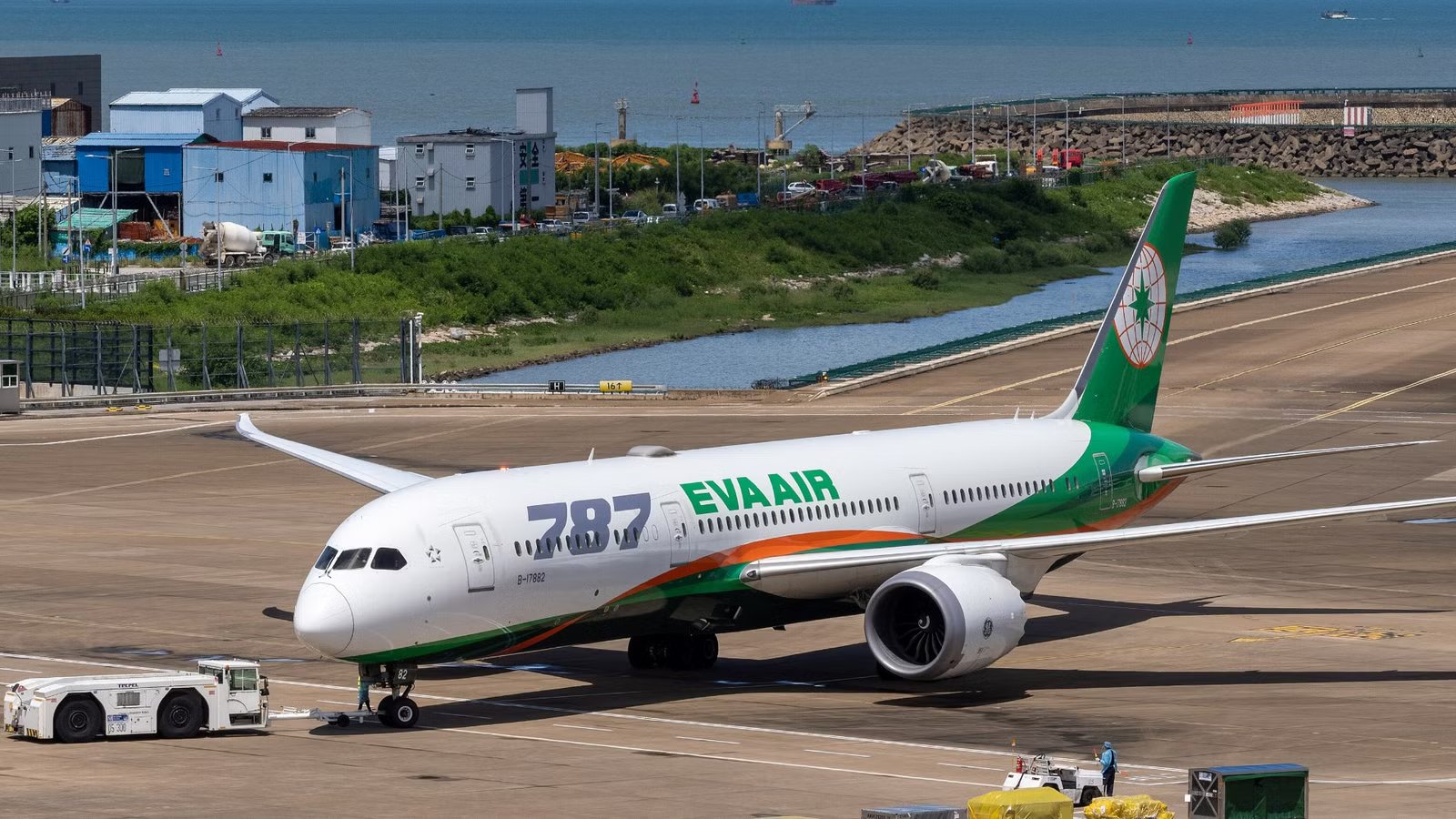
At the end of last week, EVA Air commenced operations on its newest transpacific route, linking its main hub at Taipei Taoyuan International Airport (TPE) in Taiwan with Dulles International Airport (IAD) in the US capital city of Washington DC. This represents a significant expansion in the airline’s US growth efforts, given that Dulles is a hub for EVA Air’s fellow Star Alliance member United Airlines.
The importance of this new route has also been underlined by the fact that EVA Air has chosen to deploy one of its most premium-heavy aircraft types on the corridor, namely the Boeing 787-9 Dreamliner. Washington Dulles International Airport is now the tenth US destination served by EVA Air, with the Taipei Times noting that the first three flights were fully booked. 90% of July’s seats are also sold.
A New Era

EVA Air operated its first-ever nonstop flight from Taipei to Washington on Friday, June 26, 2026. It is the leading Taiwanese carrier when it comes to US coverage, with 98 weekly flights scheduled across its ten American destinations. This growth reflects the increasing demand for travel between Taiwan and the US, with The Taipei Times noting that “Taiwan was the 16th-largest source of visitors to the US in Q1.
According to Business Traveller, round-trip fares on this route start at around $1,080, while those seeking the luxury of premium economy should expect prices to start at around $2,350. The publication adds that DC is one of just two North American destinations that is currrently served by aircraft featuring EVA Air’s new premium economy cabin. EVA Air General Manager Sun Jiaming explained that:
“This further improves the network layout in the US East Coast, forming a more complete cross-continental network with existing West Coast and Midwest destinations.”
Four Flights A Week

In terms of frequency, EVA Air plans to serve its new route from Taipei Taoyuan International Airport to Washington Dulles International Airport four times a week using the  Boeing 787-9 for the rest of the year. Data from Cirium, an aviation analytics company, shows that this will result in a monthly peak of 18 rotations in July, August, and October, while September, November, and December will see 17.
Departing from Taipei, flight BR4 is scheduled to leave at 7:30 PM on Monday, Wednesday, Friday, and Saturday, and arrive in Washington at 10:30 PM on the same day, some 15 hours later. The return flight, BR3, is less favorably timed, with its departure from DC penciled in for 1:50 AM on Tuesday, Thursday, Saturday, and Sunday. It reaches Taipei at 5:45 AM the next day, 15 hours and 55 minutes later.
Thus far, the eastbound flights that have operated on this route have performed rather favorably when it comes to shaving hours and minutes off of the planned block time. Indeed, tracking data made available by Flightradar24 shows that the first two iterations of BR4 took 13 hours and 47 minutes and 13 hours and 58 minutes. The first iteration of BR3, on the other hand, took 16 hours and 14 minutes.
Why Washington, DC Is The Next Big Transpacific Gateway
One particular carrier is planning to expand its services significantly.
What’s It Like On Board?

According to present fleet data made available by ch-aviation, EVA Air currently has nine examples of the Boeing 787-9 at its disposal. These midsized widebody twinjets are just four years old on average, compared to a fleet-wide mean figure of 9.1 years old, and the carrier also has four more on order. Data from aeroLOPA shows that the carrier deploys both two and three-class layouts on the 787-9.
With Washington Dulles International Airport being a lucrative transpacific destination, EVA Air favors the lower-density three-class layout on this route. As seen above, the best seats in the house are the 26 ‘Royal Laurel’ business class flatbeds, which are laid out four-abreast in a 1-2-1 setup. There are also 28 premoum economy recliners (2-3-2) and 244 economy class seats (3-3-3) on board the 787-9.