dailynewsnblog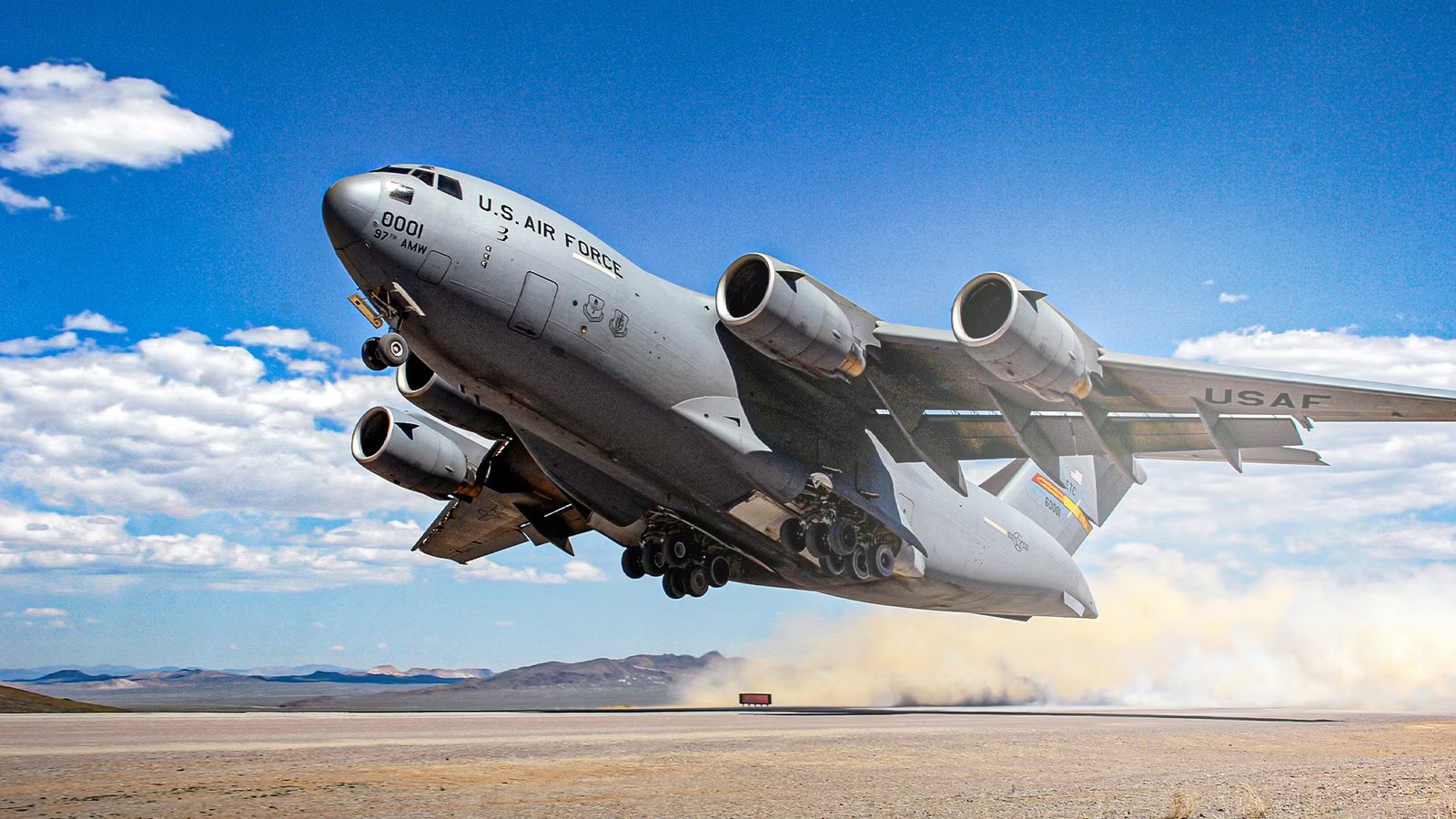
Currently, there is something of an apparent paradox. The United States is by a massive margin the world’s foremost expeditionary military power. It operates numerous military bases around the world, including in the Middle East, Europe, and the Western Pacific. While most supplies move by sea, strategic transport aircraft are vital to operating these bases, sustaining combat operations, and ensuring the timely arrival of needed supplies and components.
This demands a massive transport aircraft fleet. However, while Russia produces the Il-76 airlifter, China produces the Y-20 airlifter, and the Europeans produce the smaller A400M Atlas airlifter, the US has not produced any strategic airlifters for eleven years since the C-17 Globemaster III production line shut down. The US does produce the C-130J, but these are tactical airlifters built for a different role. Here is what to know about renewed interest in restarting C-17 Globemaster production.
Renewed Interest In Restarting C-17 Production

Reports have been surfacing since at least mid-2025 that Boeing is exploring the possibility of restarting its C-17 Globemaster III airlifter production. In an article published in June 2026, The War Zone wrote, “Congress recently directed the U.S. Air Force to prepare a formal briefing on the feasibility of acquiring new Globemaster IIIs. The Air Force’s C-17 fleet is critical for U.S. power projection globally.”
It also says that operators are “encouraged” by contacts with Boeing about a potential restart in production. Boeing delivered the final C-17 in 2015, having delivered a total of 279, most (223) of which were purchased for the US Air Force. Even when Boeing closed the line down, there was some interest in export customers, including Saudi Arabia. The final production aircraft were delivered to export customers, with the US Air Force accepting its final airframe in 2013.
Reporting on the potential restart of production has previously centered on potential exports and an “unnamed country”, although now it appears the focus has returned to Boeing’s biggest customer, the US Air Force. The USAF operates two types of strategic transport aircraft: the C-17 and the larger C-5M. These are a critical component of the US’s expeditionary operations and its ability to supply its bases around the world.
US Concern Over Its Existing Fleet

Operations in recent years, like Operation Epic Fury, have put a large amount of strain on the fleet. This is leading to questions about the viability of sustaining the fleet until 2075. The House Committee on Armed Services’ report notes, “The committee is concerned that future operational demands may place additional strain on the existing C-17 fleet.” It then goes on to say the C-17 fleet continues to bear significant operational demands.
It writes that the committee is “concerned that future operational demands may place additional strain on the existing C-17 fleet.” Accordingly, it directs the Secretary of the Air Force to provide a briefing no later than March 1, 2027, on the feasibility of restarting production of the Globemaster III. The briefing needs to include the status of tooling, supplier base viability, workforce availability, and potential reconstitution costs.
Boeing C-17 Globemaster III operators | Quantity (per Planespotters.net) |
|---|---|
Australia | 8 |
Canada | 5 |
India | 11 |
Kuwait | 2 |
Europe/Strategic Airlift Capability Heavy Airlift Wing | 3 |
Qatar | 8 |
United Arab Emirates | 8 |
United Kingdom | 8 |
United States | 222 |
The committee also wants to know an estimated timeline for reestablishing production and an estimated delivery date for the first aircraft. Other details the report is to cover include cost estimates for restarting the line, cost estimates for procuring the aircraft, options for service life extension programs, modernization of the existing fleet, alternative approaches to increasing strategic airlift capacity, and international interest in contributing to restarting the C-17 production line. The committee floats procuring commercial cargo aircraft and expanding the Civil Reserve Air Fleet.

How Many C-17 Globemasters Are Left?
Only one C-17 Globemaster has been written off due to a crash, and none have been retired and scrapped.
Potential Alternative Aircraft

There is no other US airlifter that could fill the place of the C-17 Globemaster III, although there are aircraft options that could potentially relieve some strain. The Europeans built the military turboprop Airbus A400M Atlas strategic/tactical airlifter and the upcoming commercial Airbus A350F cargo aircraft. However, it seems unlikely these would be seriously considered by the US as it prioritizes American aircraft programs.
One potential aircraft the Air Force could consider is the Radia’s proposed massive capacity Windrunner. This cargo aircraft would have a cargo volume 10x larger than a Boeing 777 and be able to land on unpaved landing strips. The aircraft is enormous and would likely be quite niche as it is specialized for outsized cargos. Another option includes the blended-wing-body medium-sized aircraft JetZero is developing with Northrop Grumman.
JetZero says it remains on track for the first full-sized demonstrator flight in 2027. The Air Force is currently interested in the aircraft as a refueling aircraft. The committee says it is interested in purchasing commercial cargo aircraft. Realistically, the only two options are a variant of the Boeing 767 or the larger upcoming Boeing 777-8F (or outgoing 777F). It’s unclear if the Air Force could be interested in purchasing second-hand 747-8Fs.
Next Generation Airlift (NGAL) Aircraft

It is also unclear what this means for the US’s Next Generation Airlifter (NGAL) program. NGAL is the Air Force’s project to develop a new single strategic/tactical airlift aircraft to eventually replace its fleet of C-5M Super Galaxy and C-17A Globemaster IIIs. The program remains in the early stages (pre-Analysis of Alternatives), although it is being accelerated in Fiscal 2027. The current plan is to have the first production aircraft as early as Fiscal 2038 with initial operational capability in Fiscal 2041.
These are likely optimistic timelines and are contingent on stable funding and uninterrupted development. The plan is to replace both the Super Galaxies and Globemaster IIIs on a one-for-one basis, acquiring a total fleet of around 274 NGALs. Early baseline requirements (from Requests for Information) say that the “Aircraft must have a wingspan of less than 223 feet; Capability to carry a minimum payload of 160,000 pounds over at least 2,500 nautical miles unrefueled.”
The current plan envisions NGAL fully replacing the C-5M Super Galaxy fleet by 2045 and the Globemaster III fleet by 2075. Interestingly, if the Air Force does push ahead with NGAL as planned, and it puts the C-17 back into production, there is a possibility of the two aircraft being produced concurrently. Historic parallels suggest that Boeing may need three to over five years to restart the C-17 production line.

6 Reasons The C-17 Globemaster III Will Be Hard To Replace
The C-17 is a mainstay of US strategic airlift capability and is set to continue to serve the Air Force for many years to come.
Cost Of Restarting C-17 Production

Currently, the best study into restarting the C-17 production line is a RAND Corporation independent analysis published over a decade ago. Unfortunately, this is out of date, but still the best there is. RAND also explored the option of producing an updated variant of the C-17 called the C-17B. It is always difficult to restart cold production lines as tooling is lost, engineers move on, and supply chains shrivel.
At the time, RAND estimated it could cost between $2.1 and 2.7 billion in 2011 dollars to restart C-17A production and $4.6 to $6.4 billion for a new C-17B version. Setting up for a more advanced version, called the C-17FE, would cost $6.2 to $7 billion. Cumulative inflation in the United States since 2011 is 49%, although inflation on C-17 production may be uneven.
The individual costs of new production C-17s are highly contingent on the number purchased. Another important factor is what capabilities these new aircraft would have. One reason why future C-17Bs would likely be more expensive than original C-17As is that aircraft are expected to be more capable and networked. Transport aircraft are no longer simply transports and a “box that flies.” This is seen in Airbus’s vision of its A400M operating in future networked kill chains deploying drones.
“Last Mile” & Pushing Strategic Airlifters Back

The Air Force and Marine Corps have grown increasingly concerned with the survivability of large unstealthy aircraft like the C-17 in future conflicts. Increasingly, these forces are looking at alternative programs to offer “last mile” cargo transports using runway-independent aircraft, STOVL aircraft, and various forms of cargo drones. As adversary capabilities grow, the “last mile” can become medium transport distances ranging hundreds of nautical miles.
Aircraft like the C-17, C-5M, C-130J, and even CV-22s are expected to remain vital to the US’s ability to sustain expeditionary capabilities deep into the century. However, emerging threats are expected to push them further back as airbases become vulnerable and aircraft like China’s J-20s and the upcoming J-36 are able to threaten the aircraft at increasingly greater ranges. Aircraft like the C-17 are designed to operate in austere forward airbases, but this may no longer be sufficient in future conflicts.
Strategic transport aircraft can be expected to safely lift cargo and troops from the US Mainland to Hawaii and possibly to Guam. But operating beyond Guam could become increasingly problematic in the event of a high-end conflict. US Air Force focused programs include Silent Arrow CLS-300 and Next Generation Airlift – Last Tactical Leg, while the Marine Corps focused solutions include R66 TURBINETRUCK and Piasecki KARGO. Solutions range from wing-ground effect (ekranoplans) to MALE drones. A common feature is that these aircraft are typically autonomous and often electric or hybrid electric.