dailynewsnblog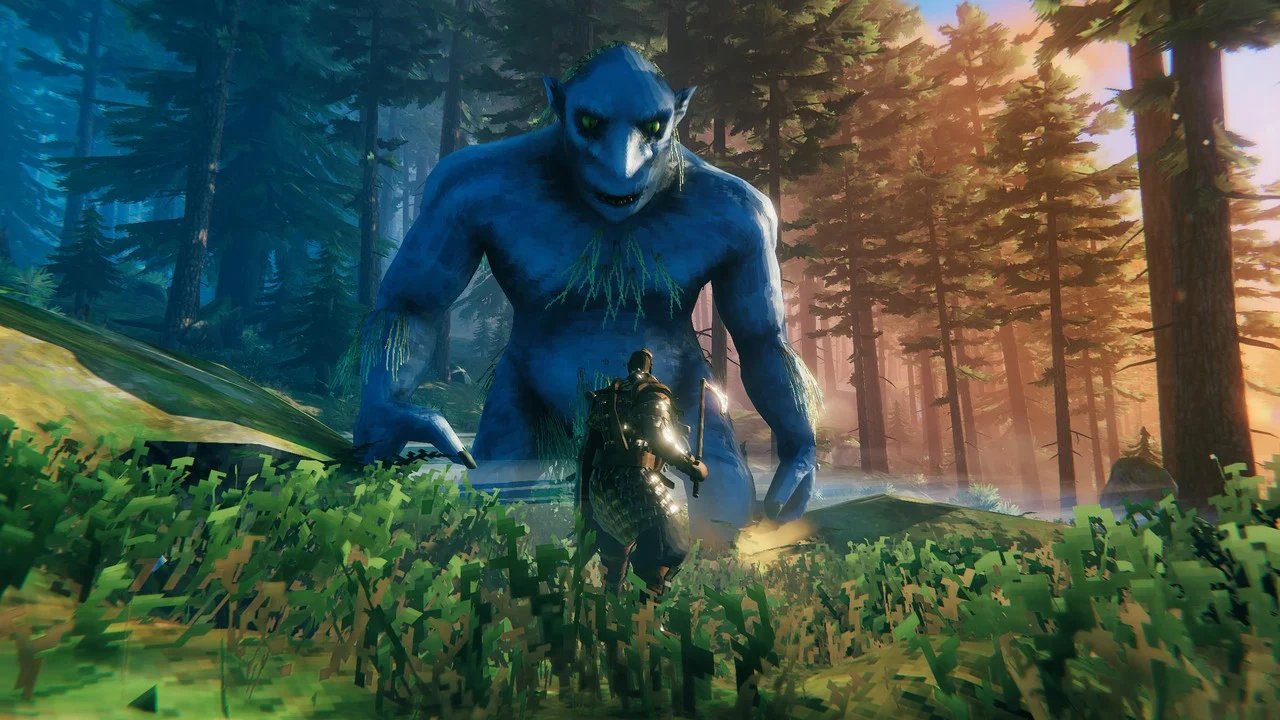

I spent my first few hours in Valheim running around in my underwear.
Only a casual acquaintance of the survival-crafting genre, I was nevertheless sucked in by the open-world freedom and rich Nordic vibe the game had to offer. Pushing out into the (relatively) safe Meadows biome, punching trees to make tools and setting up makeshift base camps along the way, I gained a misguided level of confidence that led me to confronting a giant deer spirit with a wooden spear and shield.
Dead and deposited half-naked in one of my ramshackle huts, I set back to punching the local flora and started all over again. Valheim is a game of moments: your first entry into a strange new area, a cosy homestead raided by trolls, venturing onto open water during a storm, summoning and taking down a Forsaken. It’s a dense, atmospheric experience that arrives on Switch 2 in a slightly uneven state.

Releasing its version 1.0 after a hugely popular five-year run in early access, Swedish developer Iron Gate Studio’s labour of love comes to Nintendo’s console as a potentially infinite immersive experience that offers solo and party-based adventurers a chance to craft their own edda.
You start by creating a fallen warrior, ripped from Valhalla and sent to the Tenth World by Odin. This exiled place was sundered from the other realms by the allfather, but not before he cast his most fearsome enemies into it. These foes have now grown in strength, and he has sent you and your ilk to fight them in his stead. Awakened in a strange place and guided by Old One Eye’s ravens, Hugin and Munin, your warrior must go from unarmed vagrant to elder beast-slaying hero.
Sharing some foundational DNA with other survival crafters, namely Minecraft, Valheim is much more concerned with an emerging narrative than its peers. Spiritually based on massive single-player adventures/RPGs like Skyrim and Legend of Zelda, it combines the skill progression and Norse motifs of the former with the sense of wondrous discovery that defines the latter.

The vast seeded maps contain biomes that are both visually distinct and separated by myriad dangers. Dungeons scatter the landscape, offering challenge and riches, while your every move progresses your core abilities, conveying a real sense of growth in your journey. The meticulously drip-fed worldbuilding is what sets Valheim apart from its contemporaries; here you have freedom of creation, but feel part of an ongoing narrative.
Each biome offers a unique set of difficulty hurdles coupled with a moody new setting. After learning the ropes in the Meadows, you push into the Black Forest, which is your first real taste of enemy mobs. You’ll need to learn how to keep warm to traverse the Mountains, which may be your first encounter with a status effect, of which there are many more.
There are eight biomes in 1.0, each escalating the enemy types and piling on those status effects (Swamp really ain’t fun), culminating in the Deep North. Alongside new enemies, each new zone adds to your ever-expanding recipe list. In Valheim, discovery is progression, and a new environment brings new raw materials to craft shelter, weapons and armour. There are hundreds of crafting opportunities to build your own journey through the Tenth World, and each death will send you back into your chest of goodies to see what will get you past the next difficulty spike.

These spikes come in the form of bosses that can be summoned in each area. The Forsaken that Odin fears are a formidable foe, and none can be tackled without significant preparation and planning. The aforementioned deer beast is the first challenge, a huge creature that fills the screen with lightning and can be summoned right from the start of your journey, when you’ll have nothing in your inventory capable of besting it. Later, there are giant tree monsters, hideous bone constructs, and straight-up dragons to fight. These are punishing milestones, but the game gives you all the tools you need to take them down, and you can always call on the support of your fellow Vikings.
All of Valheim’s challenges can be experienced with others, and the game is designed for players to band together and take down The Forsaken. Adventurers can create their own dedicated server or join others from the community. There are plenty of servers available to browse at any given time, some of which are open. The big draw here is crossplay, with Switch 2 players having the option to join an already bustling community.
Unfortunately, a release patch delay put console and PC versions out of sync, so any hopes of joining my friends on other platforms were delayed by a week. When a fix came, I found myself suffering through frequent disconnects, enjoying a genuinely great multiplayer experience in frustratingly bite-sized chunks. With no local co-op, players will have to rely on the Nintendo community for grouping up until network stability improves.

Alongside the currently uneven online experience are nagging performance issues. Valheim has a low-poly visual style that harkens back to the muddy, blurry textures of sixth-generation RPGs. It’s a charming aesthetic that is surprisingly easy to love. It also means the game isn’t very graphically demanding, so it’s a shame that the current patched version is still blighted by a juddering drop in frames that occurs intermittently throughout.
There are three performance options available: a 60fps target mode, a balanced 40fps with 120hz, and a 30fps locked mode with boosted graphical flourishes. As is customary, performance mode makes for the best experience overall, but all modes suffer from those regular frame drops. The handheld experience is much the same, offering a mostly stable time plagued by those annoying performance dips.
Audio is crisp and intoxicating. This is a game made by its ambience and Patrik Jarlestam’s compositions will be playing in your head long after you’ve put the controller down. The sound design itself is extremely effective in cranking atmosphere, with every new grunt and animal cry a potential fight to the death.

Valheim generously caters for Switch 2 by offering a full suite of control options. Mouse controls work well, offering a nice transition for anyone who moves over from PC. The touchscreen is a real boon in handheld when navigating crafting menus, and gyro controls are also present, but I found them more hindrance than help.
One final thing worthy of note is the generous suite of world mods that let you tailor difficulty. As a relative newcomer to this kind of game, I appreciated the option to add training wheels to my experience. Dialling down enemy difficulty, easing the penalty of death, and reducing the grind of crafting allows for Vikings of all skill types to quest through the Tenth World on their own terms.
Conclusion
Valheim 1.0 is finally here and it brings an atmospheric, challenging, and compulsive persistent world to Switch 2. An epic survival-crafting game with solid fantasy worldbuilding, it’s a fascinating hybrid. Performance issues and uneven crossplay blight the release experience, so let’s hope Iron Gate keeps an eye on this version with future updates.