dailynewsnblog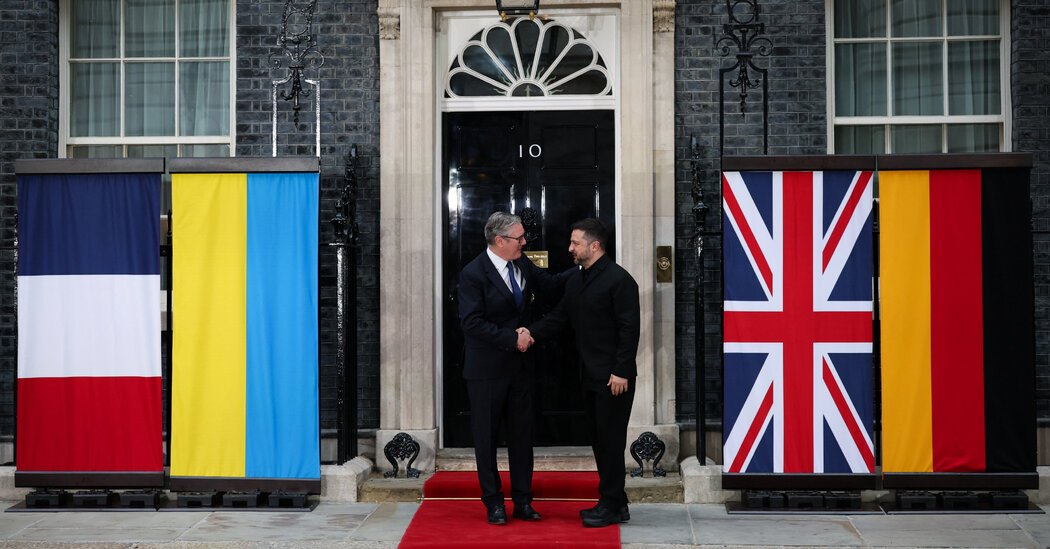
President Volodymyr Zelensky of Ukraine met with the leaders of Britain, Germany and France in London on Sunday, as Europe considers taking a more active role in peace talks with Russia after more than a year of unsuccessful U.S. mediation.
U.S.-mediated talks have stalled as Moscow stuck to uncompromising territorial demands and Washington shifted its focus to the war with Iran. But Ukraine and its European allies say that Russia’s recent battlefield setbacks and mounting economic strains could create an opening to revive talks by making a peace settlement more appealing to the Kremlin — a prospect increasingly discussed in Russia.
In a letter to President Vladimir V. Putin of Russia last week, Mr. Zelensky offered to resume talks. He added that “Europe should be part of this process,” renewing his call for European leaders to step in after Washington’s retreat from negotiations.
European leaders have said they do not see themselves replacing Washington as mediators — a prospect Mr. Putin has also dismissed — but rather as additional participants in efforts to end a war whose outcome will shape Europe’s security for decades to come.
“I believe we should talk to Putin,” President Alexander Stubb of Finland told the Swiss newspaper Neue Zürcher Zeitung in an interview published on Sunday. “We must do this together with the Americans, but at the same time ask ourselves whether American foreign policy toward Russia and Ukraine is currently in Europe’s interest. If not — and in certain aspects, it isn’t — then we must get involved.”
E.U. officials in recent weeks have been weighing ways to step up their roles in future talks. Sunday’s meeting in London was expected to advance those discussions. In a joint statement after the meeting, which was held at 10 Downing Street, the four leaders said that “Europe had an important role to play in any settlement, as a steadfast supporter of Ukraine.”
In addition to Sunday’s meeting, Mr. Zelensky said he would meet King Charles III on Monday.
Formally joining the peace talks would mark a new role for Europe, which had until now been largely sidelined from the negotiations by the United States and confined to managing tensions between President Trump and Mr. Zelensky to keep talks from derailing.
For months, European leaders quietly accepted Washington’s lead in the negotiations despite rounds of inconclusive talks. That was largely because Moscow, holding the upper hand on the battlefield, demanded territorial concessions that were a red line for Kyiv. Secretary of State Marco Rubio acknowledged last month that the talks “were not fruitful.”
The dynamic began to change this year.
First, the joint Israeli-U.S. attack on Iran shifted Washington’s attention away from Ukraine, effectively freezing U.S.-mediated talks.
Around the same time, Moscow’s military prospects sharply deteriorated. Its troops have barely advanced on the battlefield since the start of the year, unable to break through Ukraine’s drone-dominated defenses and suffering attacks on their supply lines.
Ukraine has also stepped up its strikes on Russia’s oil assets, eroding a critical source of funding for its war effort. This is part of a wider long-range campaign that has hit Russian cities once shielded from the war’s impact, like the strike in St. Petersburg this past week.
Russia has also stepped up its air attacks on Ukrainian cities, military and industrial facilities. On Sunday, Ukrainian authorities claimed that a Russian drone had struck a nuclear-fuel storage facility near Ukraine’s Chernobyl power plant. They added, however, that no nuclear fuel was stored in the building at the time of the attack, and that radiation levels at the plant remained within established limits.
Mr. Zelensky said Moscow’s battlefield setbacks could force it back to the negotiation table. “I told our American partners, ‘I think there is a window for negotiations because each month, Russia will be losing more and more troops,’” he told CBS’s “Face the Nation” last month.
But as U.S. mediation waned, the Ukrainian leader began calling for Europe to step in, something he had rarely done before.
“Who could represent Europe in the negotiations?” he said on “Face the Nation.” “There is an E3 format — the United Kingdom, France and Germany. I don’t know if this is the best format, but I think these countries could be negotiators from Europe.”
António Costa, the president of the European Union’s political arm, said last month that he and Mr. Zelensky had discussed a possible European presence at the negotiation table.
The new diplomatic overture will not result in Europe scaling back military support for Kyiv. Rather, the bloc sees this support as a means to raise the cost of continuing the war for the Kremlin and push it to the negotiating table. The European Union recently approved a $106 billion loan for Kyiv that will help sustain a large share of its war effort for the next two years.
On Sunday, the leaders of Germany, France and Britain hinted that further support would be announced in upcoming summits and stressed the need to expand production of air defense and deep strike capabilities.
Megan Specia and Jeanna Smialek contributed reporting.