dailynewsnblog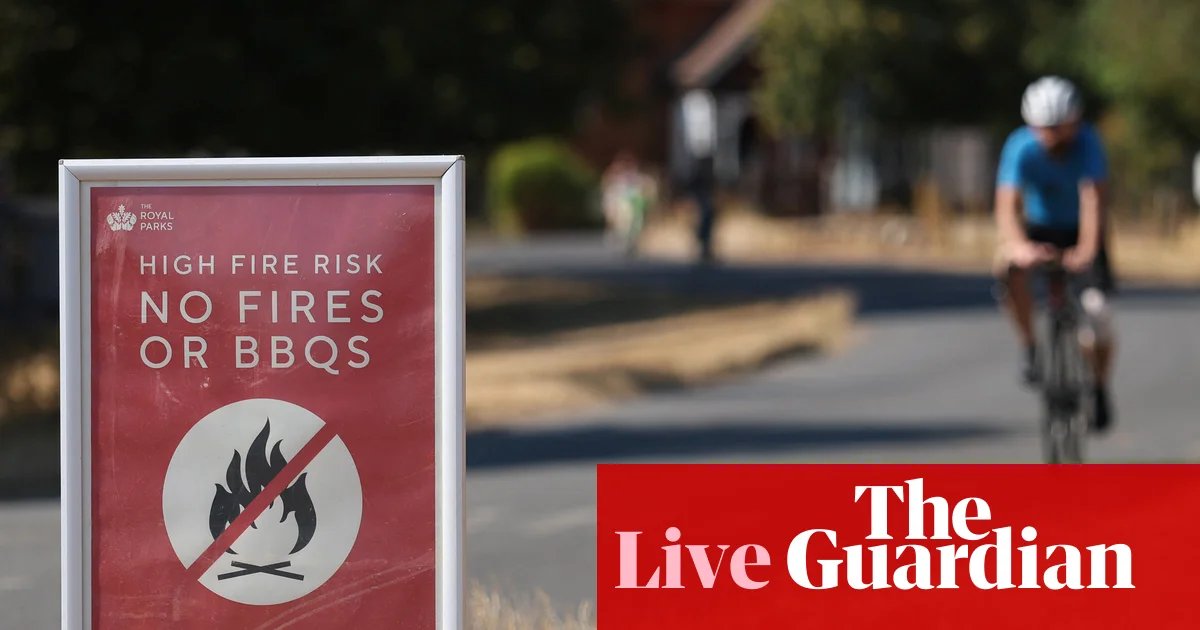
Burnham says he is considering ban on disposable BBQs

Andrew Sparrow
Disposable barbecues could be banned to help prevent fires, the prime minister has said.
Speaking to reporters on a visit to Stevenage, Andy Burnham said a ban was something the government was “certainly going to consider”.

As reported earlier, the prime minister will chair an emergency Cobra meeting in response to the extreme heat.
Burnham said:
There is obviously a significant problem of wildfires in the south. The New Forest fire is a great concern; we have seen them in northern areas, as well as Suffolk recently.
This is a message for the public as well because the wildfires I mentioned, many of them have been created by disposable barbecues.
I do believe we need to get the message out loud and clear. People should not be using those barbecues outside at this moment in time.
I don’t know yet what the remedy is, but I do want to leave the meeting today with a loud and clear message that we do want people to take the greatest possible care when they are out in the countryside, both in terms of cigarettes, but also those temporary barbecues that we know are causing risk of fires.”
For more UK politics news, you can follow our live blog here:
Key events
Closing summary
The government will look at banning disposable barbecues as wildfires continue to rage across the country, prime minister Andy Burnham has said. Disposable barbecues have been the cause of a number of serious fires over the last few years, but campaigners were critical of the PM’s failure to link those fires more broadly to the climate crisis. Read the full story here.
Andy Burnham will chair an emergency Cobra meeting in response to the extreme heat, which has caused wildfires and plunged many parts of Britain into drought. The prime minister will meet ministers, officials and agencies as high temperatures continue across the UK, with 33C forecast on Wednesday and up to 38C on Thursday. Andrew Saprrow will be covering any news coming out of this on the UK politics blog here.
The Met Office has issued an amber weather warning for extreme heat across parts of England tomorrow, in place from 9am until midnight. In an update on X, it said: “Temperatures will rise quickly tomorrow, with many areas reaching 35C+ and highs of 36-37C possible, especially across the Midlands, east and south-east.”
Yvette Cooper, the health secretary, has said that she has told NHS England to start planning ahead for summer heatwaves, just as it prepares every year for a crisis in the winter. In an article published in the Mirror, Cooper says global heating means Britain will face heatwaves like the one we are going through now “with increasing frequency and increasing intensity”.
Repeated debilitating heatwaves this summer are likely to have cost the UK economy more than £4bn in lost economic output by the end of July, new analysis shows. Green thinktank Verdant had suggested June’s unseasonally hot weather had an economic cost of £2.36bn. Updating its assessment to include last month’s high temperatures, it finds a £4.4bn hit to output.
Just 20 staff are working on climate adaptation within a key government department tasked with protecting the environment and maintaining food security, a freedom of information request has revealed. The officials make up 0.3% of staff within the Department for Environment, Food and Rural Affairs.
The conservation group WWF has issued a statement on the government’s emergency Cobra meeting taking place today to discuss the extreme heat. The WWF’s head of climate policy, Rick Parfett, argued that the government should not approve the North Sea drilling projects because they would worsen climate change without reducing household energy bills.
The Scottish Fire and Rescue Service (SFRS) has issued a warning for a very high risk of wildfire across the eastern Highlands, eastern and southern Scotland from today until Thursday. In a statement, SFRS said it was acting in conjuction with the Scottish Wildfire Forum (SWF).
Firefighters have worked through the night and are continuing to tackle the heathland fire in the New Forest in Hampshire, the local authority said. The A31 that runs through the New Forest is closed in both directions, with road closures expected to remain in place for at least the next 48 hours while emergency services continue to respond to the fire.
People have been urged to avoid Dunwich Heath in Suffolk as authorities assess wildfire damage and deal with an unexploded second world war bomb uncovered by the blaze. The wildfire at the nature reserve has scorched more than 100 hectares (247 acres) of heathland since it took hold almost two weeks ago, the National Trust said.

Damian Carrington
Most of England is in drought, crops are dying in the fields and farmers face the worst harvest on record, with warnings of food price rises to come.
But there have been only 34 on-farm reservoirs completed in the past five years, according to the Country Land and Business Association (CLA).
“Today’s emergency Cobra meeting has to mark a reset. For years, farmers have been watching crops die in the ground because there’s not enough water. Yet every winter, rain pours down across fields. Farmers should be able to capture more of that when it’s plentiful and store it for the dry months ahead,” says Gavin Lane, president of the CLA, which represents land and business owners.
“Instead, planning rules make reservoirs slow and costly to build, while rigid restrictions on taking water to fill them can leave farmers short when they need it the most. Farmers are now spending £45,000 on average before they even put a spade in the ground. Many simply can’t afford to take the risk.”
Lane said Burnham must reform the planning system for building reservoirs, an issue he says ministers have ignored for years.
Yvette Cooper says NHS must prepare for regular heatwaves, just as it plans for winter crisis every year
Andrew Sparrow
Yvette Cooper, the health secretary, has said that she has told NHS England to start planning ahead for summer heatwaves, just as it prepares every year for a crisis in the winter.
In an article published in the Mirror, Cooper says global heating means Britain will face heatwaves like the one we are going through now “with increasing frequency and increasing intensity”. And this puts extra pressure on the NHS, she says, referencing a report that said there were almost 3,000 excess deaths because of the heat in May and June.
Cooper, who is attending the meeting of the Cobra emergency committee this afternoon to discuss the extreme heat, says:
During the heatwaves in May and June, we saw more than 2,800 lives lost because of the extreme heat, and this year is on track to see the highest ever number of heat-related deaths. My thoughts go out to every family who has lost loved ones …
Our NHS is used to gearing up for these kinds of pressures in winter. But we are going to need the same level of preparation in future summers. I have told the NHS to start drawing up summer plans now in the way they have traditionally done for winter.
Especially as all the same people who are most at risk when it is very cold are at risk in the extreme heat: older people, the youngest children, and people with existing conditions …
We know Britain will face heatwaves like this with increasing frequency and increasing intensity. So we have to take the health consequences much more seriously, so that everyone is ready when they come.
Cooper also says in her article that some of the £6.75bn being spent on improving NHS buildings will fund air conditioning.
For more UK politics news, follow our live blog here:

Zoe Wood
“If it is 35C outdoors, I can get the temperature down to 21C,” says Andrew Ingram of the sanctuary that his living room has provided this summer.
“On the nights I’ve slept in there, you have to put your thick pyjamas on,” jokes Ingram, who lives in Maidenhead, Berkshire, with his wife, Sue.
“When I post on Facebook about it, people say: ‘That’s air conditioning’ and I say: ‘No, it’s the heat pump.’ It’s just working the other way around.”
Rather than generating heat from burning fuel, a heat pump transfers heat energy from one place to another. However, despite the name, heat pumps can be used for cooling, too.
“It’s been a revelation,” Ingram says. “We bought it on the basis that there might be a heatwave, and it’s been an absolute lifeline this year.”
Read more:
As a reminder, the Met Office has issued an amber weather warning for extreme heat across parts of England tomorrow, in place from 9am until midnight.
In an update on X, it said: “Temperatures will rise quickly tomorrow, with many areas reaching 35C+ and highs of 36-37C possible, especially across the Midlands, east and south-east.”
Allow content provided by a third party?
This article includes content hosted on platform.x.com. We ask for your permission before anything is loaded, as the provider may be using cookies and other technologies. To view this content, click ‘Allow and continue’.
The conservation group WWF has issued a statement on the government’s emergency Cobra meeting taking place today to discuss the extreme heat.
The WWF’s head of climate policy, Rick Parfett, argued that the government should not approve the North Sea drilling projects because they would worsen climate change without reducing household energy bills.
He said:
Convening a Cobra meeting underlines that extreme heat, drought and wildfires are no longer distant risks. They are immediate threats affecting communities across the UK today.
As climate change drives more frequent and extreme weather, the government must focus not only on emergency response but also on tackling their root cause. Licensing the Rosebank and Jackdaw oil and gas fields would lock in future emissions that will strain our NHS, emergency services and communities even further.
The UK must roll out clean energy across the UK to cut bills, drive local growth, and ensure our buildings and farms are fit for future temperature rises. Nature is our best ally in tackling climate change as well as its impacts like extreme heat and flooding. That means restoring and protecting nature now, so it is more resilient to the climate extremes we know are coming.”
Wildfire risk warning issued for parts of Scotland
The Scottish Fire and Rescue Service (SFRS) has issued a warning for a very high risk of wildfire across the eastern Highlands, eastern and southern Scotland from today until Thursday.
In a statment, SFRS said it was acting in conjuction with the Scottish Wildfire Forum (SWF).
Deputy assistant chief officer Kenny Barbour, said: “It’s extremely important members of the public exercise extreme caution and think twice before using anything involving a naked flame during a wildfire warning. These fires place a huge drain on our resources and pose a threat to the safety of our firefighters and members of our communities.”
The statement said the warning comes as firefighters continue to work in the Cairngorms, four weeks after the wildfire first started there.
Residents in London have reported seeing smoke rising over the east of the city, with the London Fire Brigade reporting it has dispatched ten fire engines and around 70 firefighters to a fire on Ripple Road in Barking. In a statement it said “The cause is not known at this stage.”

Helena Horton
Every year on 12 August, fans of traditional British cuisine flock to plush restaurants in Mayfair to dine on grouse served with bread sauce and game chips.
But those hoping to find the small wild birds, sourced from the UK’s moorlands, may be disappointed. Wildfires have been raging on moors across the UK, burning habitats and incinerating wildlife after record-breaking heat has turned the landscape into a tinderbox.
The intensive management of grouse moors involves the draining of peatland and the burning of the vegetation that grows on it. Environmental experts argue that doing this creates the conditions for wildfires as dry peat acts as fuel and smoulders for extended periods, making fires almost impossible to extinguish.
Because of this, the Green party in Scotland, where there are a large number of grouse shoots, has called for the Glorious Twelfth – the traditional start of the grouse shooting season, before which time they cannot legally be hunted – to be banned. The UK government recently banned the burning of vegetation on deep peat in order to preserve these habitats.
The climate crisis, caused by pollution from burning fossil fuels, makes every heatwave more likely and intense. The heatwave at the end of June was the most severe ever recorded in Europe and would not have been possible without human-caused global heating.
Read more from Helena Horton here: Inglorious Twelfth? Calls for grouse season to be banned to prevent wildfires and peatland damage
Drought, heatwaves and wildfires will ‘get worse’ without net zero, warns climate adviser
As the UK battles with the growing spectre of worsening drought, heatwaves and wildfires, a key climate adviser has warned it “gets worse from here” until greenhouse gas emissions behind global warming are cut to net zero, PA reports.
Julia King, the chair of the adaptation subcommittee of the Climate Change Committee, told the news agency “we need to remember that this is as good as it gets”.
“It gets worse from here. Until we get to net zero, things go on getting worse,” she warned, as she also urged the government to take steps to help the UK adapt to rising temperatures, such as air conditioning in hospitals, schools and for vulnerable families.
Here are some of the latest images on the newswires as parts of the UK face the fifth heatwave of the summer:
Expert warns of ‘climate leaveism’ caused by school closures during extreme heat
We have more comments in response to the report that heatwaves have cost the UK economy £4.4bn (which you can read here).
University of Manchester professor Sir Cary Cooper, widely regarded as one of the world’s leading authorities on workplace organisation, health and wellbeing, has warned that school closures are creating a largely unrecorded impact on employers and workers – a phenomenon he has described as “climate leaveism”.
He said:
The estimated £4.4bn hit is a stark reminder that extreme heat is now a workplace and economic crisis. However, even this figure may not reveal the full disruption. When overheated schools close, working parents are forced to take leave, lose working hours or catch up late into the evening.
This ‘climate leaveism’ may not be reflected on the absence spreadsheet but it certainly impacts the employee. Businesses must prepare for extreme weather as an ongoing workforce risk, with clear dependent-care policies and managers empowered to respond flexibly. Otherwise, the hidden costs will continue to be paid through exhaustion, stress and lost productivity.”
Just 20 of 6,600 Defra staff working on climate adaptation amid drought and wildfires
The Guardian’s environment correspondent Sandra Laville has this exclusive report on the government’s lack of resources to prepare for the impacts of climate change, revealing that just 20 of 6,600 Defra staff are working on climate adaptation.
That means just 0.3% of staff within the Department for Environment, Food and Rural Affairs are tasked with protecting the environment and maintaining food security.
“England is desperately unprepared for the impacts of the climate crisis, and these shocking figures show how few officials are working on the problem at the top of government,” said environmental writer and campaigner Guy Shrubsole, who obtained the data through a freedom of information request.
Read more:
Damian Carrington
Climate scientist Dr Clair Barnes has a useful reminder of the root cause of the UK’s blazing and bone dry summer.
The science linking this summer’s heatwaves to climate change is crystal clear – fossil fuels have made every single one hotter and more likely.
Our findings this summer show that climate change is causing heatwaves to reach dangerously hot temperatures that would have been inconceivable in a preindustrial climate and directly driving up heat-related deaths.
We also found that the current drought isn’t only the result of the lack of rainfall but has been made much more severe by these prolonged high temperatures. Hotter air can hold more moisture and so the extra heat we’ve seen has been making the atmosphere thirstier, sucking water from the ground.”
Barnes is at Imperial College London and the World Weather Attribution consortium.