dailynewsnblog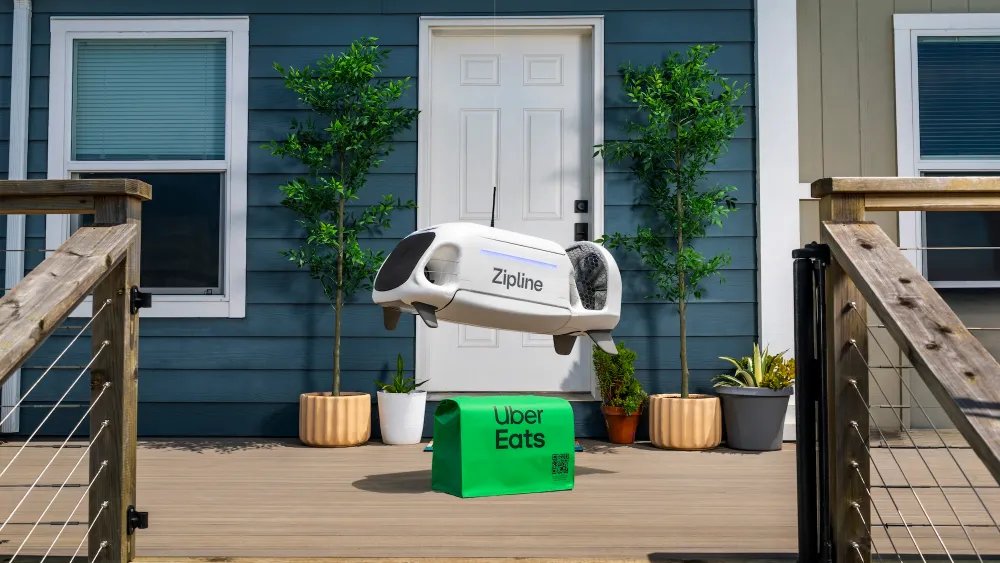
Uber and autonomous drone delivery company Zipline announced a strategic partnership aimed at completing 1 million drone deliveries per day in the U.S. by the end of 2029.
The first deployments are expected later this year for the Uber Eats service in markets where Zipline already operates, including Dallas and Houston, before expanding into dozens of U.S. cities.
Uber will make a strategic investment in Zipline as part of the deal.
For Uber, the partnership is another step toward a delivery network that increasingly decides how an order should move based on the characteristics of the shipment and the surrounding infrastructure. The company is building what it calls a “hybrid delivery network” spanning human couriers, sidewalk robots and drones.
The ride hailing app already offers a white-label, on-demand delivery service called Uber Direct, which is available to merchants and restaurants and integrated within Shopify’s online store.
Uber says its current typical delivery times last around 30 minutes, but Zipline says its drones can deliver products in as little as five to 10 minutes, with a network spanning food, retail and healthcare.
“Together, we’re shaping the future of delivery by creating a faster, more sustainable way for people to get what they need,” Uber CEO Dara Khosrowshahi said in a statement. “We look forward to bringing this technology to more communities and making autonomous delivery part of everyday life.”
This is the second major drone delivery investment from the ridesharing platform, which partnered with Israel-based Flytrex last September. Under that tie-up, the companies are experimenting with drone delivery in various Dallas-Fort Worth-area markets. Uber also has an agreement to work with Ireland’s Manna in Europe.
Uber first tested drone deliveries in 2019 with its aerial ridesharing division, Uber Elevate, which it sold the next year amid regulatory hurdles.
Zipline is coming into the new partnership with significant momentum and a sizable amount of fresh capital.
In January, the San Francisco-headquartered company raised more than $600 million in a funding round that valued it at $7.6 billion. The financing was designed to accelerate U.S. expansion, including launches in Houston and Phoenix and further growth into at least four states during 2026. At the time, Zipline had surpassed 2 million commercial deliveries, with its U.S. delivery volume growing roughly 15 percent week over week for seven straight months.
That investment now looks like part of a much larger push for the Walmart partner to establish the infrastructure necessary to make autonomous delivery a mainstream logistics channel.
Zipline co-founder and CEO Keller Cliffton offered perhaps the clearest description of the company’s ambition.
“Teleportation isn’t science fiction anymore,” Cliffton said. “It’s becoming part of everyday life.”
As of Monday’s announcement, Zipline has upped its completed delivery number to 2.7 million deliveries of more than 20 million items, having flown more than 135 million autonomous miles.
The company also believes the economics are compelling. Zipline points to roughly 5.5 billion deliveries made annually in the U.S., arguing that almost all of them still rely on a roughly 4,000-pound vehicle to move a relatively small order.
“Every dollar of growth in the delivery sector is capped by the same physical constraint—how fast can you move something from its origin to the person who ordered it,” Zipline said in its announcement. “But there are only so many roads in cities and we’re not building new roads.”
Major delivery platforms are positioning autonomous aircraft as a core piece of their networks rather than an experimental add-on.
Last month, DoorDash received Federal Aviation Administration Part 135 air carrier certification to develop its own aircraft, allowing the company to launch an in-house drone delivery program DoorDash Air.
The delivery company became the eighth drone operator in the U.S. to receive this government authorization. The company still plans on continuing its existing partnerships with drone operators including Alphabet’s Wing and Flytrex.
Unlike DoorDash, there is no indication that Uber is seeking to manufacture its own drones.
Beyond the delivery companies’ investments, both Walmart and Amazon have recently expanded on their own delivery ambitions.
Walmart expects to bring its partnership with Wing to 270 stores across the U.S. by 2027, which would cover the ground of 40 million Americans. At the start of 2026, the retail giant said it could serve 2 million U.S. residents across its markets.
The company recently unveiled it would bring drone delivery back to Florida after a near-two-year hiatus.
As for Amazon, the e-commerce giant is launching drone delivery in its 11th market—Omaha, Neb.—this year.
The Everything Store expects these deliveries to take under two hours, but noted that most deliveries are completed in under 20 minutes. The service costs $2.99 for Amazon Prime members and $4.99 for non-members.