dailynewsnblog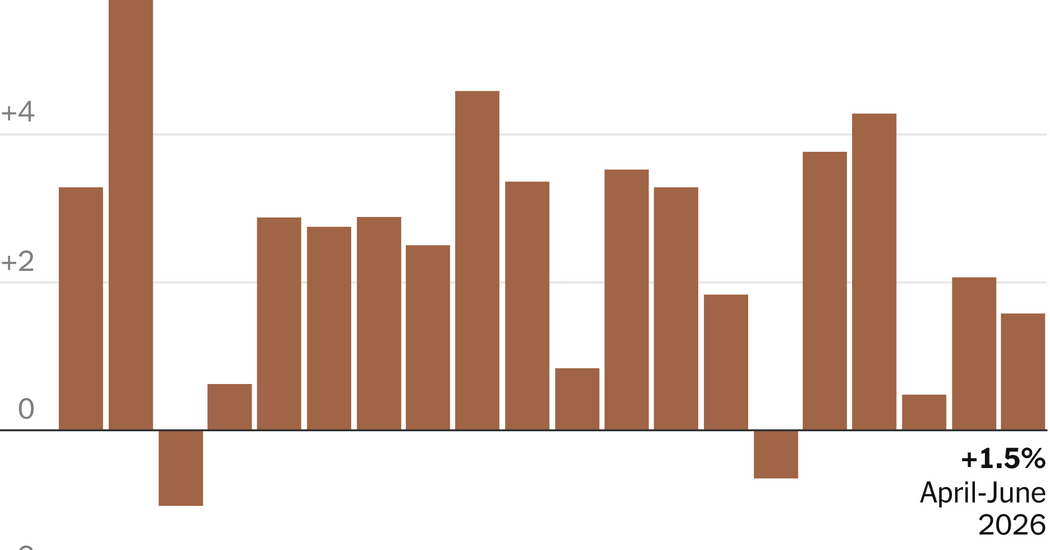
The American economy slowed in the second quarter of the year, expanding at an annual rate of 1.5 percent as the war with Iran upended prices, supply chains and energy markets.
Oil prices have receded from their peaks in the spring. But damage in the form of higher prices for gasoline and other petroleum-based products is still hitting households and businesses. Because G.D.P. is adjusted for inflation, these rising costs dampened the growth reflected in the data.
Growth over the past three months was lower than the 2.1 percent annual rate of growth in the first quarter. Still, the report showed that consumer spending and business investment — especially related to the artificial intelligence boom — remain relatively healthy. An underlying “core” measure of growth, which captures the sum of consumer spending and gross private investment, increased 3.9 percent in the second quarter, compared with 1.7 percent in the first quarter.
“Underlying growth was strong,” said Eric Wallerstein, a former adviser at the Federal Reserve and the chief macro strategist at the Clocktower Group, an asset management and advisory firm. “That said,” he added, “real incomes and spending have been trending lower.”
This was the first estimate for the second quarter by the U.S. Bureau of Economic Analysis. Revisions, conducted by civil servants at the agency, can be substantial, especially during periods of price volatility.
Data collected by Viresh Kanabar, a financial researcher, shows that business orders and expenditures are rising. Retail sales have also been strong for several months. But consumer purchases are also growing at a much softer pace when adjusted for inflation, Mr. Kanabar’s data shows. Over the past six months, he notes, “real” inflation-adjusted income has also fallen overall, and at a rate not seen since the height of the inflation spike in 2022.
G.D.P., in simplest terms, is an account of the exchange of goods and services in the economy. And G.D.P. growth is a fluctuating mix of four factors: business investment, government expenditures, net exports and household consumption, which typically constitutes about 70 percent of the U.S. economy.
Consumer spending and business investment held strong, but a pullback in net government spending and an increase in imports dragged on momentum.
“It’s a chug-along economy until further notice,” said Dan Alpert, a senior fellow in macroeconomics at Cornell Law and managing partner at Westwood Capital, a financial firm.
Earlier this month, the Trump administration imposed tariffs of 10 to 12 percent on imports from more than 80 countries. Economists have criticized the president’s global tariffs, and courts have struck many of them down.
Economists do not expect the tariffs that remain in place to cause a downturn. But many do believe it will slow growth and raise prices. According to one estimate by Yale researchers, the tax duties are costing the average American family around $1,100 annually.
Many business leaders have expressed confidence that the Iran conflict will stay contained, with limited harm to broader commercial activity. But the Strait of Hormuz, a key fuel bottleneck partially under Iran’s control, is still not a reliable passage for global shippers. Market analysts have issued stark warnings that international oil inventories are quickly depleting. So the risk of widespread shortages could soon be rearing again.
One partial saving grace has been that the domestic and global economy have become much less “energy intensive.” The amount of energy burned to generate a dollar of growth has fallen by about a third since 2000 in the United States and Europe and by roughly 40 percent in China. But lower crude inventories could still lead to an inflationary surge in oil prices that halts growth.
There is some evidence that the jump in energy prices has already bled into the rest of the economy. Grocery prices are expected to rise and airfares, which have surged, are not expected to retreat anytime soon.
The Federal Reserve held interest rates steady on Wednesday. But three of the 12 members on the Fed’s policymaking committee dissented, voting to raise rates, a signal that pressure to contain inflation is mounting. Kevin M. Warsh, the Fed’s new chairman, has pledged to curtail inflation. But he, like his predecessor, will also be weighing how tightening monetary policy could harm growth and the jobs market.
The labor market has stabilized this year, compared with 2025. The pace of payroll growth over the past three months has been uneven but averaged 111,000 jobs a month. That stabilization, some Fed observers say, gives Mr. Warsh and other Fed leaders room to raise rates without risking too much harm.
Yields on long-term bonds have risen recently, as investors worry that continually elevated inflation will erode the future value of some assets. Investors have been hand-wringing about a potential A.I. bubble. But stock indexes are up this year, and corporate earnings continue to outperform expectations.
According to FactSet, the S&P 500’s net profit margins are on track to rise to 16 percent in the latest quarter, the highest level since FactSet started tracking the metric in 2009. Economists are asking, with a mix of wonderment and anxiety, how closely tied the A.I. boom and G.D.P. growth could become.
Where the future returns on all this A.I. spending will come from remains a key question, as large companies leverage debt and billions of dollars in cash flow to follow through on investment commitments.
A.I. systems rely on a massive, energy-intensive physical infrastructure of chips, cables and cooling systems. And the growth of those underlying physical systems is central to the immense investment boom among businesses building out A.I. Goldman Sachs estimates $765 billion in capital expenditures on artificial intelligence by the end of the year.
Because of some statistical quirks, the A.I. build-out, which relies on many imported foreign components rather than domestic parts, is partially tempering measures of domestic growth too.
“From a G.D.P. math standpoint, a lot of the A.I.-related capital expenditure, which adds substantially to G.D.P., gets offset by the fact that we import most of what goes into the data centers,” said Jake Oubina, a managing director and deputy head of economic research at Piper Sandler, an investment firm.
Federal tax refunds, which bolstered households in spring, are now mostly exhausted. And with household’s savings buffers much lower than in the recent past, “consumption will be much weaker through the rest of the year,” Mr. Wallerstein of the Clocktower Group argued.
“Yes, the A.I. boom is not 100 percent of G.D.P.,” he said. “But it is an A.I.-driven economy.”