dailynewsnblog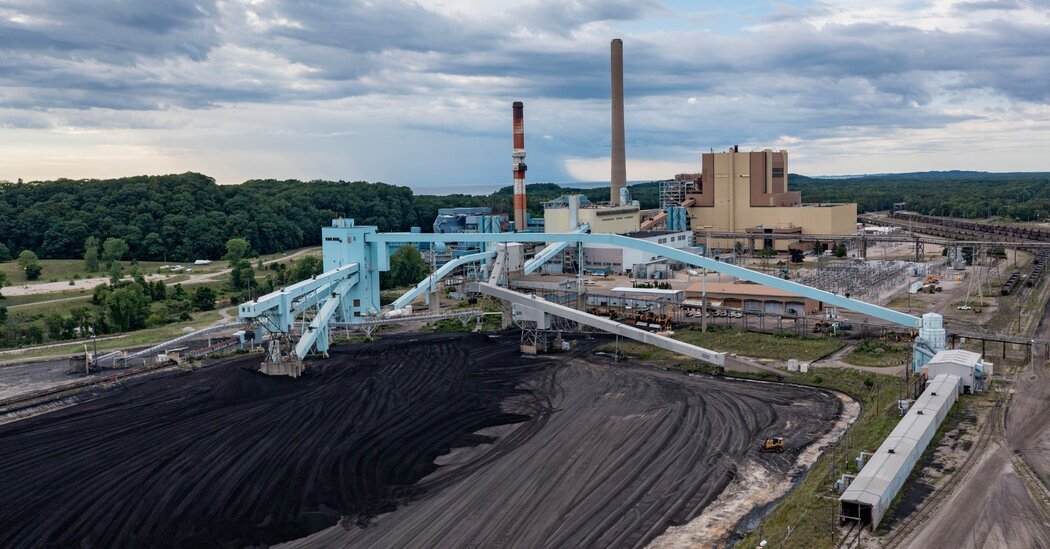
It’s been nearly a year since the Trump administration began issuing orders to keep five aging coal plants in four states open past their scheduled closures, citing an “energy emergency” that it said threatened the reliability of the U.S. electricity supply.
Since then, the Energy Department has repeatedly renewed these 90-day directives preventing the facilities from shutting down, even as one plant has yet to burn coal and another requested its order be allowed to expire. The moves have not come cheaply: Keeping the plants open has already cost hundreds of millions of dollars, much of which will be paid by ratepayers.
The Trump administration has pushed a broad campaign to revive coal in the United States, rolling back regulations on emissions and offering funding for plant upgrades, despite the significant health risks of burning coal and the industry’s yearslong decline.
On Friday, the Court of Appeals for the District of Columbia Circuit will hear a case brought by Michigan, Minnesota, Illinois and nine nonprofit groups arguing that the Energy Department’s orders are illegal and that there is no energy emergency. The case focuses on one plant, J.H. Campbell in West Olive, Mich., but has implications for five plants.
The Trump administration has said the emergency orders are necessary to deal with rising energy demand. Citing the use of the power plants during a cold snap this winter, Ben Dietderich, spokesman for the Energy Department, said “these operations serve as a reminder that allowing reliable generation to go offline would unnecessarily contribute to grid reliability risks.”
But critics say its use of emergency orders is not an efficient, economical or environmentally friendly way to meet rising electricity demand and ensure the grid is not overwhelmed during peak hours.
“The consequences of the Department of Energy’s actions are massive costs being imposed on ratepayers to keep around these old, expensive, dirty coal plants,” said Michael Lenoff, lead attorney for Earthjustice, an environmental nonprofit group that is part of the case.
Consumers Energy, which operates the J.H. Campbell plant in Michigan, has reported $180 million in expenses associated with running the facility since last May. In Washington, the Centralia plant, which is operated by the power company TransAlta, reported nearly $20 million in costs during the first three months of the emergency order, even though it has not burned any coal since its directive was issued in December.
In a statement, Consumers Energy said, “We are focused on complying with the federal orders.”
In an affidavit submitted to a federal energy regulator, a TransAlta executive outlined what it would take to restart the plant: 75,000 gallons of diesel, plus $200,000 worth of electricity before it could begin generating any of its own energy. Even if the plant never runs again, it would cost an estimated $7 million to dispose of its 98,000-ton pile of coal. TransAlta said its facility remains available but has not been directed to operate.
Expenses could climb elsewhere if the Energy Department’s orders continue. Vince Parisi, the president of the Northern Indiana Public Service Company, said in a recent regulatory hearing that one of the units at the state’s R.M. Schahfer plant covered by a Department of Energy order has been broken since last summer. He estimated the facility requires more than $100 million in investments to operate at full capacity.
CenterPoint Energy, which operates the F.B. Culley plant in Indiana, asked the Department of Energy to allow the emergency order for one of its units to expire without a renewal, according to a letter obtained by the Citizens Action Coalition, an Indiana advocacy group.
“Safe and reliable operation beyond March 2026 hinges on major and costly interventions,” wrote the Indiana region president Michael Roeder, estimating that repairs would cost $16 million to $20 million.
The Department of Energy renewed the emergency order for the F.B. Culley plant the next month. In a statement, CenterPoint said it was “committed to prioritizing affordability and reliability for our southwestern Indiana customers.”
The environmental effects of the emergency orders are becoming clear, too. From June to December 2025, the J.H. Campbell plant emitted 36 pounds of mercury, a neurotoxin that can impair brain development, a recent New York Times analysis found. Mercury emissions from coal-burning power plants rose by 9 percent in 2025 after years of declines. Coal plants are the single largest source of mercury emissions in the United States.
During Winter Storm Fern in late January, when temperatures plunged below zero in parts of the Midwest, three of the plants provided “essential power,” according to a fact sheet issued by the Department of Energy. But Mr. Roeder pointed to the cold weather event as evidence of his plant’s unreliability after “systemic equipment failures” forced an outage on January 26.
As part of President Trump’s plans to boost the coal industry, the Environmental Protection Agency has eased restrictions on greenhouse gas and mercury emissions from coal plants. Last month, the agency said it would weaken cleanup requirements for waste from burning coal.
Those efforts, combined with an increase in electricity demand driven by energy-intensive data centers, led to a 13 percent increase in the amount of electricity produced by coal in 2025, after years of decline. Coal emits about twice as much carbon dioxide as natural gas when burned for energy, and its rebound contributed to a nationwide increase in emissions of 2.4 percent last year.
Administration officials have said they hope to keep as many plants open as possible and prevent further closures. At the beginning of 2025, plant operators planned to retire 8.5 gigawatts of capacity; less than a third of those retirements proceeded as planned.
The largest retirement planned for this year is the J.H. Campbell coal plant. And the second-largest retirement planned for 2026, a unit at Tennessee’s Cumberland Fossil Plant, has already been delayed.
In court, the states and nonprofit groups argue that the Energy Department has not justified its use of emergency orders. The orders have generally been used in the past for a few days at a time during extreme weather events like hurricanes or heat waves.
Lawmakers in Washington State have taken a different approach to fighting the postponement of the closure of the last coal plant there.
After the Trump administration issued an emergency order in December to keep the Centralia plant open, Washington legislators passed a law that ensured the plant was covered by the state’s cap-and-trade law and a sales tax on coal.
As a result, burning coal in the state is now an expensive proposition.
“Both the state of Washington and TransAlta have held up their end of the bargain,” in moving forward with the closure of the plant, said Representative Joe Fitzgibbon, a Democrat who sponsored the new law. “And then the Department of Energy came in late December and tried to disrupt that.”
“We think that with our new law,” Mr. Fitzgibbon added, “we’re pretty confident that the plant is not going to start burning coal again.”
The plant did not run at all during the 90 days covered by the first emergency order. The Energy Department renewed the directive on March 13. That measure runs through mid-June, and the plant has still yet to burn coal.