dailynewsnblog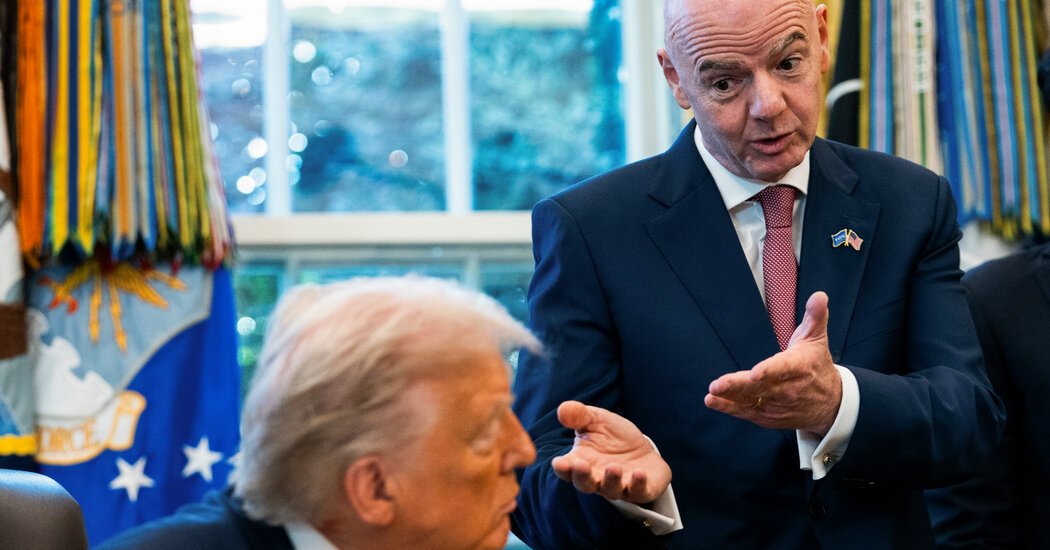
The way FIFA’s president, Gianni Infantino, tells it, there was nothing out of the ordinary when he received a call from President Trump after the United States’ victory over Bosnia secured the team’s path to the quarterfinals.
The two men speak all the time about the World Cup, Mr. Infantino said. But that phone call unleashed one of the biggest crises in the World Cup’s 96-year history and has further shaken belief in FIFA’s claims of being a neutral arbiter of the world’s most popular sport.
Mr. Trump, by his own account, was watching the game on television and was furious to learn that the team’s star striker, Folarin Balogun, would miss tonight’s quarterfinal match against Belgium after receiving a red card following an on-field review by the Brazilian referee. For Mr. Trump, that was a wrong that needed to be righted — and he knew who to call.
“All I did was ask for a review because I didn’t think it was a foul,” Mr. Trump said, describing the call as if it were a perfectly ordinary act, not one whose consequences have raised the worst type of suspicions a sporting event can face.
Soccer’s rules on a red cards are clear and widely accepted. Even if the decision is deemed harsh, the player must miss at least the next game through automatic suspension. But when FIFA announced a reprieve for Mr. Balogun on Sunday, many onlookers surmised something closer to a presidential pardon.
FIFA, frequently mired in controversy, has shielded itself behind legalistic language about processes and committees, insisting that Mr. Trump and Mr. Infantino are merely interested parties to a decision made by an independent committee over which even FIFA’s top leader has no say.
“During our conversation, I explained that there was an ongoing legal process involving FIFA’s independent judicial bodies and that the case would be decided in due course by the competent bodies,” Mr. Infantino said in a statement. “That is how FIFA’s system works, and it is a principle that I will always uphold.”
That system has long been criticized as opaque. With assistance from the White House, U.S. Soccer built a case that freed Mr. Balogun from a suspension that other players sent off the field at this World Cup have been unable to escape. The committee, chaired by Mohammad Al Kamali, a little-known lawyer from the United Arab Emirates, has 18 members from countries as diverse as Colombia, Tonga, Paraguay and Vietnam.
On Monday, FIFA issued a statement signed by “the chairperson of the FIFA disciplinary committee” — without citing Mr. Al Kamali by name — that listed 13 points but failed to explain why Mr. Balogun’s red card, though upheld, merited a suspended one-game ban rather than an immediate one. The statement noted that the committee “has the discretion to suspend any disciplinary measure.”
The committee’s deliberations are held behind closed doors, though sensitive cases are flagged to senior FIFA leadership, including Mr. Infantino, before decisions are issued. Committee officials also receive stipends and perks like luxury travel as part of their work for FIFA.
Miguel Maduro, who was FIFA’s first head of governance appointed by Mr. Infantino, said the committees can’t be autonomous “under the current FIFA rules where they are ultimately selected by and dependent upon those whom they ought to control and be independent from.”
“This is the reality at FIFA,” Mr. Maduro added. “They use the word independence, like they use the word peace, human rights or accountability. They use all the right words but have in place no governance instruments to give actual meaning to those words. It’s performative. Window dressing.”
Mr. Infantino has portrayed himself as largely removed from the process. “I read the decisions of the FIFA Disciplinary Committee when they are issued,” he said. “Sometimes I agree with them, and sometimes I disagree.”
Mr. Trump, too, sought to deflect accusations of favoritism.
“I don’t believe he made the decision,” he said of Mr. Infantino. “I think it was a committee that made the decision, and they made the right decision because, number one, it wasn’t a foul.”
Mr. Balogun’s case has no modern precedent at a World Cup, a fact that has infuriated not only Belgium but soccer officials, coaches and politicians around the world. Adding to the anger, a separate FIFA appeals committee ruled Belgium’s request to revisit the decision inadmissible.
It has also drawn new scrutiny to Mr. Infantino’s relationship with Mr. Trump, which has the appearance of affecting matters on the field, and threatens to follow the FIFA president in to his campaign for a new four-year term as president next year.
A chorus of condemnation has poured in from across Europe.
“When the certainty of rules is no longer guaranteed by its guardians, the integrity of the game is at stake and the credibility of a competition is undermined,” UEFA, soccer’s governing body in Europe, said in statement. “We express our disbelief at such an unprecedented, incomprehensible and unjustifiable decision.”
Mr. Infantino’s friendship with President Trump has already brought censure. Lise Klaveness, who heads Norway’s soccer body, has previously accused Mr. Infantino of breaching FIFA’s regulations on political neutrality when he delivered a newly created FIFA peace prize to Mr. Trump in December. She renewed that criticism on Monday.
“Such a suspension is not subject to appeal,” Ms. Klaveness said in a statement. “When FIFA nevertheless clears the player to participate in the next match without providing any explanation, there is reason for concern regarding the integrity of the competition, political interference in sporting matters, and the credibility of football.”
The German Football Association echoed her. “The impression that there has been active political interference in sport must be dispelled swiftly and conclusively,” it said in a statement. “The integrity of the competition and the credibility of FIFA are at stake.”
For all the anger, Mr. Infantino has maintained that nothing improper had occurred, insisting that “independent institutions and the rule of law is what protects the integrity of our competitions and the credibility of FIFA at all times.”