dailynewsnblog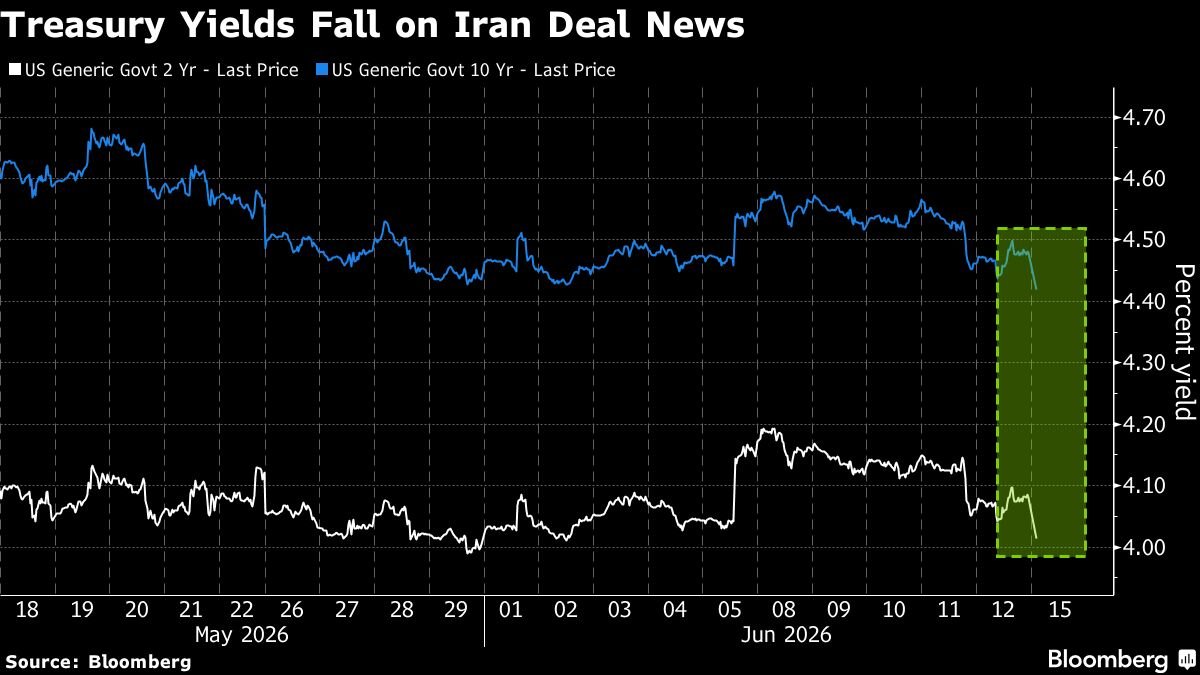
(Bloomberg) — Treasuries advanced across the curve as investors dialed back expectations for Federal Reserve interest-rate hikes following news of a deal to halt the Iran war.
Most Read from Bloomberg
Yields dropped on every tenor, led by shorter maturities that are among the most sensitive to changes in monetary policy. Swaps traders are now pricing in about a 60% chance of a quarter-point Fed hike by December, down from about 80% on Friday. Brent crude fell more than 4%, easing concern over inflation.
The Treasury gains were fueled by optimism a resolution to the Iran conflict will help reopen the Strait of Hormuz and bring down oil prices. The stakes extend far beyond the $31 trillion Treasury market, given US bonds serve as the global benchmark for borrowing costs, influencing everything from corporate debt to emerging-market assets.
“Some of the short positioning in rates will be taken off,” said Matthew Haupt, a hedge fund manager at Wilson Asset Management in Sydney. “Central banks can now be less hawkish, as they can afford to wait and look through any short-term inflation.”
Treasury two-year yields fell six basis points to 4.02%, while those on benchmark 10-year notes dropped by five basis points to 4.43%. Yields on 30-year bonds declined as much as five basis points to 4.92%, the lowest since May 7.
The US and Iran said they had reached a deal to reopen the Strait of Hormuz, a channel for roughly a fifth of the world’s oil supplies. That will come as some relief for the US where consumer prices rose in April at the fastest pace in three years, putting the spotlight on new Fed Chairman Kevin Warsh and the central bank’s policies.
“In bond markets, based on the observed postwar correlations, a 10% decline in oil prices would lead to an approximate 13-basis point decline in US 10-year Treasury yields,” said Tomo Kinoshita, a global market strategist at Invesco Asset Management Japan Ltd.
Asian bond markets also rallied. Yields on 10-year Australian notes retreated two basis points to 4.79%, while those on similar-maturity New Zealand debt slid six basis points to 4.41%. Japan’s benchmark 10-year bond yield dropped five basis points to 2.585%.
‘Nervous Wait’
Treasury investors may not be completely out of the woods just yet.