dailynewsnblog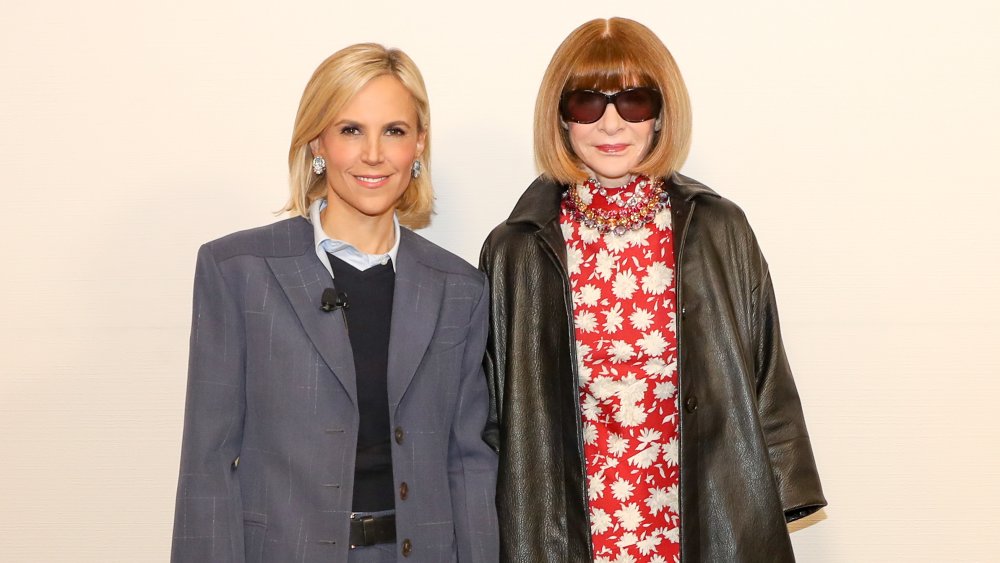
The Tory Burch Foundation held its second annual Founders Breakfast Thursday morning, honoring Anna Wintour, global editorial director of Vogue and chief content officer of Condé Nast, and three women entrepreneurs who won the Founder award.
The packed event, held at the Pierre Hotel in New York, was attended by 380 people, including Martha Stewart, Amanda Seyfried, Huma Abedin, Aerin Lauder, Natalie Massenet, Jessica Seinfeld, Deborah Roberts, Phoebe Gates, Amy Griffin, Derek Blasberg, Sara Moonves, Chloe Malle, Perri Peltz, Steven Kolb, and Alina Cho.
“Our mission, simply put, is to increase women’s economic power through entrepreneurship,” said Tiffany Dufu, president of the Tory Burch Foundation, which was founded in 2009. “Tory Burch Fellows have generated $470 million in economic impact toward our goal of $1 billion by 2030, and they’ve created more than 2,000 jobs.”
The 400 Fellows in the program now exceed $1 billion in annual revenue at 10 times the national average for women-owned businesses, “and 91 percent of them has said the foundation has been key to their success,” said Dufu. More than 700,000 people have used their Online Learning Center, and 20,000 business owners participated in the webinars last year alone.
“What’s incredibly exciting is now that we have the numbers to prove our game-changing impact, we are expanding our Fellows program,” Dufu said. This year they jumped from 50 entrepreneurs a year to 120. Next year, it will be 160.

Viola Sutanto, Pilar Guzman, Tiffany Dufu, Andrea Seymour, and Jennifer Pitt.
Neil Rasmus/BFA.com
Dufu said they can’t do this work alone and she reached out for additional support. “While we are called a foundation, we really are a not-for-profit that provides direct services, and the need has never been greater. In addition to the obstacles women face, this was a tough year for all entrepreneurs, as any founder in this room could tell you, and it’ll get tougher with funding cuts to small business support nationwide. Our role is more critical than ever. What we do works. With your partnership, we can do more,” said Dufu.
Supporters of the breakfast included Bank of America, Amy Griffin, Simone, Bloomberg Philanthropies, and The Lee Family Trust.

Martha Stewart
Neil Rasmus/BFA.com
The foundation then introduced the three entrepreneurs in the program who were awarded Founder Awards. The first was Viola Sutanto, founder and creative director Maika, a California-based lifestyle brand that makes bags and accessories. She is now part of the Bank of America Marketplace, which the bank sponsors to help showcase small businesses across America. Sutanto became a Tory Burch Fellow in 2020, when her revenue was $500,000 a year. This year, the company has reached $3.5 million in sales.
In accepting her honor, Sutanto said she started her company alongside a baby, and they were both named Maika. At 3 years old, Maika began lobbying for a sibling. They had planned on only one child “but after nearly two years of daily campaigning, we relented and had our son Alastair.” She said that when Maika was 9 years old, one morning she woke up vomiting blood. In the E.R. the doctors brought in specialists. Maika had bone marrow failure, and without a transplant would not make it. “As it turned out, that little brother she wanted so badly was the perfect match for her,” she said.

Tory Burch, Anna Wintour, Amanda Seyfried, Martha Stewart and Huma Abedin
Ellen Fedor for the Tory Burch Foundation
She said during Maika’s illness was the first year that the company wasn’t profitable. “It was also the year I applied to be a Tory Burch Fellow. My numbers looked awful. I almost didn’t hit send, but I did, and the foundation looked at my bottom line and took me in. It changed my life. I became a Fellow in the pandemic year when our wholesale business was decimated. Eighty-five percent of our orders were canceled in one week. But there was another silver lining from a hospital stay. I had used the time to learn everything I could about paid digital marketing. When the pandemic hit, everyone was scrambling to get online, but we were already established,” she said. With the backing of the foundation, they went online and told their story and their e-commerce business grew by 800 percent. “The Tory Burch Foundation believed in me before I believed in myself.”
The next Founder Award went to Andrea Seymour, cofounder, chief executive officer and principal designer of Springdale Custom Builders, a Charlotte, N.C.-based residential design-build firm.
Since Springdale launched in 2016, they have completed 120 custom homes and renovations. When Seymour became Fellow in 2013, Springdale had $3.7 million in revenue. This year, Springdale is forecasting $12 million.
Seymour told the story of how she had developed a career in hospitality and sales when she married her husband, who’s a general contractor. They were on their honeymoon on the beach when he got a call saying his company had folded and he was out of job. They decided that day to start their own construction company. She said she had been doing design work on the side for years, so she kept her main job and helped get the company off the ground. Two years later she joined full time as CEO and principal designer.
During the pandemic, she discovered the Tory Burch Foundation webinars. “They became a lifeline for me and a respite from the product shortages, labor challenges and constraints and an 18-month-old who decided to stop napping.” A friend suggested she apply for the Tory Burch Fellows program. “Getting accepted was truly the honor of my life. I am so passionate about it.” Robert Isen, president of corporate development and chief legal officer of Tory Burch, was assigned as her mentor. “He pushed me to identify capital factors. His faith in us kept me knocking on doors. Finally, at the umpteenth bank, I was bragging about being a Tory Burch fellow, and the manager said, ‘Is that like Tory Burch purses? I buy those for my wife.’ And I was like, ‘well, yes, keep buying those purses, and let me tell you why.’ I walked out with a line of credit.”
The third entrepreneur to win a Founder Award was Pilar Guzman, founder and CEO of Half Moon Empanadas, a fast-growing Miami-based brand. Under her leadership, Half Moon Empanadas has expanded to 26 locations nationwide with another four more to open soon. The brand has a strong presence in major U.S. airports in 10 cities, with one opening at JFK Airport at the end of the year.
When Guzman applied to the Tory Burch Fellows Program in 2020, Half Moon had $3 million in revenue. This year, the company will reach $30 million.
“I was 15 years old, a young girl from a small town in Veracruz, Mexico, walking through downtown L.A. with my father. I looked up at the high rises and said, ‘Papi, one day I’m going to work in one of those buildings. He looked at me the way he always did with complete belief. Well here I am Papi, standing on the stage sharing what it took me 18 years to build,” said Guzman.
She said her story is one of resilience. “The truth is, you’re not born with resilience. You learn it when there is no other choice. I know what it’s like to have my 2-year-old besides me and get a call saying we have $20 in the bank. I know what it’s like to be nine months pregnant without health insurance, sitting in a Medicaid office the day before my C-section, begging for approval. To be evicted not once, but twice, at home and at the restaurant. To go seven years without a salary from my own company. To be turned down by 10 banks when I was trying to finance our first airport location, and then to be hit by COVID. We shifted our entire kitchen to making meals for senior centers,” she said.
“When things get tough, we don’t run for the exit. We look for another way. I found my way to the Tory Burch Fellowship. The fellowship challenged me to think more deeply about our direction and plan for the long term. The Tory Burch mentors gave me clarity, and the confidence to ignore those who said expanding into airports was too ambitious and even crazy. It was then that I saw it clearly. Airports were our future, so we grew, we explored, but we also built ladders. Seventy-eight percent of our team is female, 63 percent is Hispanic, and that is no accident. In an industry like mine, where the average hourly wage is $15.87, our team members earn $24.75.”
“And when you do that, you’re not just shaping a company, you’re creating real economic mobility for entire communities, especially for women,” she said.
Tory Burch then gave out a Posthumous Founder Award to Olive Ann Beech, a pioneering entrepreneur in American aviation and among the most influential business leaders of the 20th century. As cofounder of Beech Aircraft Corp. in 1932, alongside her husband Walter, she helped shape the company’s strategy, operations and culture of excellence. After he died in 1950, she became president and led the company to global prominence for more than three decades. She was also named of America’s best-dressed women by the New York Dress Institute.

Amanda Seyfried
Neil Rasmus/BFA.com
In accepting the award on her grandmother’s behalf, Jennifer Pitt said, “I don’t know what would have pleased my fashionable grandmother more, actually receiving this award or being in the same room as Anna Wintour and Tory Burch.”
Tory Burch, designer and founder of the Tory Burch Foundation, then introduced Wintour, who won the Iconic Founder Award, saying, “Not all entrepreneurs start companies. Some, like Anna, transform institutions.”
“To summarize, Anna’s achievements are daunting, but thankfully one of the lessons I’ve learned from Anna is the power of being clear, and to the point when Anna became editor in chief Vogue in 1988, she did far more than lead a magazine. She re-imagined it. Under Anna, Vogue became not simply a publication, but a global force shaping culture, commerce, and conversation itself,” said Burch.
In a Q and A with Wintour, Burch asked about Wintour’s hiring practices and what she looks for in an employee. Wintour said she learned from her father, Charles Wintour, who led the London Evening Standard, to make sure when you hire someone, they know what they’re talking about. And make sure that you like them.
She recalled a story her father told her of the late Tom Stoppard, who was interviewing for a job as a political writer at the Evening Standard. Her father said to him, “I hear you’re interested in politics,” and Tom said, “yes.” When her father asked the name of the foreign secretary, he paused. “Well, I said I was interested in politics, I didn’t say I was obsessed,” said Stoppard. So Wintour said she keeps that in mind because a lot of people know she loves the theater and tennis, and when she asks what have they seen lately, there’s a long pause, and they’ll say, “Annie.”
She said her dad always told her to work with people she likes. “It doesn’t matter how brilliant the résumé, how on paper they’re going to be the most incredible asset. I just think, ‘Am I going to be pleased to see this person when they walk into my office?’”
Burch asked how creatives should think about balancing creative risk and the realities of commercial success. Wintour said it’s concerning to her how many want to jump right in and start a business, “and nearly all of them will fail.”
“So my advice is learn your craft and learn the balance between what it is you want to say as a designer and also what is going to work.” She pointed to Tom Ford, who spent 13 years working for Cathy Hardwick and then Perry Ellis. “He was 33 when he took the moribund Gucci, that was dying at the time and had no revenue, and turned it into that multibillion business that it became because he had an unbelievably strong point of view,” said Wintour.
When asked what she does when she faces challenges, Wintour said, “As a leader, challenge is the most interesting, and where you see people for who they are.” She said the fashion industry has been through so many difficult situations, such as COVID, 9/11 and the markets crashing. “But my instinct is always, what can you do to help? What can you do to give your teams something to do? Because often they are paralyzed or scared…” She said after 9/11 they organized a small fashion show a few weeks later to help sell the young designers who were not able to show. “And out of that was born the CFDA/Vogue Fashion Fund.” She said during COVID, they launched A Common Thread and gave out hundreds of grants to designers who were in need.
Wintour then discussed her role as chairperson and driving force of the Met Gala, which takes place Monday night. When she was asked by Oscar de la Renta if she could take over the Met Gala in 1995, she had no idea she was signing up for a “30-year second job.”
“But it’s been extraordinary because the Met itself is wonderful….and it’s in support of the Costume Institute and the extraordinary work that Andrew Bolton does. And I think the thing I’m most grateful for is as its reach has grown, you see what it also does for New York City. You see the hotels that are filled, the restaurants that are filled, the Uber drivers that have jobs. It helps everyone. And it’s no longer the Met, it’s the Met week,” said Wintour.
Burch asked Wintour what are some misperceptions that people have about her. For starters, she said she wears her sunglasses because she has “hideous eyesight, and I can’t see anything, and I also don’t do very well in very bright light. Also they’re an incredibly useful disguise when things are going like the way that you want, when the shows aren’t quite as entertaining…” She said she doesn’t wear black, although she loves black. “The reason I turned against it slightly was in the ’80s and ’90s before social media, when I used to go to the shows and every single editor I saw looked like they were dressed for a funeral. It was just sad, and there was no personality. So that was one of the good things that came out of social media. That everybody started to dress in color and a little bit more individual.”