dailynewsnblog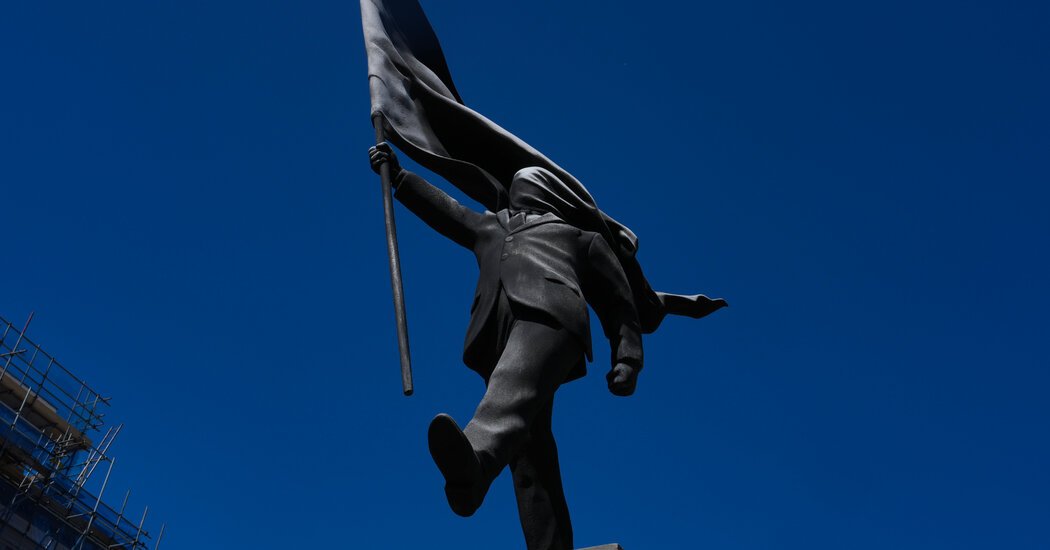
The artist Banksy appears to be taking credit for a large statue that was erected in London under the cover of darkness. It displays a man in a suit marching with a flag that billows onto his face, covering it entirely.
The statue, interpreted by many observers as a comment on blind nationalism, depicts the man striding off the edge of the plinth on which he stands. It appeared in Waterloo Place, a street in the St. James’s section of London, where there are many statues of 19th-century British military and colonial figures.
Banksy’s representatives told the BBC the statue was installed early Wednesday. The artist later posted a video of the statue and its apparent installation on his Instagram account on Thursday afternoon. The statue immediately drew crowds of curious onlookers, and pictures and videos of it were widely shared on social media. By Thursday afternoon, local authorities had placed barriers around the installation.
Philip Mould, a London art dealer, said in an Instagram video that the statue was not far from his gallery.
“Personally, I think what’s rather clever about it is he’s got the proportions perfectly right for the space,” Mr. Mould said. “I also rather like it when art, which is often forgotten, can be controversial, can be stimulating in this way.”
How the artist might have installed a large object in a prominent location, and whether it was done with official approval, was unclear. London generally requires artists to go through an extensive review process before receiving permission to create public art.
A representative of Mayor Sadiq Khan of London said in an email: “Banksy has a great ability to inspire people from a range of backgrounds to enjoy modern art. His work always draws great interest and debate, and the mayor is hopeful that his latest piece can be preserved for Londoners and visitors to enjoy.”
In September, a worker, toiling under police guard, removed a Banksy mural that had appeared only two days earlier on an outer wall of the Royal Courts of Justice building in London. A spokesman for Britain’s Ministry of Justice said the courts were protected under British heritage laws, so the court was “obliged to maintain its original character.”
The mural had depicted a judge attacking a protester with a gavel and was seen by many as a comment on the treatment of supporters of Palestine Action, a pro-Palestinian group that was banned as a terrorist organization by the British government in July. In February, the High Court in London ruled that the ban was unlawful.
Banksy is well known for his murals, such as “Girl With Balloon” and “Flower Thrower,” which have seemed to appear spontaneously overnight on public streets and buildings. The mystery surrounding his identity has only added to the public fervor surrounding his art, which has fetched millions at auction.
Last month, Reuters said it had determined Banksy’s identity after an extensive investigation that hinged on a New York police report from the year 2000. At the time, Banksy was a largely unknown street artist hanging around downtown Manhattan and was arrested for trying to deface a billboard, according to the evidence.
Reuters identified the artist as a man born Robin Gunningham, who a British tabloid, The Mail on Sunday, reported was Banksy in 2008. Citing public documents, Reuters said the artist had been using the name David Jones.
Mark Stephens, a lawyer for Banksy, told the news agency that Banksy “does not accept that many of the details contained within your inquiry are correct.” Reuters added that he did not confirm or deny the artist’s identity.