dailynewsnblog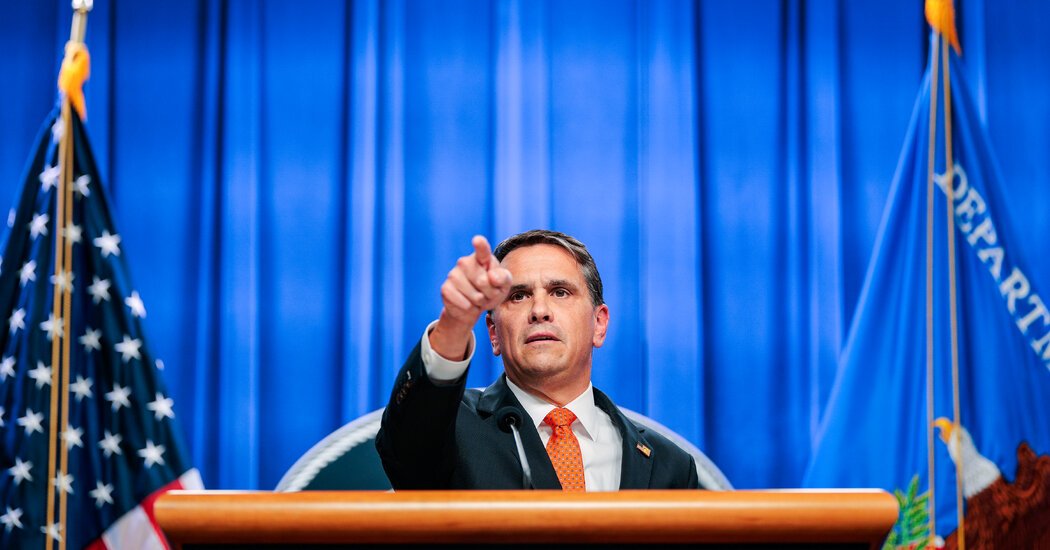
Todd Blanche, the acting attorney general, is doing what he can, as quickly as he can, to shed the “acting” label.
Mr. Blanche, who ran the day-to-day operations of the Justice Department as the top deputy to his predecessor, Pam Bondi, before her unceremonious ouster this month, has long been a target of pro-Trump influencers who accuse him of slow-walking the prosecutions of President Trump’s enemies.
But now Mr. Blanche is striving to silence critics on the right with a conspicuous salvo of actions to demonstrate progress on the president’s priorities, among them payback against Mr. Trump’s adversaries.
At Mr. Blanche’s urging, the Justice Department is moving ahead with investigations into several high-profile targets — including John O. Brennan, the former C.I.A. director who helped investigate Russian interference in Mr. Trump’s 2016 campaign.
Beyond Mr. Brennan, current and former officials say, Mr. Blanche has also given the green light to inquiries into Cassidy Hutchinson, a former White House aide who outraged Mr. Trump four years ago after she implicated him in the violence that erupted at the Capitol on Jan. 6, 2021; the Democratic fund-raising organization ActBlue over documented discrepancies in its screening of overseas donors; and the Southern Poverty Law Center, a civil rights nonprofit in Alabama that was indicted this week over a discontinued program that paid informants to infiltrate white supremacist and extremist groups.
Moreover, prosecutors plan to revive a botched attempt to bring charges against James B. Comey, the former F.B.I. director, after a federal judge threw out charges last year that Mr. Comey had lied to Congress, the people said. It is not clear what they are investigating this time.
And they are soon expected to subpoena bodyguards who protected Fani Willis, the state prosecutor who brought criminal charges against Mr. Trump in Georgia, possibly in connection with an investigation into her government-funded travel, one of the people said.
Still, few tasks are as central to mollifying a demanding president as fast-tracking an indictment of Mr. Brennan, despite the fact that multiple inquiries have already shown no evidence of wrongdoing.
Mr. Blanche is broadly overseeing the Brennan inquiry, which for now has two components. The first, examining whether he lied to Congress in testimony in 2023, could soon result in a case being brought to a grand jury in Washington. The second, relating to what Mr. Trump’s allies have cast as Mr. Brennan’s involvement in a “grand conspiracy” by Obama and Biden administration officials to keep Mr. Trump out of office each time that he ran, is expected to drag on longer and is playing out in Florida, according to people briefed on the matter who requested anonymity to discuss continuing investigations.
Ms. Bondi’s critics had claimed that she was too timid, even though prosecutors under her direction tried, often repeatedly, to bring charges, only to be rebuffed by grand juries and judges for lack of evidence. Some subordinates quit in protest of what they considered politicization of the department, which historically acts independently of the White House.
One critic of Ms. Bondi was Mr. Trump’s longtime ally Joseph diGenova, 81, whom Mr. Blanche put in charge of the investigation of Mr. Brennan last week, when the career prosecutor who led it was taken off the case after raising concerns about its validity.
“Pam Bondi was ineffective,” Mr. diGenova told Newsmax shortly before he was hired. He added, “The weaponization investigation cases in Florida have basically come to a standstill because Bondi got in the way.”
Whether Mr. Blanche will prove any more effective is an open question. But he has clearly hastened the cadence.
Blanche, ‘Unleashed’
This new push for prosecutions predates Ms. Bondi’s departure. But Mr. Blanche has made it clear to senior White House officials that he plans to move more efficiently than Ms. Bondi against Mr. Trump’s targets and in executing other White House priorities, including authorizing federal prosecutors to seek the death penalty in a wider range of cases.
Justice Department officials have said that each one of these investigations stands alone on the merits and that the internal conflicts over the Brennan case are part of the normal deliberative process of staffing investigations.
Mr. Blanche, the architect of the president’s successful stall-and-brawl defense strategy in three of the criminal cases he faced, has shed some of his lawyerly reserve, recently heralding his role in forcing out about 200 department employees involved in the investigations into Mr. Trump.
“There is not a single man or woman at the Department of Justice who had anything to do with those prosecutions,” he told an audience at a conservative political conference in Washington last month.
That message appears to be landing. During a private event at the White House earlier this month, Mr. Trump singled out Mr. Blanche, who was in attendance, delivering a hoarse, patented shout-out.
“He’s been unleashed,” said Mr. Trump, according to an attendee, as he brought up Mr. Blanche’s earlier work as his private lawyer.
He added, “All I know is this man now is doing a fantastic, he’s doing a great job always, but he’s doing a great job as the attorney general.”
Mr. Blanche has scoffed at the idea that he is auditioning, and says he is just doing whatever he can to help the president execute his agenda.
“I did not ask for this job,” Mr. Blanche told reporters earlier this month, adding, “I love working for President Trump.”
Yet Mr. Blanche, a former federal prosecutor in Manhattan, has also made it clear in private he very much wants the job permanently, according to a senior administration official who works closely with him.
A MAGA Outsider
The greatest threat to Mr. Blanche comes from MAGA conservatives who see him as an outsider.
And some of Mr. Trump’s most ardent supporters have sought to install Ed Martin, a far-right legal activist from Missouri, as the deputy attorney general. Even though his chances of being confirmed by the Senate were virtually nonexistent when he was Mr. Trump’s pick to lead the U.S. attorney’s office in Washington, Mr. Martin holds an ace: He has a direct line to the president.
Mr. Martin has sparred with Mr. Blanche for over a year. Mr. Martin angered department brass with a series of freelancing stunts, like sending a threatening letter to a former F.B.I. agent who had testified against the conspiracy theorist Alex Jones.
Late last year, Mr. Blanche moved to marginalize Mr. Martin, stripping him of his oversight of an internal task force examining what it calls the weaponization of the department against the president and his supporters, claiming that Mr. Martin had taken few actions. (The department is expected to release a new report from the revamped committee soon.)
While Mr. Martin has some powerful supporters, he is aware of the opposition he faces from Mr. Blanche, whose team has promised to keep him from getting the No. 2 slot at the department, according to people familiar with the situation.
A formidable potential rival, Harmeet K. Dhillon, who leads the department’s civil rights division, has made it clear that she wants to move up the ladder, and some Justice Department officials believe she is gunning for the top job, according to officials familiar with the situation.
But Ms. Dhillon has told Mr. Blanche she is a team player, supports the president’s decision to appoint him as acting attorney general and wants to help him succeed.
Abigail Jackson, a White House spokeswoman, praised both Ms. Dhillon and Mr. Blanche, whom she described as “an American patriot.”
“The president’s entire team, which includes Harmeet, is doing a great job advocating for sanity, law and order, and policies that keep Americans safe,” Ms. Jackson said.
By contrast, Ms. Dhillon and the White House counsel, David Warrington, her former law partner and ally, have been sharply critical of the Justice Department’s No. 3 official, Stanley Woodward Jr., the officials said.
Backers of Ms. Dhillon have pushed the White House to install her in Mr. Woodward’s place, according to one of those officials, but as of now Mr. Woodward has remained in place. And Mr. Trump has committed to promoting her, according to a person in Ms. Dhillon’s orbit.
There are other possible candidates for attorney general. But not many.
In the days preceding Ms. Bondi’s dismissal, Lee Zeldin, the administrator of the Environmental Protection Agency, was feverishly discussed by Mr. Trump as a successor. Jeanine Pirro, the U.S. attorney in Washington and a longtime friend of Mr. Trump, often tops the list of possible replacements, but she has repeatedly said she has no interest in the post.
Nonetheless, the job is Mr. Blanche’s to win, or lose, according to current and former officials.
Mr. Trump’s first term showed the president’s willingness to keep acting leaders in place indefinitely. Still, Mr. Blanche’s greatest selling point is perhaps the stability he provides to a department in flux: It would be far more onerous to replace him than to leave him where he is. Mr. Blanche has already been confirmed by the Senate, and could effectively remain in charge of the department for the foreseeable future.
A Moderating Influence
Notably, Mr. Trump has yet to nominate Mr. Blanche as the permanent attorney general. But at the fund-raiser, he praised Mr. Blanche as a solid steward of the department and a dogged defense lawyer who helped him avoid what the president views as unjust prosecutions.
That last attribute is not insignificant. Mr. Blanche could be called upon to defend the president if Democrats retake the House and launch further investigations into his conduct, or even embark on a renewed effort to impeach him.
Not surprisingly, Mr. Blanche downplays his efforts over the past year to counter moves, including some pushed by the White House, that he viewed as being unsupported by evidence or the law.
The most notable example came last fall when Mr. Blanche told White House officials that there was not enough evidence to indict Letitia James, the New York attorney general, on mortgage-related charges in Virginia. He was overruled. He also opposed the hasty appointment of Lindsey Halligan to lead the prosecutions of Ms. James and Mr. Comey. A judge later ruled she was illegally appointed and threw out both cases.
In a previously unreported incident, Mr. Blanche cautioned senior administration officials against immediately ordering the arrest of Mr. Comey after he posted a formation of seashells that Trump supporters claimed was an incitement of violence against the president, urging them to allow an investigation of the episode to proceed, according to two people familiar with the situation.
The department has not ruled out taking future action against Mr. Comey in the matter, one of those people added.
In the end, however, Mr. Blanche faces the same dilemma faced by every attorney general Mr. Trump has hired (and fired): Proving criminality in court is much harder than calling every enemy a criminal.
“The president wants Blanche to pursue his targets,” said John P. Fishwick, who served as U.S. attorney for the Western District of Virginia from 2015 to 2017. “The challenge for Blanche is that several of these cases are very uphill.”