dailynewsnblog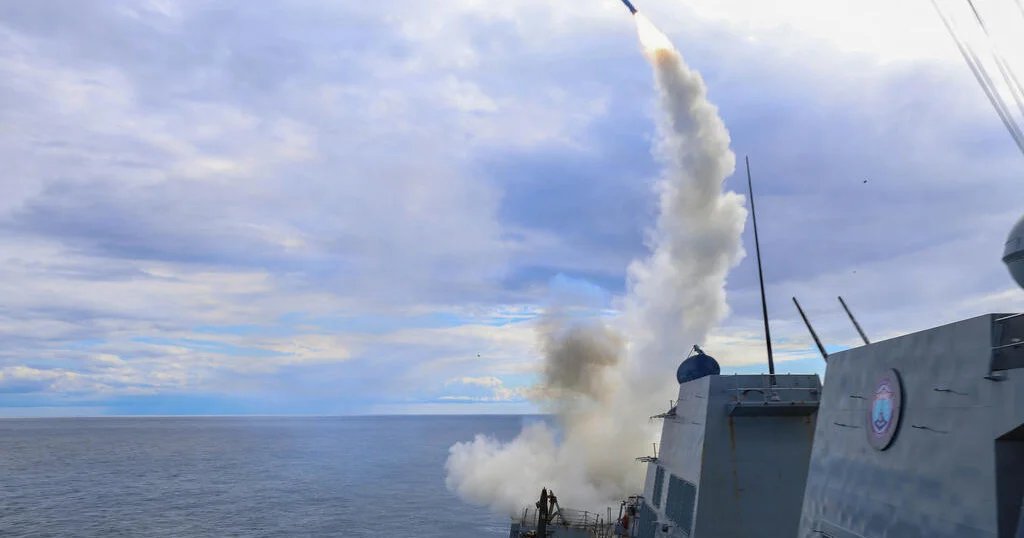
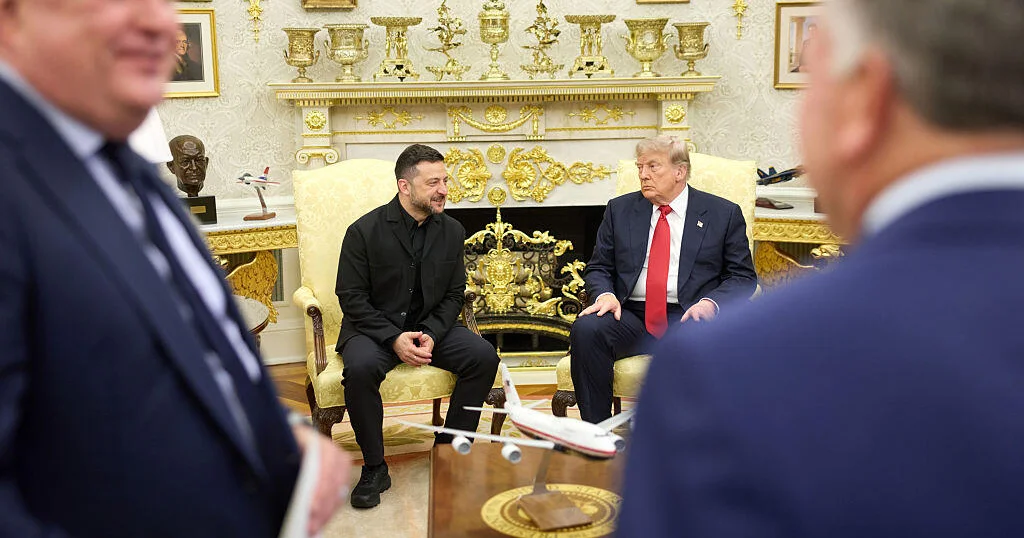
Washington — Days after the United States opened its military campaign against Iran, President Trump sought to project confidence in the nation’s war footing, declaring that America possessed a “virtually unlimited supply” of key munitions and could fight wars “forever” using them.
The remark conveyed a familiar image of American military power, a projection of being technologically unmatched, logistically dominant and capable of sustaining operations indefinitely. But recent congressional testimony from Pentagon officials and an analysis of the U.S. arsenal point to a more constrained reality, where the U.S. advantage lies less in limitless supply than in highly advanced, but finite, systems.
Of particular concern are supplies of advanced long-range missiles capable of striking targets hundreds of miles away, as well as interceptor munitions used to defend U.S. forces against incoming attacks.
Mr. Trump’s announcement of an indefinite ceasefire extension with Iran earlier this week prolonged a window for the U.S. to re-arm assets in the Middle East with existing stocks after a five-week bombing campaign.
The president told reporters Thursday the U.S. isn’t under any pressure to wrap up the conflict, saying, “we’ve never had so much ammunition.”
Long-term supply questions remain.
U.S. Navy via AP 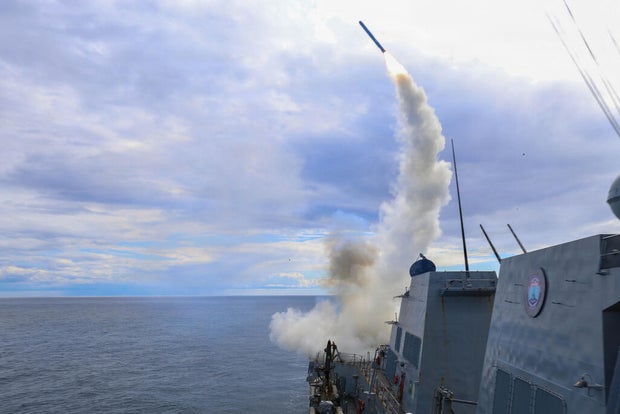
The Center for Strategic and International Studies analyzed U.S. munitions stocks and concluded that the U.S. “may have expended more than half of the prewar inventory” of at least four key munitions, including Tomahawk missiles.
The report said the “United States has enough missiles to continue fighting this war under any plausible scenario. The risk — which will persist for many years — lies in future wars.”
Testifying before the Senate Armed Services Committee on Tuesday, Adm. Samuel Paparo, the head of U.S. Indo-Pacific Command, said that scaling up output of high-end systems such as the Tomahawk cruise missile or AGM-158 JASSM, a stealthy long-range weapon, could take years for companies like Lockheed Martin and RTX’s Raytheon.
“I think it will take one to two years for them to scale,” said Paparo, whose responsibilities include preparing for any potential conflict in the Pacific region, including with China. “It won’t be soon enough. There are finite limits to the magazine, and I have all the faith in the world that they’re being employed judiciously.”
Murat Usubali/Anadolu via Getty Images 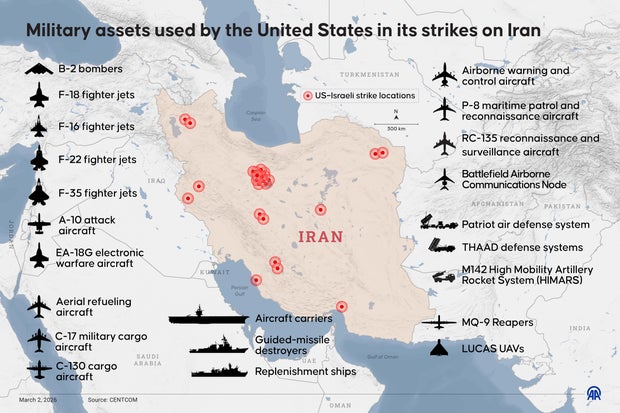
Defense planners often draw a distinction between capability and capacity. While the United States retains extraordinary capabilities, the number of those weapons available and the ability to replace them are more limited.
For years, defense officials have warned that stockpiles of key munitions are under strain, particularly as the United States supports multiple operations at once. Air defense interceptors, for example, are in demand not only in the Middle East under U.S. Central Command, but also in Europe and the Indo-Pacific, where they are central to planning for a potential conflict with China.
Those overlapping requirements have forced difficult trade-offs. Weapons expended or deployed in one region are often drawn from the same inventories intended for another. Meanwhile, production cannot easily keep pace, and many advanced munitions rely on complex supply chains and specialized components.
When asked by Democratic Sen. Richard Blumenthal of Connecticut if Paparo agrees with his concern over the transfer of munitions and capabilities to the Middle East, the admiral underscored the realities that modern wars consume munitions in large volumes.
“I think we maintain deep magazines and there’s no walking away from the quantitative use of weapons. And our way forward is to supercharge our defense industrial base and equally important is to innovate with non-traditional primes,” said Paparo, referring to smaller companies, often tech startups such as Palmer Luckey’s Anduril, which makes lower-cost drone technology.
In early March, Mr. Trump held a White House meeting with executives from defense contractors whom he said agreed to increase production of “Exquisite Class Weaponry” fourfold.
In Pentagon shorthand, defense officials often use the term “exquisite” to describe a narrow class of weapons that sit at the very top of the military’s arsenal. The systems are defined not just by their precision and range, but by their complexity, cost and scarcity, such as the Tomahawk cruise missile or Patriot missile system.
“We want to reach, as rapidly as possible, the highest levels of quantity,” the president posted on social media.
Capt. Russell Shirley-Jones 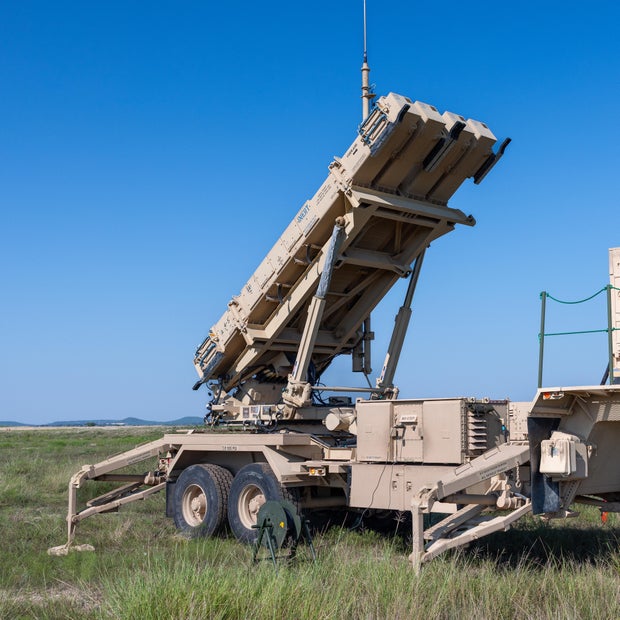
Since the White House meeting, the Defense Department has announced several “framework agreements” to boost production for Terminal High Altitude Air Defense (THAAD) systems to take down incoming missiles, critical components for munitions and more offensive Precision Strike Missiles.
“By empowering industry to invest in the factory floor, we are building a decisive and enduring advantage for our warfighters to outpace any potential adversary,” Michael Duffey, the under secretary of defense for acquisition and sustainment, said in a statement at the time.
The agreements are intended to give industry a demand signal that incentivizes them to make long-term investments.
The Pentagon’s budget request this year also asked for more than $70 billion to procure missiles and related equipment, a nearly threefold increase compared to last year.
Andrew Harnik / AP 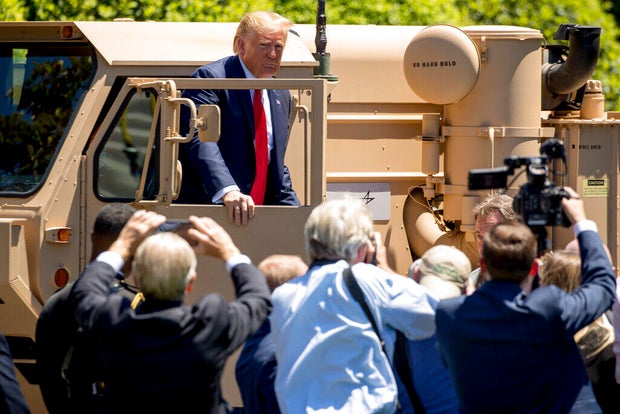
Actual timelines for production could vary. CSIS, in its analysis of seven critical munitions, noted current production timelines show it takes several years to deliver the weapons to the military.
“Rebuilding to prewar levels…will take from one to four years as missiles in the pipeline are delivered,” the CSIS report said.
Mr. Trump said he would meet again with the defense companies in May.
Concerns about stockpiles are not new. They rose to the forefront after Russia’s full-scale invasion of Ukraine, when it became clear that Ukraine’s allies in the U.S. and Europe were not producing fast enough.
But that was largely about artillery needed in the trench-like warfare seen in Ukraine, whereas now there are concerns about long-range missiles that could be crucial in a potential war against China.
“President Trump’s war of choice in Iran has resulted in significant military posture changes in the Indo-Pacific region and on the Korean Peninsula,” said Democratic Sen. Jack Reed of Rhode Island during a congressional hearing on Tuesday. “Over the past two months, President Trump has transferred out of your theaters to Central Command, including a carrier strike group, an amphibious ready group, various missile defense capabilities and other munitions.”
Asked about claims that THAAD missile systems, which are American-made anti-ballistic missile defense systems, were moved from the Korean Peninsula to the Middle East, Army Gen. Xavier Brunson, commander of U.S. Forces Korea, said that reporting was incorrect. But he added that they were sending forward munitions, underscoring how munitions intended for one region get shuffled to another.
“We’ve not moved any THAAD systems. So THAAD still remain on the peninsula currently. We’re sending munitions forward and those are sitting right now waiting to move,” said Brunson. “There was previous moves where radars were taken forward, this was in advance of Midnight Hammer [in June 2025 when U.S. bombed major nuclear facilities in Iran]. Some of those things have not come back yet.”
Ultimately, the stark reality is that even the world’s most powerful military has to operate within limits.