dailynewsnblog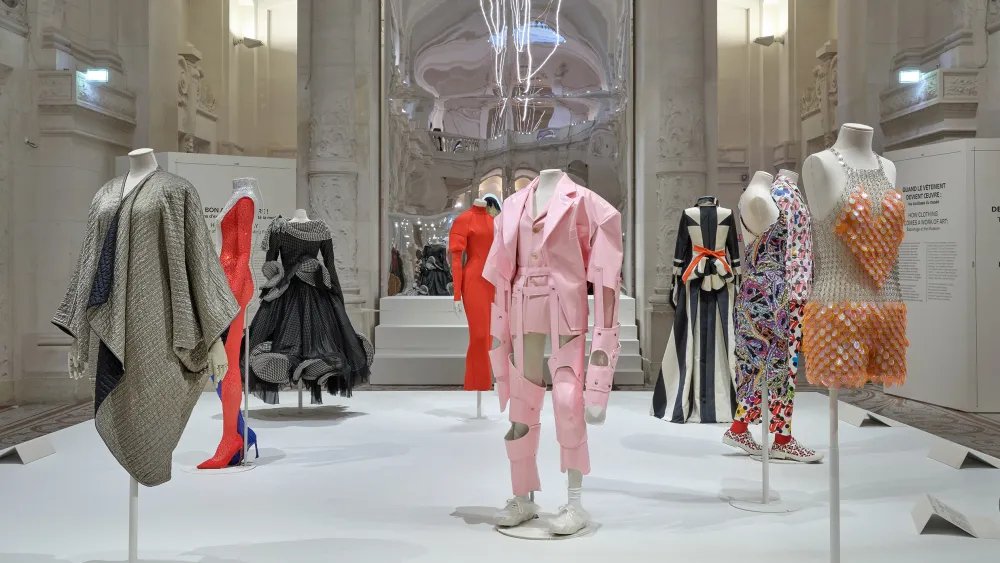
PARIS — From feminist pioneers to eccentric artists, this fall’s fashion exhibitions in Paris reveal how clothing can reflect culture, identity and creativity far beyond the catwalk.
‘Look: 40 Years of Fashion at the Museum’ at Les Arts Décoratifs
Does fashion belong in a museum? With the creation of the Museum of Fashion Arts in 1986, France answered that question by providing an official home for the clothing collections that had been stored at Les Arts Décoratifs since its inception in the 19th century.
The institution is celebrating four decades of fashion exhibitions with a display of 40 looks from 40 shows in its soaring central nave. The adjoining galleries trace the journey of clothes from conception to conservation.
“We’re taking you behind the scenes — not just of fashion houses, which has been done elsewhere, but of the museum itself,” said Bénédicte Gady, director of the Musée des Arts Décoratifs.
“You’ll get an insight into the hidden professions that make major exhibitions possible and help transform fashion into art — and I think that’s genuinely new,” she added.
The first gallery takes visitors from sketch to runway, with exhibits including patterns, fabric swatches and the small, articulated wooden mannequin that Madeleine Vionnet used to drape and design her signature bias-cut gowns.
In the central section, each look represents an exhibition, from retrospectives on Christian Dior, Elsa Schiaparelli or Thierry Mugler, to thematic shows.
Instead of chronological order, looks are grouped by mood and color, so a Jean Paul Gaultier costume for choreographer Régine Chopinot sits alongside pink pleated gowns by Iris van Herpen and Valentino Garavani.

A Chanel spring 1996 haute couture dress by Karl Lagerfeld in the “Look: 40 Years of Fashion at the Museum” exhibition at Les Arts Décoratifs.
Christophe Delliere/Courtesy of Les Arts Décoratifs
The final gallery sheds light on the process of acquisition, conservation, documentation and restoration, including a display case showing a clothing restorer’s toolbox, which includes everything from scalpels to dental picks, fishing-line cutters and insect pins.
Most importantly, the exhibition illustrates how Les Arts Décoratifs is uniquely positioned to juxtapose fashion with objects from its extensive collection of decorative arts: think Dior’s 1955 Soirée de Bagdad dress alongside a piece of 18th-century furniture, in an echo of a presentation the couturier staged at the museum that year.
“For us, fashion is not an isolated art form. It’s an art form rooted in a particular period, a way of thinking and a broader perspective on design,” Gady said.
‘A Wardrobe of One’s Own: Dissident Femininities in the 19th Century’ at Palais Galliera
Tapping into its rich reserve of 19th-century garments, Palais Galliera’s new show explores how women adopted elements of menswear after the French Revolution, ushering in an end to the traditional binary approach to dressing.
Starting with the Anglomania of the late 18th century, it explains how women progressively embraced the black Amazon riding habit, in a world where female dressmakers usually clothed women, and male tailors men.
From Marie Antoinette on horseback, to dissident figures like queer writer Natalie Clifford Barney, it juxtaposes the stories of women who challenged gender norms with caricatures reflecting the fear they inspired in men.
Cyclists in particular crystallized resistance to the growing women’s rights movement. As the first of their sex to wear bloomers in public, they were decried as going against nature.
“These women in trousers made the patriarchal order tremble. The Amazon was acceptable; the female cyclist was not. She was seen as a gender-neutral figure, neither man nor woman. She was a hermaphrodite,” said curator Marine Kisiel, who heads the 19th-century fashion department at Palais Galliera.
“In the English-speaking world, she became the ‘new woman’ — the emancipated woman, the New Eve, the Future Eve — who would conquer the city, enter the social sphere and leave the home. And she would do something utterly unacceptable: wear cycling clothes without actually riding a bicycle,” she added.

Bryant & Ondrak, New York, cycling outfit, circa 1897-1900.
Eileen Costa/Courtesy of The Museum at FIT
A highlight of the exhibition is the wardrobe of French painter Rosa Bonheur, on public display for the first time. An early lesbian icon, she circumvented dress codes by inventing a personal uniform that combined long skirts with suit jackets and waistcoats.
Another curiosity is a pair of Levi’s “Freedom-Alls,” the denim brand’s first garment designed specifically for women, which is also making its exhibition debut. A belted tunic worn with jodhpur-like pants, it was created in 1918 in response to women’s more active roles at the end of World War I.
A closing display of vernacular photography celebrates the scores of anonymous women who took advantage of the wind of freedom blowing in the early 20th century to dress as they saw fit, heralding the trans and nonbinary identities of today.
‘The Fabric of the Artist’ at Musée Bourdelle
Six years ago, a curator rummaging through a closet found a trove of sculptor Antoine Bourdelle’s clothes. That was the starting point for the Bourdelle Museum’s new exhibition, which explores how artists constructed and staged their identity through clothing from the late 19th century through the mid-20th century.
“Until now in the museum world, everyone has tended to look down a bit on these kinds of finds, questioning whether they’re even worth keeping,” said curator Ophélie Ferlier Bouat, director of the Petit Palais and former director of Musée Bourdelle.
“I thought it would be really interesting to build an exhibition not just around artists’ clothes, but the way they construct a persona and curate their presentation to assert an artistic identity, a unique character, or their belonging to a specific group,” she added.
Whether attempting to control public perception through posed portraits, or telegraphing their mindset through eccentric attire, artists have always had a symbiotic relationship with clothes.
The show features a smock and work trousers belonging to Edgar Degas; renowned dandy Foujita’s mariachi pants; Sonia Delaunay’s linen coat in her own geometric design, and an extravagant tulle polka dot hat worn by Tamara de Lempicka, which she used as the key prop in her 1952 painting “The Lady With the Hat.”

Blouse belonging to Gustav Klimt, circa 1905, indigo linen and white cotton embroideries, Austria, Wien Museum, and drawing of Gustav Klimt in blue tunic by Egon Schiele, 1913, pencil and gouache on paper, private collection.
Courtesy of Musée Bourdelle-Paris Musées
Alongside these rare personal artifacts are the paintings, photographs and caricatures that helped shape artists’ public image.
Bourdelle always wore the same uniform of tunic and pants, in linen for the atelier, and in more luxurious fabrics for going out.
“This attire sparked a lot of chatter among the public and press, with widely differing interpretations: some saw it as a workman’s smock, while others perceived him as a somewhat mystical, almost medieval character,” said Valérie Montalbetti Kervella, the art historian in charge of Bourdelle’s sculptures and collections who discovered his clothes.
Gustav Klimt’s signature blue tunic, one of the star items in the show, was created by his lifelong companion, muse and fashion designer Emilie Flöge, who invented the loose-fitting Reformkleid in reaction to the restrictive corsets of the Victorian era.
By the end of the show, the clothing has become the art. A gray felt suit, produced by Joseph Beuys in a limited edition of 100, is a reference to his oft-told claim that he was rescued after a plane crash in Crimea by Tatar tribesmen who wrapped him in fat and felt. It turned out to be pure myth.