dailynewsnblog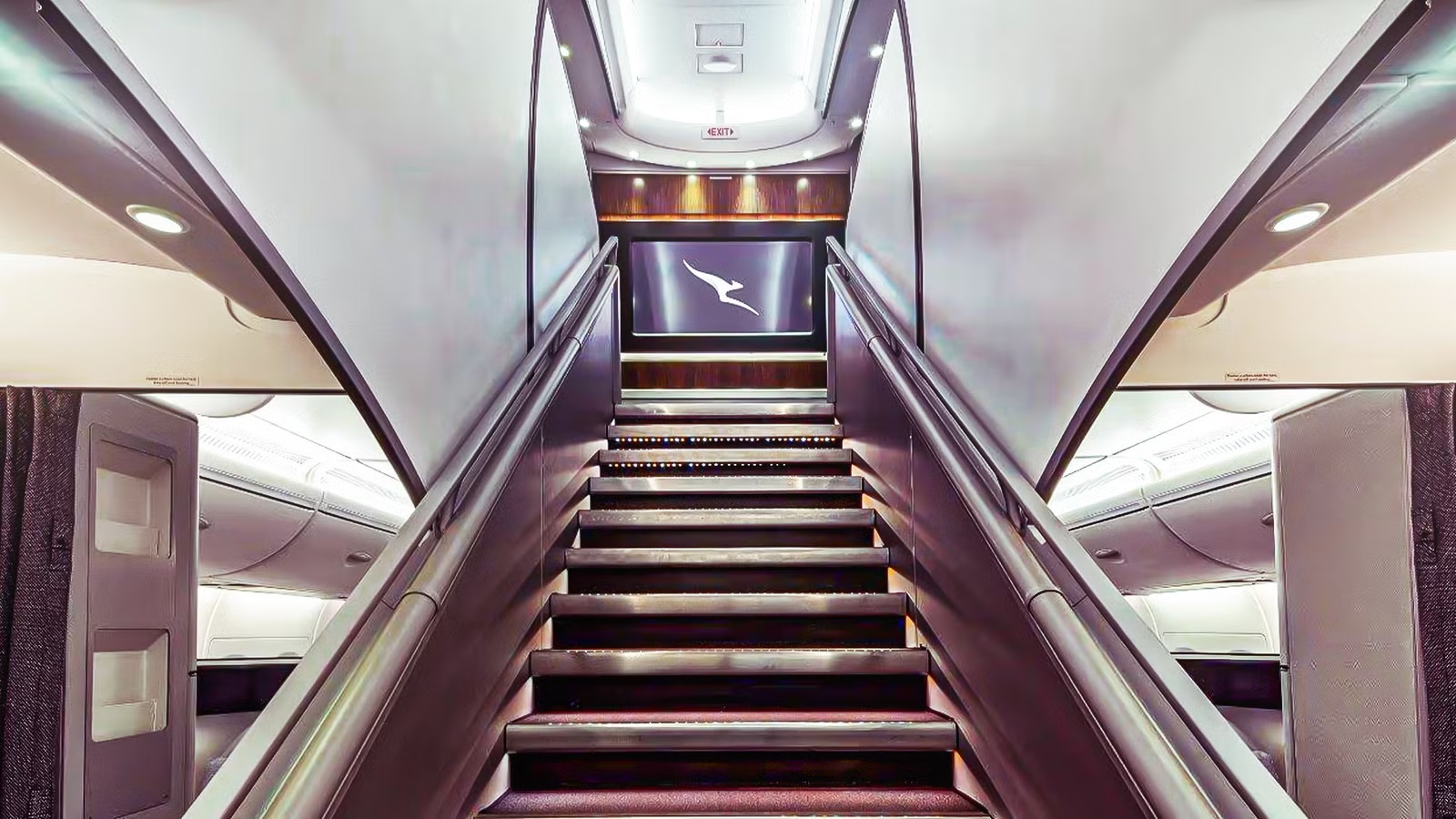
 Emirates is by far the biggest operator out of the ten airlines that regularly fly the Airbus A380 today. Despite almost disappearing from the skies altogether just a few years ago, a resurgence in its use since the pandemic has meant passengers can enjoy the string of accolades it still boasts over its successors. Not only is it the largest passenger plane ever to have been built, being the sole full-length double-decker jet airliner and only able to house over 500 seats, but the aircraft also brought about several leaps in performance that remain relevant now.
For passengers, among the most notable advancements was a drop in background sound in the cabin. Even against the newest passenger airliners rolled out several years later, the superjumbo is still a far quieter model to fly on than any other. So why is this, who flies it, and what is set to take the title with the A380’s looming retirement?
Airbus A380 Itself

Airbus set about building a new flagship for carriers’ fleets back in the early nineties. Aimed at tackling the growing issue of congestion at major airports and rivaling the Boeing 747, the idea for a new double-decker jet with a massive capacity came about. Namely, this would fit suitably to the hub-and-spoke model, offering a means for airlines to bring larger numbers of passengers at a time to a central airport before sending them onward to the destinations.
As with any new jet design, Airbus toyed with the latest innovations during the A380’s development. It was the first time engineers had used a full digital mock-up while designing a plane, for instance. Carbon fiber reinforced plastics, which would later be more widely incorporated on the Airbus A350, were also adopted on the superjumbo, alongside “weight-saving, safety-improving hydraulic systems”.
All told, the manufacturer ultimately filed over 380 patents during its development, according to Airbus’ website. Among the features covered by these was noise-reducing acoustic paneling. So successful were these in absorbing the sound of air rushing around the huge fuselage and the jet’s four Rolls-Royce Trent 900 or Engine Alliance GP7200 engines, that the paneling went on to “become the norm in aircraft design and production,” per Airbus.
A380 Cabin Quietest To This Day

This paneling helped to create an aircraft with a cabin so quiet that nothing has come close to rivaling it since. But it was far from the only contributing factor. Sheer size played an important part, leaving passengers further from the engines than on other planes, but also from outer surfaces where aerodynamic noise is more pronounced. High bypass ratio engines also helped, rotating more slowly than against older designs.
Details down to the A380’s aerodynamics were considered too, all with the purpose of reducing the sound made by the giant airframe cutting through the air. In short, the effort paid off, and several studies have placed the A380 well ahead of widebody rivals in terms of cabin quietness.
Cabin noise levels of different aircraft at cruising altitudes, from US Credit Card Guide:
Aircraft | Average noise level (decibels) | Number of measurements |
Airbus A380 | 56.0 | 4 |
Airbus A350 | 60.8 | 3 |
Boeing 787 Dreamliner | 61.9 | 5 |
Airbus A330 | 63.2 | 5 |
Boeing 777 | 65.7 | 8 |
Boeing 757 | 65.8 | 3 |
Embraer E175 | 66.9 | 4 |
Boeing 767 | 67.4 | 2 |
Airbus A320 | 68.5 | 7 |
Boeing 737 | 69.6 | 7 |
Using in-house software on Samsung smartphones, National University of Singapore researchers in 2022 published onboard sound readings taken during Airbus A330-300, Airbus A350-900, Airbus A380-800, Boeing 777-200ER and Boeing 787-9 flights. “The minimum cabin noise values confirm it is by far the quietest long-haul aircraft in the skies,” the report found of the A380. A similar study, published on US Credit Card Guide, made the same determination in 2018 while also considering narrowbody models, as shown in the table above.
Emirates By Far Biggest A380 Operator

A quieter flight experience offers very real benefits, mainly in terms of comfort and reducing the physical strain of spending hours upon hours in the cabin. While position in the cabin can indeed play a part in how noisy a flight is, the studies show the model itself is key.
Catch what other flight trackers miss
Emergency squawks, holds, NOTAMs — live signals, no signup.
Open tracker
Catch what other flight trackers miss
Emergency squawks, holds, NOTAMs — live signals, no signup.
Open tracker
For the largest fleet of these quieter models, no other airline operates nearly as many A380s as Emirates. According to Planespotters.net, the United Arab Emirates co-flag carrier had 116 superjumbos on its books as of July. Of these, 26 were parked, with the remaining 90 in service.
Aircraft | In service | Parked | Total |
Airbus A319 | 1 | – | 1 |
Airbus A350 | 24 | – | 24 |
Airbus A380 | 90 | 26 | 116 |
Boeing 777 | 140 | 5 | 145 |
Total | 255 | 31 | 286 |
Given Emirates’ hub-and-spoke model, the A380 has proven a useful tool for channeling passengers en masse through its base at Dubai International Airport (DXB). Following the A380’s introduction into commercial service in 2007, Emirates received its first model the next year and has most recently completed a refurbishment project to add the likes of premium economy cabins to those still in its fleet. Today, the airline lists four different configurations for its A380s, leaving capacity ranging from 484 seats across four classes, to 615 seats in two classes.
Singapore, British Airways, And Other A380 Operators

Nine other carriers still operate the A380, though none sit close to Emirates in terms of numbers. Some 189 active superjumbos remain around the world on regular passenger services.  Singapore Airlines and
  British Airways continue to fly just 12 of these apiece as it stands. However, despite having so few compared to Emirates, they represent the tied, second-largest operators of the A380.
Based on Planespotters.net data, two of British Airways’ A380s were parked as of July. One of Singapore’s was grounded in the meantime. Singapore, which was the launch customer for the A380 back in 2007, flies the aircraft in two layouts, each of which incorporates 471 seats and four classes. British Airways also offers four classes on its A380s, which house a capacity of 469 passengers.
Airline | Number of A380s |
Emirates | 116 |
British Airways | 12 |
Singapore Airlines | 12 |
Qantas | 10 |
Etihad Airways | 9 |
Lufthansa | 8 |
Qatar Airways | 8 |
Asiana Airlines | 6 |
Korean Air | 5 |
All Nippon Airways | 3 |
Qantas is the next largest operator, boasting ten A380s in its fleet, ahead of  Etihad Airways with nine models. The remaining airlines that still use A380s for regular passenger services then include
  Lufthansa,
  Qatar Airways, Korean Air, Asiana Airlines, and All Nippon Airways. This handful of airlines will likely be the last to use the A380 too, after Airbus ceased production in 2021.
A380’s Retirement Looms

Despite a string of records and clear strengths around passenger comfort, the industry arguably began moving on from the idea that massive jetliners were the future before the A380 first took to the skies. Development might have begun in the early nineties, but it took until 2007 for carriers to begin getting their hands on the A380.
Twin-engine alternatives only grew in popularity in the meantime. Longer-range variants of the Boeing 777, for example, were increasingly emerging, while the clean-slate 787 Dreamliner was only a few years away. Where the A380 was perfectly suited for high-density flights to huge hubs, it simply lacked the flexibility that smaller counterparts offered.
Come 2019, Airbus announced A380 production would be wound down at great cost on the back of insufficient demand. Billions had been spent on the project, which ultimately delivered 251 models to 14 customers, but weaknesses were only ever becoming more apparent. The move from Airbus followed Emirates’ decision to cancel 39 orders for the superjumbo. Soon after, the pandemic saw widespread groundings of A380s and — were it not for airlines juggling a rebound in demand and aircraft delivery delays since — likely would have spelled an end for the model once and for all.
Boeing 787, Airbus A350, Or 777X: The Next Quietest?

As it turned out, supply issues have left airlines scrambling for additional capacity to meet demand as they awaited deliveries of their latest jets. Airbus’ A380 has been granted a new lease of life as a result, and so the chance to nab a noticeably quieter flight remains for the time being. However, this will not last forever, and when the A380 does eventually disappear, the title of the quietest cabin on a widebody will be up for grabs.
Both the A350 and 787 sit close to each other as the next on the list for the quietest cabins at cruising altitudes. Launched in 2015 and 2011, respectively, the duo represent the latest advancements in aviation technology. Per the 2018 study, the 1.1-decibel jump recorded between the two actually meant there was “no statistically significant difference” in that case. The University of Singapore research drew a similar conclusion, noting a slightly higher average on the A350 over the 787 “was deemed to be minimal”.
Either way, “cabin noise [has] improved significantly compared to the noise levels reported in earlier studies in the late nineties,” as the latter found, thanks to improved engine performance and innovation in aircraft designs. One jet that may well give the A350 and 787 a run for their money is the Boeing 777X. Currently tipped to enter service over the year ahead, Boeing has specifically flagged that the next-generation variant will boast a “quieter cabin” than its predecessors, so watch this space.