dailynewsnblog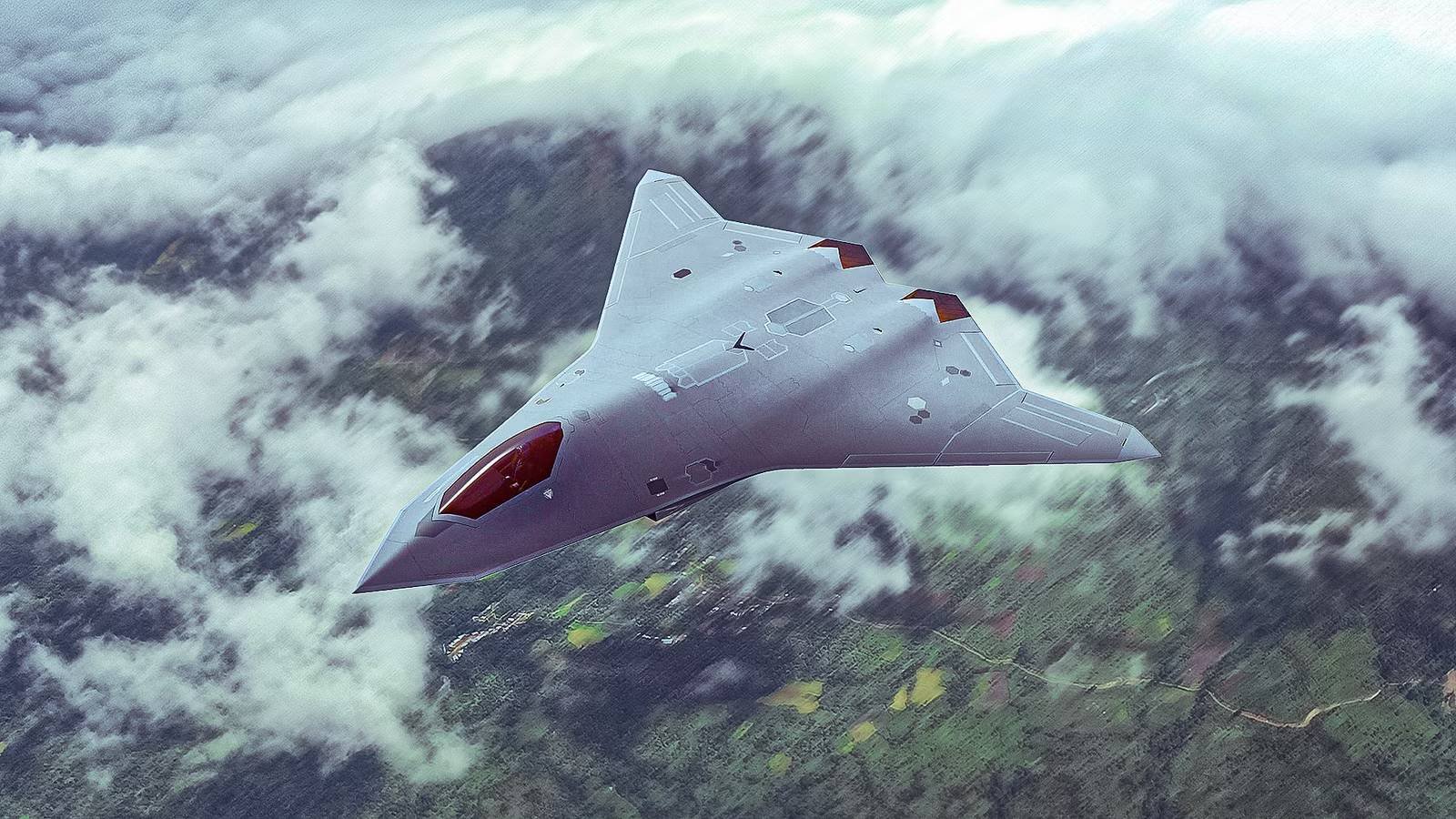
The world’s leading nations are currently racing to develop 6th-generation fighter jets. However, it is important to note a few things; one is that, to some extent, the category doesn’t exist in a neatly defined sense. There is no universally recognized criterion for what constitutes a 6th-generation fighter jet, and the term is often used for marketing, propaganda, and clickbait value. That said, the consensus revolves around 6th-gen fighter jets resembling all-aspect stealth flying supercomputer command centers that happen to carry missiles.
Classic fighter jet performance, like speed and agility, is secondary or otherwise unimportant to the generation. Another important aspect is that 6th-generation fighter jets are highly classified and are in early stages, which leads to a lot of guesswork and uncertainty. This list will consider seven of the more commonly talked about programs, often described as 6th-gen jets, and rank them by their perceived stage of development and funding commitment.
7
Russia PAK-DP MiG-41
Planned in service mid-2020s (likely 2040-2050 if ever)

After decades of decline and being a rump state of the USSR, Russia continues to prioritize its image as a “great power” and one that deserves a seat at the table with the United States and China. Much of Russia’s equipment and technology is Soviet legacy, and it lacks the funds and industrial capacity to compete with the US and China directly.
For example, since 2022, the US and Chinese industries have each produced around 150–250 fighter jets annually, while Russia has produced around 20–35 annually, often similar numbers to France. Russia officially launched its 6th-generation PAK DP (often dubbed MiG-41) 6th-gen interceptor program in 2013 to replace its aging MiG-31.
In 2017, Russia Today reported it would fly in space, shoot down satellites, fly at Mach 4+, have lasers, use AI, and TASS said that it was totally “not a mythical project.” The first flight was to happen in 2020, with the type entering service in the mid-2020s. As of 2026, no new information has surfaced about it since mid-2023. The program appears to remain in the very early stages of design and is mostly used as a propaganda vehicle: “If the West can do it, we can do it better.” Even if Russia were to produce an aircraft superficially resembling the F-47, that doesn’t mean it is a 6th-generation fighter.
6
Franco-German Future Combat Air System (FCAS)
Planned in service 2040 (implausible)

The French, German, and Spanish FCAS 6th-generation fighter program is listed in 5th place here as it is a real program with real funding, but it also has real issues and faces the real prospect of collapse. Bitter disagreements between Germany’s Airbus and France’s Dassault have stalled development work and have pushed it to the brink as of May 2026.
The stated goal of an in-service date by 2040 is now unrealistic. Should the program fall apart, Dassault will likely go it alone and develop its own French next-generation fighter jet, although probably less capable than the FCAS. Germany is currently exploring its options and has sent feelers to join the rival British-led Tempest/GCAP program.
Germany is also considering developing a next-generation fighter jet with Sweden’s Saab. Germany has spoken highly of Saab, although from an economic point of view, it has been assessed that there is only enough demand for two next-generation European fighter jets. Should FCAS be built, it would replace Rafales and Eurofighters and would come with a carrier-based variant for France’s upcoming aircraft carrier.
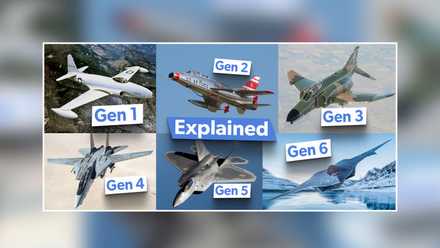
Explained: The 6 Generations Of Fighter Jets
There are six generally accepted generations of fighter jets, with each leap frogging the previous generation.
5
China’s Shenyang J-50
Estimated in service in 2030s

The Shenyang J-50 (also called J-XD or J-XDS) is one of the tailless fighter jets currently in development in China. It emerged in late 2024 and appears to be currently in flight testing. The jet could be a multirole or air-superiority fighter, and it could represent the “low” end of a hi-lo mix with the much larger J-36 also in testing.
This is similar to how China has developed the J-35 as the “low” (but also naval) counterpart to the “hi” J-20. It should be noted that what makes a 6th-generation fighter jet is not the presence or absence of vertical tail stabilizers, but the “brain” of the aircraft and its ability to network and conduct high-end sensor fusion along with electronic warfare and other aspects.
The J-50 is mentioned here, as there has been at least one demonstrator flying since December 2024. This suggests it is a serious program with significant committed funding. It’s only a little exaggeration to say the difference between a credible or uncredible aircraft program is the degree of commitment and funding. It remains unclear whether the J-50 will eventually resemble something closer in capability to what the US Air Force would consider a 5th or 6th generation fighter jet.
4
US Navy’s F/A-XX
Planned in service 2035

The US Navy’s F/A-XX program is another very serious 6th-generation program. The reason why it is ranked 4th on this list is entirely a question of funding. There is currently a dispute within Washington about whether to put the program on ice until the F-47 is developed or fund them both at the same time and risk slowing down the F-47. What is not questioned is the capacity of the US to produce a next-generation carrier-based fighter.
Demonstrators for the F/A-XX are reported to have already flown, and Lockheed Martin is reported to have been eliminated. This leaves Boeing and Northrop Grumman as the two remaining bidders for the contract. The Air Force recently stated that it expects to award a contract for the F/A-XX later in 2026, perhaps in August.
The Navy wants the F/A-XX to enter service in 2035 and start replacing its fleet of F/A-18 Super Hornets and complementing its growing fleet of F-35C Lightning IIs. While the F/A-XX would represent a massive generational leap over the Super Hornet in stealth, air superiority, electronic warfare, etc., one of the most important factors is increased range. The development of missiles and other threats pushes carriers further out to sea, opening up a combat radius that the Super Hornet will struggle with. The F/A-XX is intended to remedy this with a 1,000+ nautical mile combat radius.
3
UK, Japan, Italy’s Tempest/GCAP
Planned in service 2035

The Global Combat Air Programme (GCAP), called Tempest by the RAF, is one of the most credible and well-reported 6th-generation programs. It is a joint effort of the United Kingdom, Italy, and Japan to produce a next-generation fighter to replace their 4th-generation fighters. The Tempest is intended to serve alongside F-35 fighter jets.
BAE Systems is currently constructing the first demonstrator, and the aircraft is expected to fly in 2027. The program is in a somewhat advanced stage of development with a reasonable level of commitment and funding. Unlike FCAS, the Tempest’s main contractors, BAE, Leonardo, and Mitsubishi, have been able to resolve worksharing disputes.
The Tempest is to come with large cantered tail stabilizers, and it appears to be designed for a more generalized set of missions, unlike the heavily specialized F-47 air dominance fighter. Like other 6th-gen fighter jets, the aircraft may be optionally manned for some missions, will have lasers, and will be developed with an emphasis on MUM-T (manned-umanned teaming). It will also feature all-aspect stealth technologies.
2
Chengdu J-36
Estimated in service in 2030s

In 2024, China flew its Chengdu J-36 tailess demonstrator in public for the first time. Since then, more prototypes have emerged, each with design changes that demonstrate rapid prototyping. The large size of the aircraft suggests it is designed to carry enough fuel to have an exceptionally long range.
This could put US enablers, like AWACS and tankers, in serious danger. The range and heavy fuel volume also point to its role operating in the vast expanses of the Indo-Pacific, in an environment where China lacks a large number of tanker aircraft. One of the most notable aspects of the aircraft is that it comes with three engines.
It is possible that the three-engine design is due to China still catching up with engine designs. China has made massive strides in producing its own engines, with its J-20 fighter jets now powered by the WS-15 engine. However, China still relies on Western engines for commercial aircraft, and it has only demonstrated its engines are powerful enough for J-15 carrier operations in 2022.
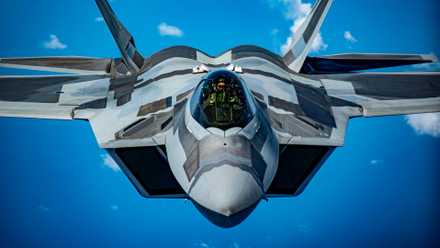
Here’s Why Air Forces Are Expanding Their Stealth Fighter Programs
The global race for the ultimate stealth jet.
1
USAF’s Boeing F-47
Planned in service 2030 (ambitious)

The US Air Force’s Boeing F-47 air dominance program is currently regarded as the world’s leading 6th-generation fighter jet program. It is a dedicated air dominance fighter intended to replace the F-22 Raptor. While some may claim China was the first to openly fly 6th-gen fighter jets in 2024, the US is known to have flown its F-47 demonstrator in 2020. Importantly, the US is now being more coy than China in its next-generation fighter jet development.
While China is flying its demonstrators in public, the US has ensured that no public images of them have emerged. Even the limited official renderings are suspected of including misdirections. The US awarded Boeing the contract in early 2025, with the program quickly becoming a matter of urgency. The first representative example is now in building, with the prototype expected to fly in 2028. The F-47 is now a priority for the Air Force.
The Air Force wants it in service around 2030, which could make it the world’s first in-service 6th-generation combat aircraft, depending on the development timeline of the J-36 and how the B-21 is classified. Importantly, the F-47 is just the manned component of the NGAD program that includes the acquisition of Collaborative Combat Aircraft (aka loyal wingman drones) for fighter jets.