dailynewsnblog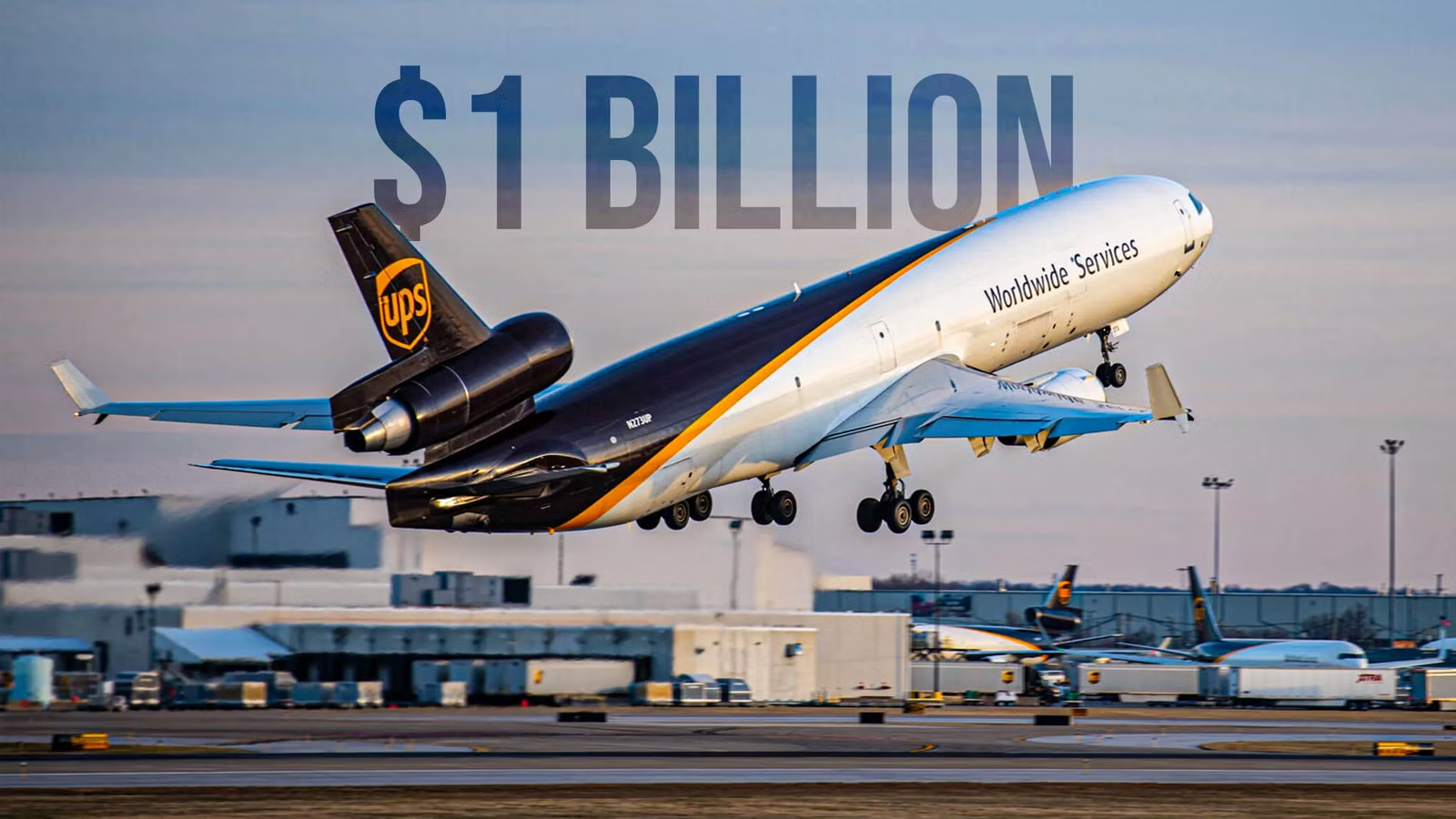
Louisville International Standiford Field Muhammad Ali International Airport is quietly spending more than $1 billion to acquire something it has never had for scheduled passenger operations: an international gateway. The surprising part is that SDF does not need to reinvent its airfield to get there. Decades of investment driven by UPS Worldport have already given the airport an unusually substantial aviation foundation, while passenger growth is creating the demand for more capable terminal infrastructure.
The immediate construction will make the airport easier to use, but the more consequential project is still years away. A 30,000-square-foot security checkpoint with 10 screening lanes is expected to open in early 2027, while a Federal Inspection Services facility targeted for 2029 would provide the infrastructure needed for international commercial passenger arrivals. That creates a more interesting question than simply how much Louisville is spending. What happens when a cargo airport with a growing passenger network finally gets the missing piece required to connect directly to the international market?
Why Is Louisville Spending $1 Billion On A Growing Passenger Airport?

Louisville’s SDF Next program has expanded dramatically from the airport’s original plans. When the program was introduced in 2018, the estimated investment was about $200 million. It has since grown into a capital program exceeding $1 billion, reflecting both the scale of the airport’s ambitions and the infrastructure required to support a larger passenger operation. The airport is not simply adding cosmetic improvements. It is reshaping the terminal and its supporting systems around a passenger market that has grown considerably over the past several years.
That growth is visible in Louisville’s nonstop network. SDF had roughly 24 nonstop destinations in 2018, while the airport’s network has expanded to more than 40 destinations in 2026. Passenger traffic reached a record 4.8 million in 2024 before easing to approximately 4.59 million in 2025. Low-cost carriers including Breeze and Spirit have also expanded Louisville’s options, helping the airport capture passengers who might otherwise travel through larger connecting airports. The result is a market that increasingly has reasons to originate trips locally rather than begin the journey with a connection elsewhere.
But domestic growth alone does not explain why international infrastructure has become the next major piece of the puzzle. Louisville is effectively reaching the point where adding another domestic route and creating an entirely new international capability are two very different infrastructure challenges, and the latter begins with a facility passengers cannot see from the departure hall.
Why Is The FIS Facility More Important Than The New Security Checkpoint?

The new TSA’s New Gatecheck Program Lets PreCheck Members Pass Security Without Flying is the most visible near-term improvement, but the Federal Inspection Services facility is the project that changes what SDF can actually offer. The $45 million checkpoint will cover approximately 30,000 square feet and include 10 screening lanes when it becomes operational in early 2027. That should give the terminal considerably more screening capacity, but security screening alone does not turn a domestic airport into an international arrival point.
International passengers arriving directly from abroad need to pass through federal inspection before entering the United States. SDF’s planned FIS facility, targeted for completion in 2029, is therefore the infrastructure that could enable scheduled international passenger service. Its importance is less about adding another building to the terminal complex and more about removing a fundamental operational limitation. Once international arrivals can be processed locally, airlines have a different set of possibilities when evaluating Louisville as an origin and destination market.
That distinction also changes the timeline for the airport’s international ambitions. The 2027 checkpoint can increase capacity for the network SDF already has, while the 2029 FIS facility creates the possibility of an entirely new category of service. The question then becomes whether Louisville’s existing aviation infrastructure is capable of supporting that change without requiring the airport to build an international hub from the ground up.
How Did UPS Give Louisville A Head Start On International Aviation?

Louisville’s unusual advantage begins well outside the passenger terminal. SDF is the primary hub for  UPS Airlines, one of the world’s largest air cargo operations, and the airport’s cargo activity has shaped its airfield for decades. The airport’s cargo infrastructure is designed around large freighters, including the Boeing 747-8, giving SDF an airfield environment that is already capable of handling aircraft far larger than those typically associated with regional domestic service.
That matters because passenger airports often have to make substantial infrastructure investments before they can accommodate long-haul aircraft. Louisville has already inherited much of that capability through its cargo operation. UPS Worldport covers roughly 5.2 million square feet, while a separate $220 million, 275,000-square-foot UPS hangar can accommodate two 747-8 freighters side by side. The airport also processed approximately 7.49 billion pounds of cargo in 2025. None of that automatically creates international passenger demand, but it means SDF’s airfield and logistics ecosystem were built around a level of aviation activity that is unusual for a passenger airport of its size.
The same investment has produced infrastructure beyond runways and cargo ramps. SDF has developed a large geothermal wellfield and a $32 million microgrid designed to improve resilience, while the airport’s broader aviation activity contributes substantially to Louisville’s economy. The interesting part is that this cargo legacy does not need to disappear for passenger internationalization to occur. Instead, Louisville can potentially use infrastructure built for freight as the foundation for a passenger network that has yet to be created.
Can Louisville Turn Its Cargo Strength Into International Passenger Demand?

The harder question is not whether SDF can physically support international aviation. It is whether enough passengers would consistently use it. Louisville has already demonstrated that passengers respond when more nonstop choices are available. The airport’s expansion from roughly 24 nonstop destinations in 2018 to more than 40 in 2026 has coincided with stronger local demand, while market leakage reportedly fell from about 18% to roughly 7% to 8%. That suggests the airport can retain more passengers when it gives them a compelling reason to start their trips locally.
The Kentucky Derby provides one particularly visible example of how demand can surge, with the annual event drawing a sharp increase in air travel to Louisville and prompting airlines to add capacity from multiple major markets. But an international route cannot rely on one exceptionally busy weekend. A sustainable service would need enough year-round traffic from Louisville and the surrounding region to support the economics of regular international flying, making the airport’s broader business, leisure and connecting potential more important than any single event.
Indicator | Documented Figure | Why It Matters For International Service |
Nonstop destinations in 2018 | ~24 | Establishes the starting point for SDF’s recent network expansion |
Nonstop destinations in 2026 | 40+ | SDF now offers substantially more direct markets than it did in 2018 |
Network expansion | 16+ additional nonstop destinations | Shows how much the airport’s direct connectivity has grown |
Passenger record | 4.8 million in 2024 | Demonstrates the scale of SDF’s local passenger market |
2025 passenger traffic | 4.59 million | Passenger volume remained above 4.5 million following the 2024 record |
Market leakage in 2018 | ~18% | Shows how many travelers were previously leaving the local market for other airports |
Recent market leakage | ~7–8% | Indicates substantially as more travelers are choosing SDF for their trips |
International processing | FIS targeted for 2029 | Provides the infrastructure needed to move from domestic service to international arrivals |
There are also several established models airlines could consider without requiring Louisville to replicate a traditional mega-hub.  Aer Lingus has used Dublin to connect U.S. cities with Europe while offering U.S. preclearance, while Icelandair has built a network around Keflavik that connects North America and Europe through a smaller international gateway. Louisville’s future does not have to follow either model, but those examples illustrate why an airport does not necessarily need the passenger volumes of Atlanta, Chicago or Dallas to participate in international network planning. Once SDF has FIS capability, the question shifts from whether international arrivals are possible to which markets could generate sufficient year-round demand.
What Changes When SDF Finally Opens Its International Gateway?

The biggest change will be operational rather than visual. Today, a Louisville passenger traveling internationally can begin the trip at SDF but may still need to connect through another U.S. gateway before reaching an overseas destination. An operational FIS facility would give airlines the option of bringing international passengers directly into Louisville, allowing SDF to function as the actual origin and destination airport rather than simply the first step toward another hub.
That distinction could matter for both passengers and airlines. A nonstop international flight removes a connection from the itinerary, but it also changes how an airline evaluates the market. The carrier would have to consider aircraft utilization, seasonal demand, local corporate traffic, connecting opportunities, and the competitive environment at nearby airports. Louisville’s existing domestic network could become part of that equation because passengers arriving from smaller surrounding markets could potentially connect through SDF rather than traveling overland to another major international gateway.
For Louisville itself, the significance extends beyond the first international route. An international passenger operation could increase the airport’s strategic value to airlines, businesses and travelers while giving the region another way to connect with overseas markets. But the FIS building will not determine which destinations succeed. That will depend on what airlines see once the infrastructure exists and whether the demand that looks promising on paper can fill aircraft throughout the year.
The FIS Opening Will Determine What Louisville Can Do Next

The real test will begin once the Federal Inspection Services facility is ready in 2029. By then, SDF is expected to have a larger security checkpoint, a more mature nonstop network and decades of cargo-driven infrastructure behind it. The airport will have addressed the physical limitation that currently prevents direct international passenger arrivals, leaving the market itself to determine what comes next.
The measurable milestones will be the routes airlines are willing to operate, the aircraft they choose, and whether those services can maintain sufficient demand beyond Louisville’s strongest travel periods. The airport’s record passenger traffic, expanding nonstop network, and reduced market leakage point to a growing local market, while its relatively modest passenger volumes, as explored in this look at the country’s quieter commercial airports, put SDF’s growth into perspective. Even with that progress, international service requires a different level of commitment from both the airport and the airline.
That makes 2029 less of an endpoint than a starting line. The FIS facility could give Louisville the capability to participate in international passenger aviation, but the first airline to use that capability will reveal something the construction program cannot answer on its own: just how much international demand has been waiting for SDF to become ready for it.