dailynewsnblog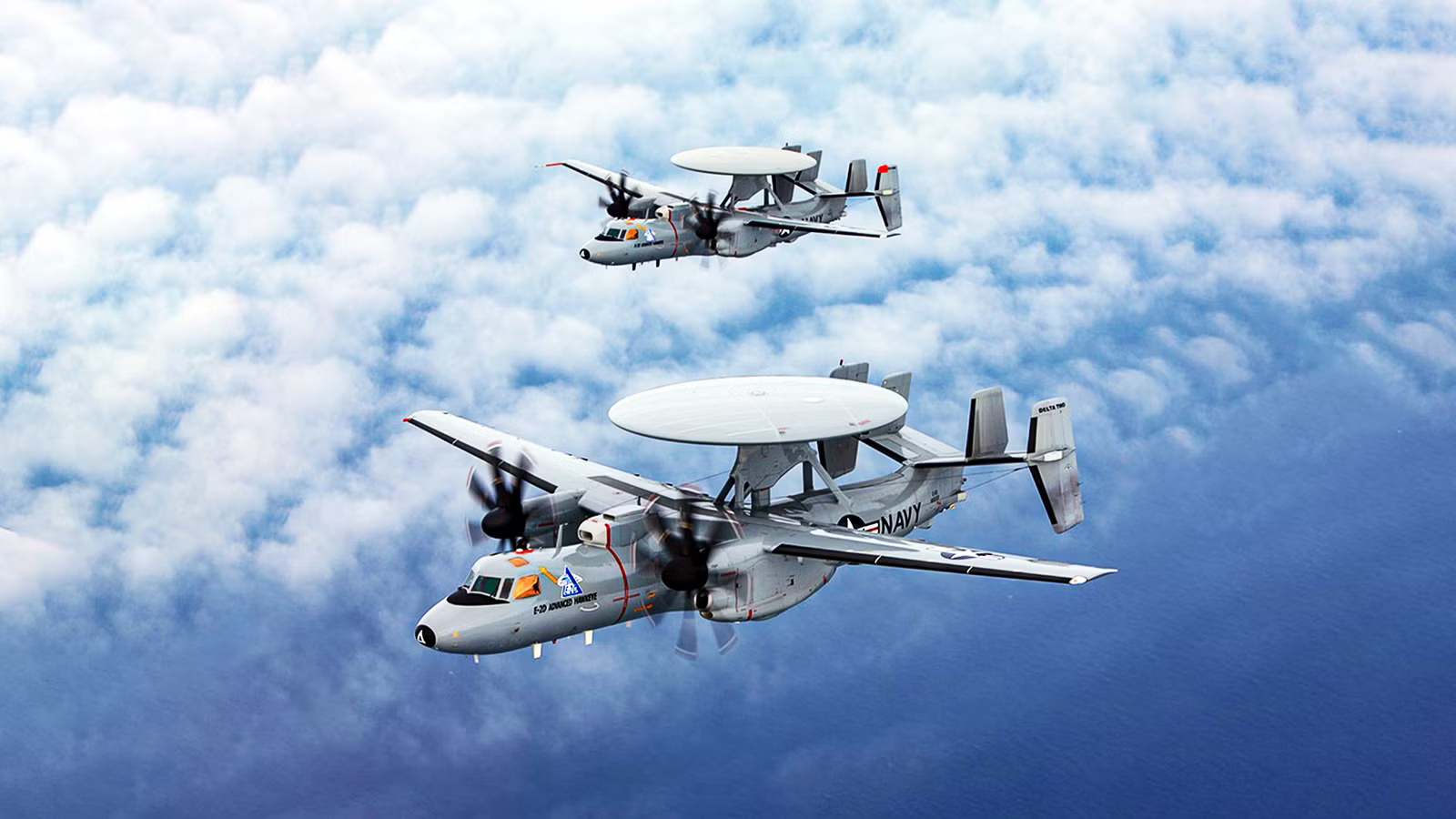
The Northrop Grumman E-2 Hawkeye first entered service in 1964 and has undergone a series of upgrades and modifications over time. It is one of the great unsung heroes of the US Navy’s carrier strike group, serving as the eyes in the sky that detect threats as they approach the task force. The Navy is moving forward with an important new series of upgrades that will enable the Hawkeye to take on a ‘quarterback’ role within the fleet and tie into its networked ecosystem being designed as the future of carrier-based airpower.
The Hawkeye is expected to remain in service into the 2040s, meaning the incoming E-2D Advanced Hawkeye Block II upgrade is planned to operate alongside the Navy’s growing fleet of F-35Cs, early examples of the future F/A-XX, the incoming MQ-25 Stingray, emerging Collaborative Combat Aircraft, and the Super Hornet. Here is what you need to know about the future of the Navy’s less-discussed but critical E-2 Hawkeye family.
E-2D Block II Passed August Design Review

In August 2026, the US Navy approved a modification that will allow Northrop Grumman to upgrade its carrier-based E-2D Hawkeye more quickly. The Block II program passed its critical design review stage, clearing the way for the Portfolio Acquisition Executive Aviation (PAE) to begin flight tests sometime in Fiscal 2029. A core aspect of the upcoming Block II upgrade is the aircraft’s new “software foundation for rapid capability insertion.”
The PAE said, “Representing the next evolution of Delta System Software Configuration 6 (DSSC-6), the Block II upgrade delivers the software foundation for rapid capability insertion.” It also explained, “This modernization introduces state-of-the-art cockpit architecture, increased computing power, an Open Mission Systems framework and robust cybersecurity.”
These upgrades are intended to ensure that the E-2D remains the premier node for airborne command and control. The improvements are expected to keep the aircraft relevant against emerging threats, partly by enabling rapid upgrades. Its new Open Mission Systems architecture helps overcome parts obsolescence. Separately, the Lockheed Martin proprietary lock on the F-35 is one of the biggest regrets the USAF has in the program, with open architecture being a core requirement of the next generation of aircraft.
The Usefulness Of Hawkeyes

The Navy says that the Open Mission Systems approach on the E-2D Hawkeye “supercharges the industrial base” and “delivers next-generation capability to the warfighter at the speed of relevance.” The Hawkeye’s modernized cockpit and flight systems are also designed to significantly reduce pilots’ workload while boosting situational awareness.
The design review follows a $1.19 billion contract awarded to Northrop Grumman in July 2026 for the first three Block II E-2Ds. Hawkeyes are designed to support carrier strike groups and greatly increase the group’s situational awareness. They are built around the mounted AN/APY-9 active electronically scanned array radar and are the most advanced command-and-control aircraft in US Navy service. Following 2026’s Operation Epic Fury against Iran, US Fleet Forces commander Admiral Karl Thomas said that the Hawkeyes were key to detecting both missile and drone threats coming from Iran in the early days of the conflict.
US Navy’s E-2 Hawkeye Family | |
|---|---|
Initially entered service | 1964 |
E-2D Advanced Hawkeye entered service | 2014 |
Block II planned service | 2030 |
Current inventory | 74 |
Requirement | 86 |
Number on order | 22 |
During the WEST 2026 conference, Thomas said, “Quite frankly, it’s the best that we have at detecting that type of thing.” Separately, while the Hawkeye’s basic design dates back more than six decades, China has recently introduced the carrier-based Xi’an KJ-600 for its expanding carrier fleet. The KJ-600 bears a striking overall resemblance to the Hawkeye, reflecting the enduring advantages of a carrier-based airborne early warning aircraft built around a compact twin-turboprop configuration.
Who Operates E-2 Hawkeye Family

As stated, the US Navy contracted for another three E-2D Hawkeyes in 2026, with the first to be delivered in 2030. This marks the end of a brief hiatus in the service’s Hawkeye purchasing (since Fiscal 2024). In Fiscal 2027 budget documents, the Navy has asked for funding to purchase another six Block II Hawkeyes. The Navy says it needs 86 Hawkeyes.
In 2025, the Air Force said it would cancel the purchase of larger, more capable E-7 Wedgetail AEW&CS aircraft and buy five E-2Ds as a stopgap measure. The Air Force is facing a gap between the retirement of its aging fleet of E-3 Sentries and the maturation of more advanced space-based capabilities. However, after Epic Fury, the Air Force said it was recommitting to the Wedgetail. As of the time of writing, it appears the plan to acquire Hawkeyes is abandoned.
Egypt, Japan, Mexico, Taiwan, and France also operate the E-2 Hawkeye family, and Israel and Singapore formerly operated it. Of these, France is perhaps the most notable as it is the only other country to operate them on its aircraft carrier, the Charles de Gaulle. The French carrier’s E-2C Hawkeyes provide the French carrier group with considerably more situational awareness compared with its Royal Navy Queen Elizabeth-class carrier counterparts. Those British carriers can’t operate the Hawkeye because of the ski jump, although they operate more advanced F-35B fighter jets.

When it comes to next-generation or sixth-generation fighter jets, much of the media attention is focused on visible and relatable features such as tailless designs (absent on the GCAP/Tempest), radar stealth, speed, manned-unmanned teaming (MUM-T), and whether or not they will have lasers. Many hallmarks of next-generation aircraft are more mundane, but just as important.
Every kilowatt consumed by powerful radars, electronic warfare systems, and mission computers ultimately becomes heat that must be dissipated. An aircraft’s ability to reject that heat therefore becomes a key constraint on how much electrical power its onboard electronics can continuously use. This is an important consideration for the E-2D Advanced Hawkeye, although it is considerably easier to solve in a larger turboprop aircraft than within the tightly constrained volume of a fighter.
Perhaps one of the most important aspects of next-generation aircraft is rapid and iterative improvements and upgrades. This is why Open Mission Systems in the Block II are so important. Additionally, the Block II comes with much greater processing power for sensor fusion, modern interfaces with fast data handling, and high-capacity tactical data exchange. It provides a foundation for integrating drones and future-generation combat aircraft far more quickly than traditional closed architectures.
Onto A Quarterback

A pitfall in comparing fighter jets (e.g., Su-57 vs F-35) is that modern fighter jets are designed to fit within an ecosystem. While this is still true for the Su-57, it is arguably less important, as the Su-57’s ecosystem is generally regarded as less capable and less mature than the United States’. This distinction was illustrated by the reported downing of a Russian Su-35S in Ukraine.
An older Ukrainian F-16AM—originally a 1980s fighter upgraded through a 2000s Mid-Life Update—was credited with destroying one of Russia’s most capable air superiority fighters. On paper, the Su-35S enjoys advantages in radar performance, range, and kinematics. The crucial point is that the engagement was unlikely to have been decided by the F-16 alone. Russian military channels and several subsequent analyses suggested the fighter was operating as part of a wider kill chain that may have included other F-16s and ground-based sensors such as a Patriot radar, although the precise sequence of events remains unconfirmed.
The ecosystem—not merely the aircraft—may have been decisive. For the US Navy, that is precisely the role envisioned for the E-2D Advanced Hawkeye. It is intended not only to be a radar aircraft, but increasingly to perform the ‘quarterback’ role once associated with an AEW&CS aircraft. It will see, fuse, distribute, and command. Its three mission operators will manage the battle in a way that would be extremely difficult to replicate inside a single-seat stealth fighter.
Evolution Into One Of Several Nodes

Navy and Northrop officials frame Block II’s open architecture explicitly as the bridge to “sixth-generation command and control” — not a sixth-gen aircraft itself. Instead, the upgrade is to be the connective tissue that lets the E-2D quarterback a mixed fleet of manned sixth-gen fighters (like the Navy’s planned F/A-XX) and unmanned systems.
The Navy is planning a future fleet of stealth F-35C fighter jets with a fleet of sixth-generation F/A-XX fighters, as well as legacy Super Hornets serving well into the century. Other key nodes include future Collaborative Combat Aircraft, the MQ-25 Stingray tanker drone, Aegis-equipped destroyers, and a growing range of aerial and surface sensors.
The Hawkeye is expected to remain in service into the 2040s. Over time, the Navy intends to shift an increasing share of sensing and tracking into space, but it has consistently argued that carrier strike groups still need complementary airborne capabilities if space-based assets are degraded, disrupted, or denied. In the longer run, the Navy is designing the future Hawkeye to be one of several sensor nodes, while avoiding it becoming a single point of failure.