dailynewsnblog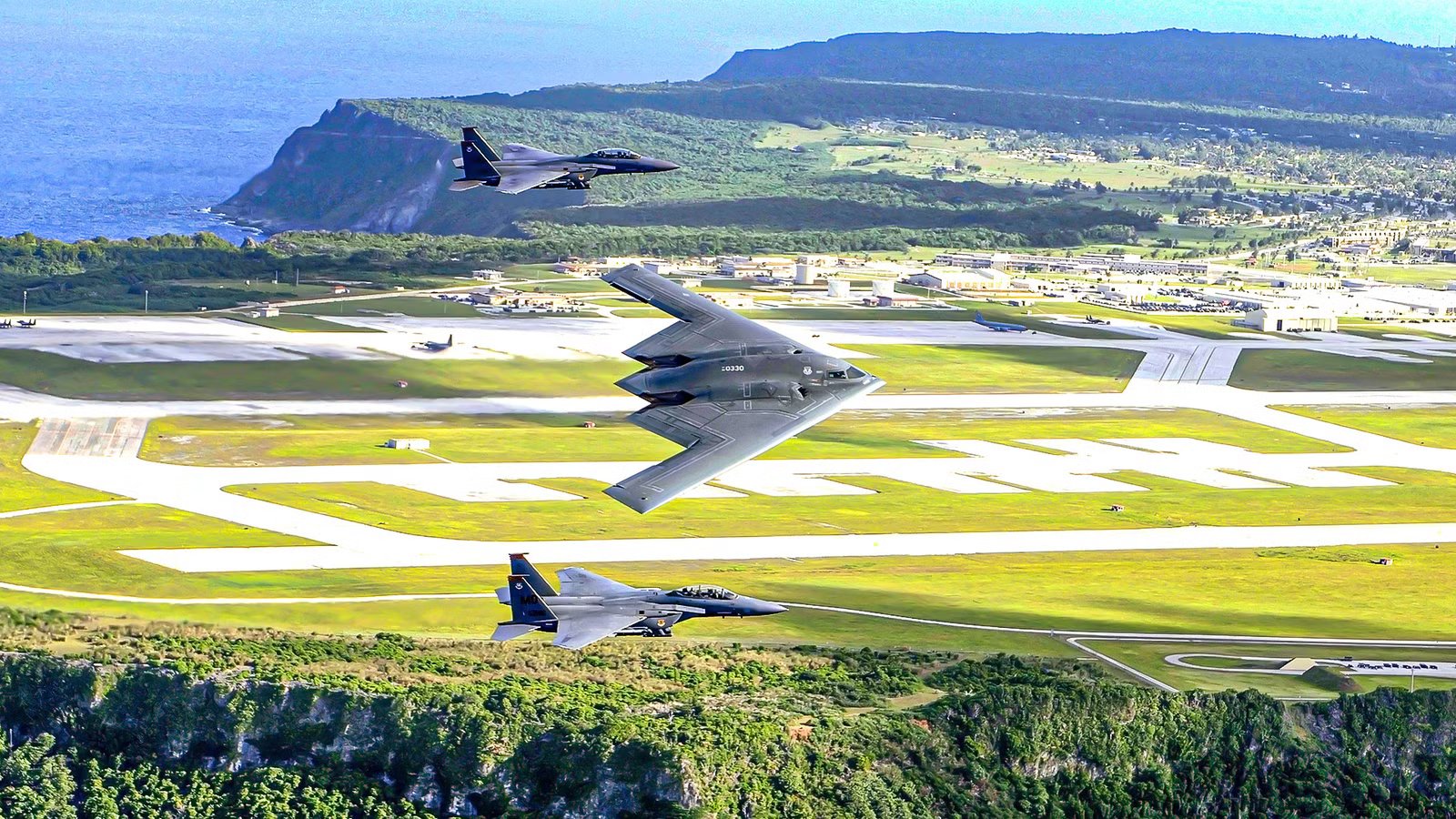
As the US military draws down its presence in Europe and the Middle East to ‘Pivot to the Pacific,’ the United States Air Force is making major investments in infrastructure for greater operational tempo and larger deployments. Andersen Air Force Base (UAM) represents one of the most important sites in the second island chain that supports the entire Indo-Pacific theater.
Andersen is one of the few bases that is host to critical platforms like the Northrop Grumman B-2 Spirit stealth bomber. As such, the USAF is moving forward with a plan to pour 20 acres of concrete that will dramatically expand apron parking. This construction program was originally intended to be part of an expanded joint facility with the Republic of Singapore Air Force, but since they dropped out, the USAF is still pushing ahead.
The reason for the continued push lies in the Air Force’s rapidly increasing focus on agile combat employment, which emphasizes flexibility and unpredictability. The USAF wants to move away from using predictable airbases for the same high-value platforms as stealth bombers as it introduces the world’s first sixth-generation aircraft, the NG B-21 Raider. Relating back to the construction choices, these planes do not benefit from new shelters significantly compared to the value of simply adding a lot more ‘parking spots’ at the airfield.
Andersen & Agile Combat Employment

The decision to pour massive open aprons at Andersen Air Force Base, rather than building protective shelters, reflects a fundamental shift in how the Pentagon plans to survive a missile exchange in the Indo-Pacific. In a conflict with China, permanent hangars are liabilities. Modern satellite imagery ensures their exact coordinates are mapped, making them easy targets for long-range ballistic and cruise missiles. Instead of trying to absorb a missile strike with concrete walls, the Air Force is betting on speed and mobility through its ACE operational concept.
Fifth-generation stealth fighters, including Air Force Lockheed Martin F-22 Raptors and F-35 variants from the Air Force, Navy, and Marine Corps, operate on the leading edge. Because their stealth profiles require carrying weapons internally, their magazine depth is limited. Their primary role is to penetrate contested airspace, map enemy radar and missile batteries, and securely data-link those coordinates to the rest of the fleet. The heavy ordnance is carried by non-stealthy or long-range platforms sitting further back.
The Boeing F-15EX Eagle II, which lacks stealth but boasts a 29,500-lb (13,380 kg) payload capacity, acts as a standoff missile truck. It can fire outsized hypersonic weapons at the targets identified by the F-35s. This firepower is augmented by B-52 and next-generation B-21 bombers executing long-range strike sorties out of Andersen’s expanded parking slips.
Simultaneously, Navy P-8 Poseidon aircraft utilize the base to sustain continuous maritime patrol loops, securing the sea lines of communication and tracking adversary submarine movements in the Philippine Sea.
Building The Air Force Of The Future

Smaller than the B-2 before it, the Raider can fit into a standard fighter shelter. However, the Air Force has chosen not to build these in order to still accommodate larger planes like the upcoming upgrades that will transition the longest-serving bombers to a newly digitalized standard. The Boeing B-52J Stratofortress will serve as a missile truck that supports the stealthy B-21 in the new Hi-Lo Fleet of the Air Force Global Strike Command.
Together, these two platforms will be the core of the new strategic strike force. At the same time, the US Air Force wants to accommodate a wider range of both its own aircraft and joint assets like the Boeing P-8A Poseidon Maritime Patrol aircraft. Based on the 737-800 airliner airframe, the Poseidon is a critical aircraft in the Pacific Theater, serving as the US Navy’s primary MPA. It is also flown by other regional allies like Australia, New Zealand, Singapore, South Korea, and even India.
Alongside these front-line combat planes are a host of transports and tankers that frequent the same air bases to support operations that deliver supplies. The Lockheed C-5M Super Galaxy does not need pristine tarmac to land on, but it does have a massive wingspan like the B-52. The Boeing KC-135 Stratotanker, which is based on an airframe similar to the iconic 707, is approaching the end but is still vital. Its successor, the Boeing KC-46A Pegasus, is even bigger, being based on the company’s 767 wide-body airframe.
Adding a huge amount of real estate to the airfield at Andersen will make it a far superior staging and launch point for operations into the first island chain. It will also make it an even more valuable rally point for the air bridge between the continental United States and expeditionary forces deployed to the Pacific.
Punch List: Everything But The Kitchen Sink

The airfield is getting upgrades to more than just concrete. New fuel storage and refueling infrastructure will expand the capacity of the airfield as well as expedite hot pit refueling operations for higher ops tempo. This complements the more flexible parking on the apron, which is not obstructed by the hard shelters that would otherwise dictate limitations on wingspan and lead to wasted time shuffling planes around. There will also be major upgrades to the stormwater management system to ensure that the facilities can withstand even the heaviest monsoon rains without diminished capacity.
To protect its new investments, the base will be getting an $8 billion enhanced integrated air defense system to protect everything on the ground. The system will create a 360-degree multi-layer defensive shield with 16 different batteries scattered across Guam, according to Arms Control. The defense architecture is designed to intercept threats at different altitudes, ranging from high-altitude ballistic down to low-altitude cruise missiles and drones.
The Air Force is also allocating multimillion-dollar contracts for renovations to secure communications and personnel barracks. The greater concentration of aircraft means more troops and equipment. At the same time, more advanced airframes require more advanced sustainment technology as well as higher security to protect classified equipment and information. These investments will ensure that all the aircraft deployed to Andersen, as well as the service members who operate them, can perform to their highest potential.
Catch what other flight trackers miss
Emergency squawks, holds, NOTAMs — live signals, no signup.
Open tracker
Catch what other flight trackers miss
Emergency squawks, holds, NOTAMs — live signals, no signup.
Open tracker
How The Raider Changes The Game

The ACE doctrine demands dispersed deployment to a wide range of bases across a theater and continuous repositioning in order to both provide maximum support for friendly forces and ensure unpredictability to the enemy. The B-21 will be far more lethal and far more rugged than its predecessor, the B-2 Spirit, which was notoriously felled by rain despite never losing a plane to combat. It can operate from smaller, austere, or allied airfields that couldn’t accommodate the massive B-2, making it far more flexible in regions like the Indo-Pacific.
The crash responsible for the destruction of the only B-2 written off from a mishap took place at none other than Andersen AFB. On February 22nd, 2008, ‘Spirit of Kansas’ was parked overnight outside on the tarmac at Andersen AFB. A flight of B-2s was in transit back to the continental United States when they were forced to make an overnight stop due to weather factors. That night, the island of Guam experienced a torrential downpour of rain. The next day, the jet lifted off and immediately came crashing back to earth due to an avionics malfunction.
The B-21 benefits from a baked-in radar absorbent material coating that eliminates this susceptibility to water. Plus, the smaller airframe of the Raider allows it to deploy to bases that were not possible with the Spirit. The Raider can deploy to hardened shelters and runways made for standard fighter jets during the Cold War, which exponentially opens up its deployment options. Not only does this make it more combat-effective, but this actually significantly reduces the ability of an adversary in a near-peer conflict to target the B-21 on the ground.
The B-21 is estimated to be 10% to 20% smaller in wingspan than the B-2 based on the limited amount of information released to the public. That is based on the Spirit being 172 feet (52.42 meters) wide, and the Raider is expected to be between 132 feet and 150 feet (40.2 and 45.72 meters) wide. Similarly, it won’t have just two engines, whereas the B-2 has four, and its overall payload is expected to be 25% to 30% lower. The B-2 can carry over 330,000 lb (149,685 kg), but the B-21 will haul 225,000 to 260,000 lb (117,934 kg).
The Timeless Value Of The Stratofortress

The newly upgraded B-52 will be a cornerstone of the Air Force’s Agile Combat Employment doctrine. The B-52J will receive a myriad of new communication systems to allow it to serve as a flying command center, functioning as a major hub for data on the battlefield. The BUFF is finally receiving Link 16, the standard jam-resistant tactical data link used by NATO and the US military. This allows the bomber to share a common operating picture with F-35 fighters, Navy destroyers, and Patriot missile systems. This is a fundamental element of the Air Force’s doctrinal shift to the next era in air warfare.
In addition to these upgrades, the Commercial Engine Replacement Program encompasses a $2 billion transformation from the B-52H to the B-52J. The CERP will replace the 1960s-era TF33 engines with eight Rolls-Royce F130 turbofans. According to The Aviationist, these engines are expected to be 30% to 40% more fuel-efficient. The advantage the Air Force gains from that additional loiter time and range is compounded by a feature it has had since it was first built: the cartridge start.
Unlike many aircraft, which require a lengthy preparation on the ground, the BUFF can launch in just 10 minutes. The B-52 is capable of a cartridge start, allowing it to start all eight engines simultaneously and take off rapidly. Recent exercises have demonstrated that B-52s can land at non-bomber airfields, receive rapid repairs and resupply, and be back in the air within a few hours. Its 8,800-mile (14,162 km) unrefueled range also allows it to reposition quickly across the vast expanse of the Pacific.