dailynewsnblog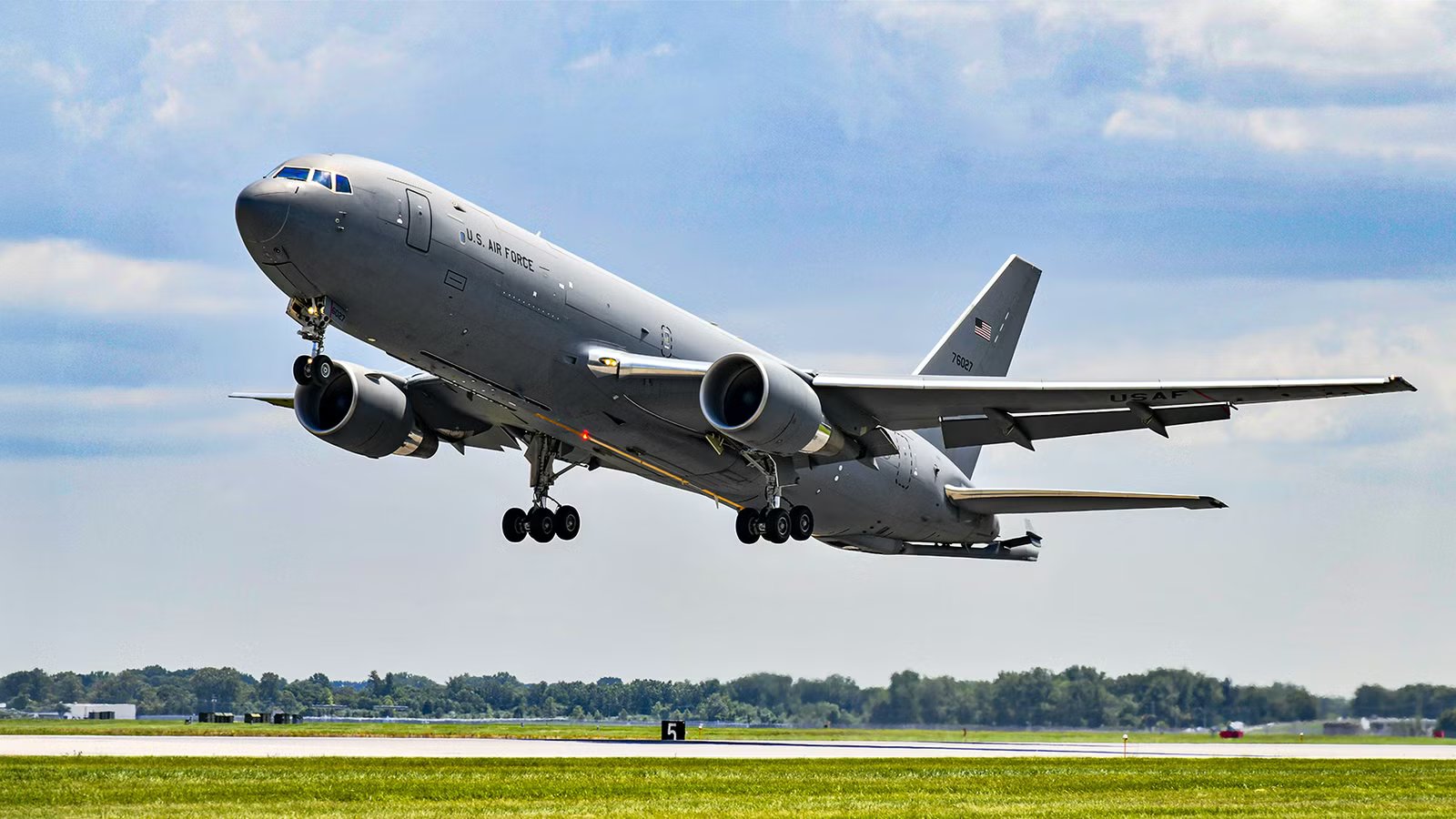
The Boeing KC-46A Pegasus is meant to be the US Air Force’s successor to the iconic and long-serving KC-135 Stratotanker. Yet, seven years after the type began the process of achieving full operating capability, it has yet to be stationed at overseas air bases alongside its predecessor from the Eisenhower era. The cause is essentially due to the ongoing technical difficulties and production delays caused by  Boeing’s engineering deficiencies.
As a kind of Frankenstein plane made from parts of three different 767 variants and a host of custom military hardware, the Pegasus is one of the most complex non-tactical aircraft ever built. It is also one of the most notoriously delayed and problematic programs in Boeing’s currently beleaguered defense division. Since the plane is both unreliable and incapable of its full mission set, it simply cannot assume forward deployment on a permanent basis yet.
This situation has forced the Stratotanker to remain the frontline provider of aerial refueling to combat aircraft from the Middle East to the Pacific. It is, however, true that KC-46 crews are deployed on temporary expeditionary assignments around the globe. Eventually, the US Air Force plans to keep about a third of the fleet permanently positioned at various airfields across the Pacific as part of its new Agile Combat Employment doctrine, or ACE.
The Problem With The Pegasus

The US Air Force keeps all its active KC-46A Pegasus main operating bases inside the continental United States. While the service frequently sends these tankers to the Pacific for short-term exercises and expeditionary operations, none are permanently stationed there. Centralizing the fleet at domestic hubs like Travis Air Force Base lets the military protect multi-million-dollar airframes from overseas wear while maintaining a fleet capable of rapid refueling across the globe.
This domestic strategy directly addresses the tactical vulnerabilities of the Western Pacific. Permanently parking a large portion of the new tanker fleet at predictable, static bases like Guam or Okinawa makes them prime targets for long-range ballistic and cruise missiles. To counter this threat, the Air Force utilizes its ACE doctrine, keeping permanent assets safely stateside and rotationally pulsing them into distributed bases.
Keeping the relatively young KC-46A fleet stateside simplifies logistics for ongoing technical problems. The aircraft still requires rolling hardware updates and specialized parts pipelines that remain heavily concentrated at domestic depots. Because the older KC-135 Stratotanker possesses a universally established global supply chain, the military prefers to leave those legacy jets stationed at forward overseas locations while keeping the newer Pegasus tankers close to domestic maintenance infrastructure.
The Air Force’s Troubled Successor To A Core Mission

The Air Force operates its aerial refueling fleet on a centralized hub-and-spoke model. The hubs are heavily fortified main operating bases located deep within the continental US, like Travis AFB. The spokes are temporary, decentralized forward locations scattered across the Pacific. Instead of parking expensive tankers permanently overseas, the Air Force centralizes the fleet at home, using it as a continuous conveyor belt that flies into the theater, conducts the mission, and rotates back.
Many new spokes are temporary, decentralized forward locations scattered across the Pacific theater, ranging from major facilities like Andersen AFB in Guam to civilian fields or remote island strips. Meanwhile, permanently stationing the KC-46A overseas has been severely delayed because of critical technical deficiencies. The plane’s original Remote Vision System suffered from severe glare and depth distortion, risking catastrophic midair collisions.
Until the RVS 2.0 retrofit is fully integrated across the production line and older models are upgraded, the Air Force will continue to rely heavily on its reliable, fifty-year-old KC-135 Stratotankers for a permanent overseas presence, keeping the advanced but troubled KC-46A anchored at domestic hubs.
The issue goes beyond vision systems, as mechanical setbacks have repeatedly stalled frontline readiness. The program has been hit by rigid boom telescope actuator malfunctions, parts shortages, and manufacturing quality issues, culminating in a freeze on aircraft acceptance due to structural cracks discovered in aileron hinges. As a direct result, the maintenance infrastructure cannot yet support permanent overseas basing. Until the RVS 2.0 retrofit is fully integrated, the Air Force will rely on older KC-135 Stratotankers for overseas presence while keeping the troubled KC-46A stateside.
The Stratotanker Continues To Carry The Burden

The paradox of depending on KC-135 from the 1950s for crucial frontline operations while keeping the new KC-46 in the US boils down to supply chain realities and risk. Since the heir to the tanker mission cannot yet handle the task in full, the USAF must keep flying an aged aircraft beyond its useful life. Therefore, the Stratotanker did receive life-extension and digital avionics upgrades to serve beyond 2050.
Even with iterative improvement, the KC-135 airframes are aging quickly. Chronic parts shortages and structural fatigue plague the fleet, forcing maintenance teams to remove parts from grounded planes. As exemplified by the tragically fatal accidents that have occurred in the past year in Alaska as well as the Middle East. These older tankers also lack sophisticated electronic warfare jamming technology, which makes them exceedingly exposed in disputed airspace.
Despite its tactical vulnerabilities, the KC-135 remains stationed at forward bases like Kadena and Al Udeid because of its reliability and full mission capability. It persists because the legacy platform has a mature system and support base built over seventy years of active duty. Every major USAF base has the tools, spare parts, and technical skills to keep a KC-135 flying smoothly for daily operations. In contrast, the digital KC-46A Pegasus lacks the infrastructure, compounded by severe technical deficiencies. Permanently stationing the KC-46A overseas right now would risk grounding the aircraft indefinitely at a remote location if a specialized component failed. To overcome this, the Air Force is gradually implementing a phased integration strategy.
The Pivot To The Pacific & Pegasus’ Vital Role

On the battlefield tomorrow, the USAF future warfighting concept hinges on maximum mobility and dispersed operations across the first and second island chains in the Western Pacific Theater. As the region of greatest operational concentration and complexity, the KC-46 is not only vital as a replacement for an old jet but a massive technological leap forward that will empower the entire Joint Force collectively.
The Pacific battle plan relies heavily on Joint All-Domain Command and Control and the Advanced Battle Management System. Stealth assets like the Lockheed Martin F-22 Raptor, F-35 Lightning II, the future sixth-generation Boeing F-47, and Collaborative Combat Aircraft have unique data links to avoid enemy detection. Although eventually, all of these platforms will be integrated into one ‘combat cloud,’ platforms like the Pegasus will be vital to extending the range of tactical aircraft back to major C2 sites.
Stationed safely outside the immediate threat envelope, the Pegasus acts as a tactical line-of-sight radio bridge for a unified mesh network. Because the Pacific theater features vast over-the-horizon distances, line-of-sight radios on low-flying assets are cut out due to the curvature of the Earth. By flying at 35,000+ feet (10,668 meters), the KC-46 serves as an elevated, high-altitude relay station. It captures the incoming signal and rebroadcasts it further down the chain, extending the radio network’s geometric range over thousands of miles of open ocean.
CJADC2: Achieving Information Dominance To Win The Day

Historically, military branches built proprietary systems that could not communicate with each other. The Pentagon is actively realizing this ‘any sensor, the best effector’ framework through a large number of combined defense projects, making virtually any player on the battlefield of tomorrow a sensor and a receiver for one giant ‘picture.’ The KC-46 will be one of the more valuable players in this network because of its persistent presence at standoff distance from the frontline.
To create a single picture from millions of data points, individual platforms no longer process data in silos. CJADC2 pulls many radar tracks, infrared satellite signatures, and drone video feeds into a unified Data Integration Layer. When every asset is part of a self-sustaining mesh network, the primary danger in the Pacific is the physical limitation of signal travel. This fully integrated architecture highlights why the KC-46 is a physical range and network-relay bridge, rather than a sensor or flying server itself.
Equipping the Pegasus with a state-of-the-art data link is part of Boeing’s vision for the Air Force to make the KC-46A the ultimate multirole airborne support asset for the Joint Force of the future. The Pegasus is meant to simultaneously deliver massive upgrades in airlift and aerial tanking performance.
The Air Force Levels Up Its Tanker Fleet

The KC-46A Pegasus was designed to replace both the 707-derived KC-135 and the massive, tri-engine KC-10 Extender. The exit of the DC-10-based KC-10 created a major capabilities gap in the Pacific because the Extender was a widebody giant that could carry 356,000 pounds (161,478 kg) of fuel. On a legacy KC-135, loading up cargo or passengers means making a massive trade-off because the fuel tanks and cargo space share a more restrictive airframe based on the 707 single-aisle jetliner.
Boeing engineered the Pegasus by combining the shorter fuselage of the 767-200ER with the ruggedized wings, heavy-duty landing gear, and reinforced cargo floor of the 767-300F freighter. They also integrated advanced wing flaps from the 767-400ER and paired the entire airframe with a modern digital cockpit.
That widebody fuselage allows Boeing to pack the entire 212,000-pound (96,161 kg) fuel payload completely under the main deck. This leaves the entire upper deck wide open, enabling the Pegasus to carry 18 standardized cargo pallets or over 100 passengers at the same time it carries a full tank of gas.
Even though the retired KC-10 could carry more total raw fuel, its massive physical footprint meant it could operate only from giant, well-established main operating bases like Guam or Travis Air Force Base. It could never land on the smaller, austere runways or reactivated World War II island strips that the Air Force is relying on across the First and Second Island Chains.
Once the airframe fixes are fully integrated, the KC-46A will transition to permanent overseas basing, stepping directly into the strategic cargo and fueling void left by the retired KC-10 while providing the survivable network data bridge that the narrowbody KC-135 simply cannot.