dailynewsnblog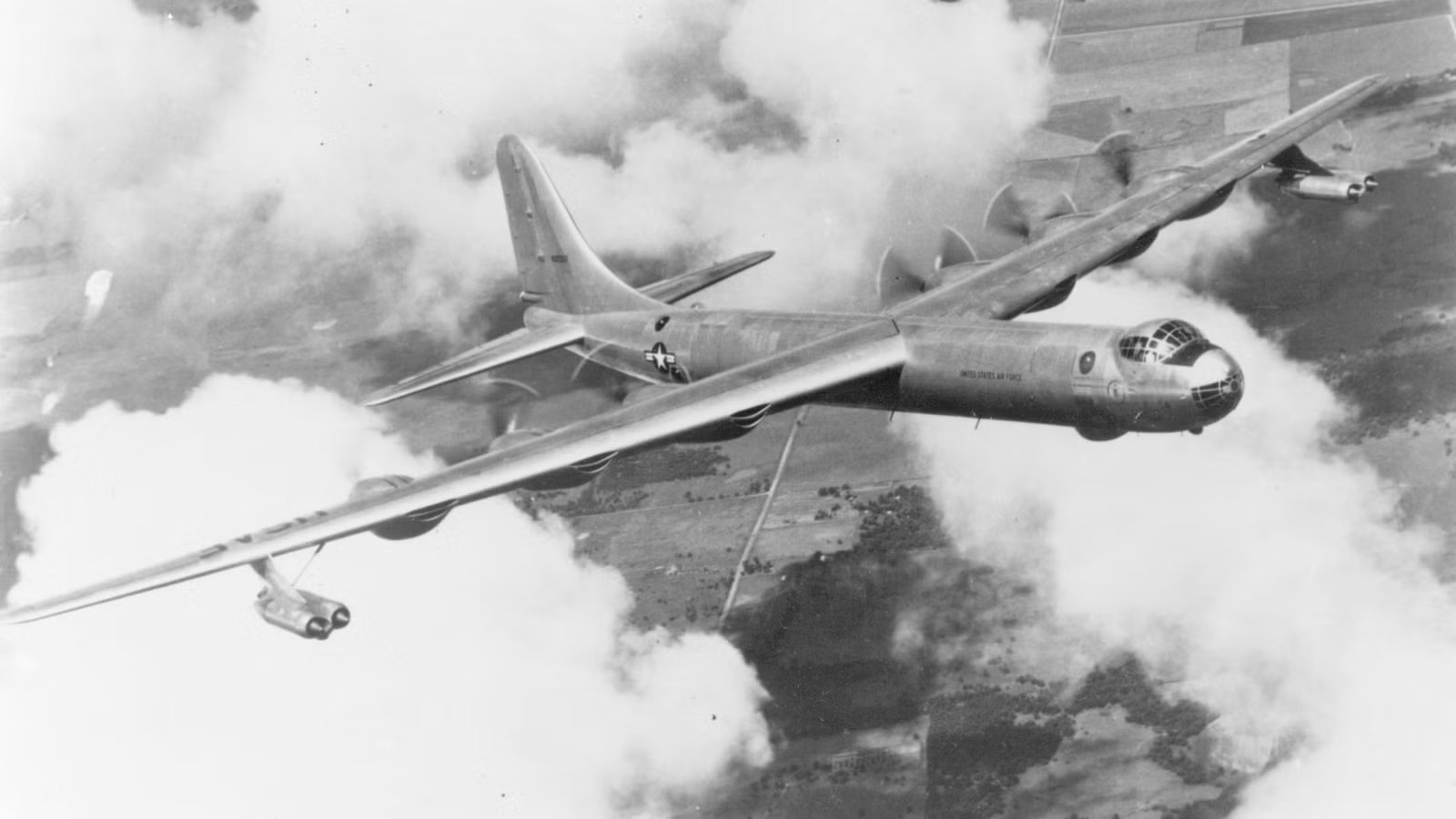
The Convair B-36 Peacemaker strategic bomber is one of the most ambitious bombers ever built. While the unusual pusher configuration of its six Pratt & Whitney R-4360 Wasp Major piston engines is perhaps its most distinctive feature, later variants also carried four General Electric J47 turbojets. These jets were added to improve take-off performance, climb rate, and high-speed dash capability, helping keep the enormous bomber operationally relevant.
This remained the case until newer all-jet bombers, particularly the B-52 Stratofortress, assumed the primary nuclear deterrence role. The US Air Force procured 384 B-36s, each capable of carrying up to 86,000 lb (39,000 kg) of bombs. Although none remain airworthy today, four complete aircraft have been preserved in museums, where they provide a reminder of the largest piston-engined combat aircraft ever placed into operational service.
The First Purpose-Built Nuclear Strategic Bomber

The Convair B-36 Peacemaker was the largest bomber built by the US, and it can be thought of as the most important transitional bomber ever built. The US Air Force Museum states that “responding to the U.S. Army Air Forces’ requirement for a strategic bomber with intercontinental range, Consolidated Vultee (later Convair) designed the B-36 during World War II. The airplane made its maiden flight in August 1946, and in June 1948 the Strategic Air Command received its first operational B-36.”
The museum also explains that “some B-36s served as photographic reconnaissance aircraft, and others were adapted to launch and retrieve specially modified RF-84F/K reconnaissance planes.” Although conceived during the Second World War as an ultra-long-range conventional bomber, the B-36 entered service as the United States shifted towards a strategy centred on delivering nuclear weapons across intercontinental distances without relying on overseas bases.
This remains a central mission of the world’s current strategic bombers (B-52, B-1B, B-2, B-21, Tu-160, and Tu-95MS). The Peacemaker’s origins date to 1941, which is before the US even entered the Second World War. There was a fear in the US that the UK could fall to Germany, and if that happened, the US would lack a forward base for its bombers to raid Germany. As such, the requirements for the bomber included that it could fly intercontinentally from North America to Europe.
The First Bomber Designed For A Nuclear Role

Designing and developing the bomber took time, and by the time it entered service in 1948, the Second World War had been over for three years. As things had panned out, the US had been able to use Britain against Germany, and had island-hopped to bring its B-29s within range of Japan.
However, the delays in designing the bomber also allowed engineers to update the design to carry the heavy nuclear bombs that weighed around 8,800 to 11,000 lbs (4,000 to 5,000 kg) and even the extremely heavy hydrogen bombs. The first experimental thermonuclear devices weighed tens of tonnes, while the first operational hydrogen bombs introduced in the early 1950s typically weighed around 30,000–42,000 lb (14,000–19,000 kg).
Convair B-36 Peacemaker Specs (Per US Air Force Museum) | |
|---|---|
First flight | 1946 |
Years of service | 1948 to 1959 |
Payload | 86,000 lb (39,000 kg) |
Number built | 384 |
Primary powerplant | 6x Pratt & Whitney R-4360 Wasp Major piston engines |
Supplementary powerplant | 4x General Electric J47 turbojets |
The Peacemaker was designed with the gigantic bomb bay doors needed to carry these bombs that no other aircraft could. When it entered service, it was able to carry around 86,000 lbs (39,000 kg) of payload, vastly more than any other bomber. With the establishment of the Strategic Air Command in 1946, the B-36 became the first true intercontinental nuclear bomber.
The world’s geostrategic picture changed in 1949 as the Soviet Union exploded its first atomic bomb. Then, the US pivoted to requiring a bomber able to strike targets deep inside the USSR while using bases in the continental United States and be able to carry heavy first-generation nuclear bombs. This is something the Boeing B-29 Superfortress couldn’t do, but was very similar to what the B-36 was originally designed for.
Why The B-36 Was Initially Successful

With the benefit of hindsight, the B-36 was always likely to be overtaken by the rapid pace of jet-powered aviation. It was conceived during the Second World War, but was ultimately built for a very different strategic environment. At first (late 1940s to early 1950s), the B-36 was unmatched.
No fighter could reliably intercept the Peacemaker at its high operating altitude (around 40,000 feet or 12,000 meters, later extending to 45,000 feet or 13,700 meters). This was before the USSR developed an integrated air defense network and a time when early Soviet jet fighters struggled to reach and engage such high-flying targets.
The Peacemaker’s enormous range also allowed it to approach the USSR from multiple directions, further complicating interceptions. But the B-36 was becoming a relic of a bygone era. It was designed before jet-powered strategic bombers were practical. By the mid-1950s, new Soviet jet interceptors like the MiG-17 and then MiG-19 made it increasingly vulnerable.
This worsened with the development of increasingly capable radar-guided air defense systems, surface to air missiles technology. The arrival of the all-jet B-52 Stratofortress further hastened the B-36’s retirement by offering greater speed, improved survivability, and comparable intercontinental range. Perhaps somewhat similar, the arrival of the B-21 will inevitably increase pressure to retire the older, expensive, and less survivable B-2 Spirits.

By the time it entered service, the B-52 was in development, but was still years away. The Peacemaker was primarily powered by six enormous 28-cylinder Pratt & Whitney R-4360 Wasp Major piston engines arranged in a distinctive pusher configuration. However, these were too slow in the emerging jet age. In an effort to bridge the gap, the US Air Force invested heavily in modernizing the Peacemaker with four General Electric J47 turbojets.
The J47 turbojet engines were mounted in two twin-engine pods beneath the outwings and earned it the famous slogan “six turning and four burning.” They were not intended for continuous cruise as they were incredibly fuel inefficient. Instead, they were used for heavy-weight takeoffs, improved climbing, increased dash speed in hostile territory, and reduced time spent over defended targets.
The USAF looked for other ways to improve the performance of the Peacemaker. It introduced the Featherweight modification programs, which removed defensive armament, ammunition, armor, and other equipment to improve altitude, range, and speed. The B-36 was given improved electronics, while the RB-36 strategic reconnaissance variant was also developed.
Why The B-36 Couldn’t Survive The Jet Age

The Air Force Museum states that “powered by six Pratt & Whitney R-4360 engines, the B-36J cruised at 230 mph [200 knots], but for additional bursts of speed its four General Electric J47s increased the maximum speed to 435 mph [378 knots].” Ultimately, the improvements addressed symptoms, but were unable to fix the underlying problem, which was that the B-36 just didn’t belong in the jet age.
Relying on piston engines, the B-36 was too slow, typically cruising at 200 knots (378 knots at maximum speed). The B-47 Stratojet could cruise at 434 knots, and the B-52 at 456 knots. By the mid-1950s, increasingly capable Soviet jet interceptors such as the MiG-17 and MiG-19, together with radar-guided surface-to-air missile systems including the S-25 Berkut and later the S-75 Dvina, steadily eroded the B-36’s survivability.
The Peacemaker faced other pressures. For example, the complex push-configuration radial engines frequently overheated, caught fire, and required changing a staggering 336 spark plugs per service. The massive size of the aircraft also demanded immense resources to maintain and operate.
The final B-36 Peacemaker was retired in 1959, just one year before a Soviet S-75 Dvina (SA-2) downed a Lockheed U-2 spy plane at an altitude of around 70,000 feet. The development contributed to the program that would give rise to the SR-71 as well as contributed to the abandoning of the XB-70 Valkyrie bomber.
Why The Peacemaker Was Forgotten

Today, the Peacemaker is largely forgotten in popular memory. It is overshadowed by the earlier B-29 Superfortress, which entered service too late to make a difference in Germany but in time to play a pivotal role in ending the War in the Pacific, including dropping the nuclear bombs on Japan. The B-36 arrived too late for the Second World War, but it was also ill-prepared for the realities of the Cold War and the jet age.
It was quickly overshadowed by the early Cold War Boeing B-52 Superfortress that entered service in the mid 1950s and continues in service today. These two successful bombers have had the effect of pushing the Peacemaker out of popular imagination. Unlike the B-29 and B-52, relatively few B-36s were preserved after retirement, with only four surviving in museums. None remain airworthy.
These can be seen at the National Museum of the United States Air Force, Pima Air & Space Museum, Strategic Air Command & Aerospace Museum, and Castle Air Museum. Making matters worse for the Peacemaker is that it was never used in combat. It entered service after the Second World War, was absent from the Korean War, and had disappeared by the time of the Vietnam War, when the B-52s were very active.
Catch what other trackers miss
Emergency squawks, holds, NOTAMs — live signals, no signup.
Open tracker
Catch what other trackers miss
Emergency squawks, holds, NOTAMs — live signals, no signup.
Open tracker