dailynewsnblog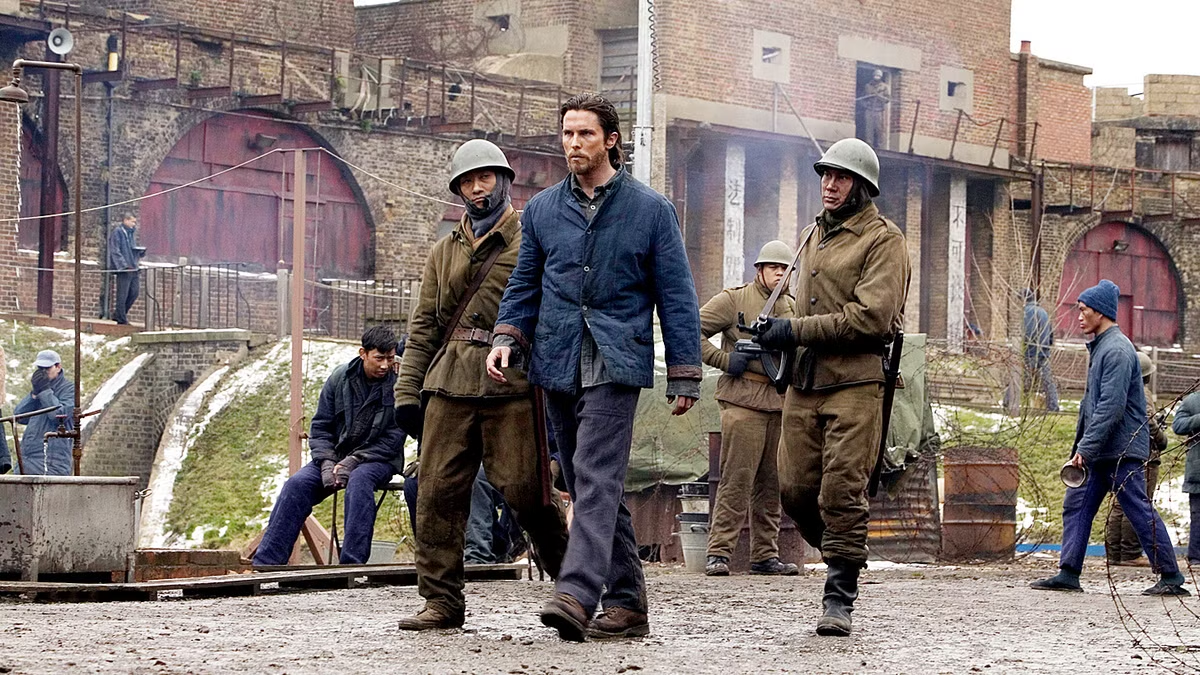
As Christopher Nolan’s adaptation of The Odyssey is dominating the box office, many are comparing it to the director’s previous film, Oppenheimer. Because they were made back-to-back, it’s a natural comparison, and there certainly is a thematic connection. Oppenheimer, like The Odyssey, is the story of a man grappling with the choices he made during the fog of war that led to devastating consequences. However, at least in terms of the way Nolan tells The Odyssey, his most similar film is one of the most overlooked entries in his filmography, and one which also tells the tale of a legendary hero.
While this early Nolan movie is often overshadowed by what came after it, in hindsight, the Oscar-winning filmmaker developed some of his most potent and unique storytelling techniques while working on the project. It just took a couple of decades for those skills to fully crystallize into what we see in The Odyssey.

Released in 2005, Batman Begins tells the origin story of Batman (Christian Bale). It covers the murder of Bruce Wayne’s parents when he’s a young boy, his return to Gotham City after college, his years abroad learning different fighting styles, and his training with the League of Shadows, a mysterious army of warriors that sees itself as a check on societal excess.
The League of Shadows, however, is a lethal organization, while Batman’s whole thing is that he doesn’t kill. So Bruce rebels against the organization and returns to Gotham to implement real change by ridding the city of the same criminal element that claimed his parents. Eventually, he decides the best means to accomplish that goal is to strike fear into the hearts of Gotham’s criminals, so he adopts the persona of Batman.
All of that is conveyed in the film’s first hour. After that, Nolan chronicles Batman’s first major challenge, a plot by the League of Shadows to take down Gotham.
Not including the closing credits, Batman Begins is two hours and ten minutes long, and Nolan covers a lot of ground during that time by using two major storytelling devices. For the first 35 minutes or so, the story cuts between Bruce’s childhood and young adult Bruce meeting Ra’s al Ghul (Liam Neeson), his mentor in the League of Shadows. Much of this is told as a vignette. There are almost no long scenes with a traditional beginning, middle, and end. Instead, it’s all middle — it’s all the meat of what happens, without any of the fat.
A great example of this comes during the most important moment in Bruce Wayne’s life: the murder of his parents. The scene is about young Bruce (Gus Lewis) and his parents attending the opera, but we don’t see them arrive at the theater or the beginning of the performance. The scene begins well into the opera when young Bruce gets scared by the bat people onstage. Within about 40 seconds, we’re at the theater, Bruce is scared, and they leave through the alley. Then they’re in the alley, the criminal Joe Chill (Richard Brake) approaches them, and they’re murdered, all within another 40 seconds. The quickness of Nolan’s direction (and longtime Nolan collaborator Lee Smith’s editing) underlines the suddenness of it all, but it also keeps the story moving along.

Once Bruce departs the League of Shadows and returns to Gotham, Batman Begins becomes more linear, but the way each scene plays is still in tight vignettes. From Bruce’s first night as a crimefighter, to his development of the batsuit, to the discovery of the Tumbler (which will become his Batmobile), we still get only pieces of scenes. This pretty much continues through to the end when al Ghul and the League of Shadows show up to destroy Gotham City.
Once in a while we get a full scene, like Batman’s first night of crime-fighting at the docks and the Tumbler chase, yet it’s incredibly rare. While Batman Begins is often overshadowed by its first sequel, The Dark Knight is far more traditional in the way the story is told.

Nolan employs the same two storytelling techniques in The Odyssey — non-linear storytelling, and scenes accomplished by vignette — albeit with different proportions than he did with Batman Begins.
The Odyssey frequently jumps between a few different settings. There’s present-day Ithaca with Telemachus (Tom Holland) and his mother Penelope (Anne Hathaway) dealing with her prospective suitors. There’s also Odysseus (Matt Damon) with Calypso (Charlize Theron) on the beach as he’s telling her the story of his voyage after the battle of Troy. Then there’s the story of Odysseus’ journey itself.
At times, there’s even a fourth narrative when Telemachus travels to Sparta and Menelaus (Jon Bernthal) tells stories about the war, but those are generally self-contained. But while Batman Begins is only non-linear for the first 35 minutes, the vast majority of The Odyssey is told this way. It isn’t until Odysseus returns to Ithaca in the last half hour or so does it become linear.

When it comes to the short scenes via vignette, Nolan does less of that here than he did in Batman Begins, yet he still employs it a lot. There are many “complete” scenes used during Odysseus’ journey. When he faces the cyclops, we see Odysseus and his men arrive on the island, follow a sheep, enter the cave, discover the cyclops, and try a few different methods to escape. Then they escape and the cyclops chases them until they depart. You’re getting the whole story there.
But until Odysseus returns to Ithaca, most of the scenes on Ithaca are brief and to-the-point. The same is true for the scenes where Telemachus is with Menelaus. We get fragments of them eating dinner and hunting together, but no more than that.

Nolan’s most interesting use of these fragmentary scenes in The Odyssey all surround the Trojan Horse. In the beginning of the movie, we get just a little bit of Sinon (Elliot Page) on the beach with the horse and then the Trojans arrive. This is told via a bard (Travis Scott) with oral poetry. Then, when Telemachus is with Menelaus, we get more of the Trojan Horse story, now told from inside the horse, along the execution of the plot to bring the horse into Troy. But even that isn’t the full story as we only hear about the most triumphant parts of the war. It isn’t until near the end of the movie, when Odysseus reunites with Queen Penelope, that we understand the meaning of that scene. That’s when we see how gruesome and savage the battle became.
None of these three pieces tell the whole story of the Trojan horse. Only when they’re combined do you fully understand what happened at Troy and the impact of it all for Odysseus.

Of course, Nolan didn’t invent this kind of storytelling. Perhaps the best-ever example of a film told in a similar way is Citizen Kane, in that it’s told out of order and with a lot of scenes that only explore the middle of what’s going on. There are countless other examples too. Even within Nolan’s own filmography, there are far more complicated non-linear stories. Inception, Tenet, and Memento are so non-linear they may require multiple viewings to grasp it all.
The Odyssey is not nearly so mind-bending, but like Batman Begins, it’s an epic tale of a storied hero. Many people had told stories about both Batman and Odysseus well before Christopher Nolan did, and many more stories will be told about them that Nolan has nothing to do with. But in each case, Nolan used similar storytelling techniques to tell a sweeping narrative which helps to convey just how grand these characters are.
Batman Begins is available to stream on HBO Max and The Odyssey is in theaters now.