dailynewsnblog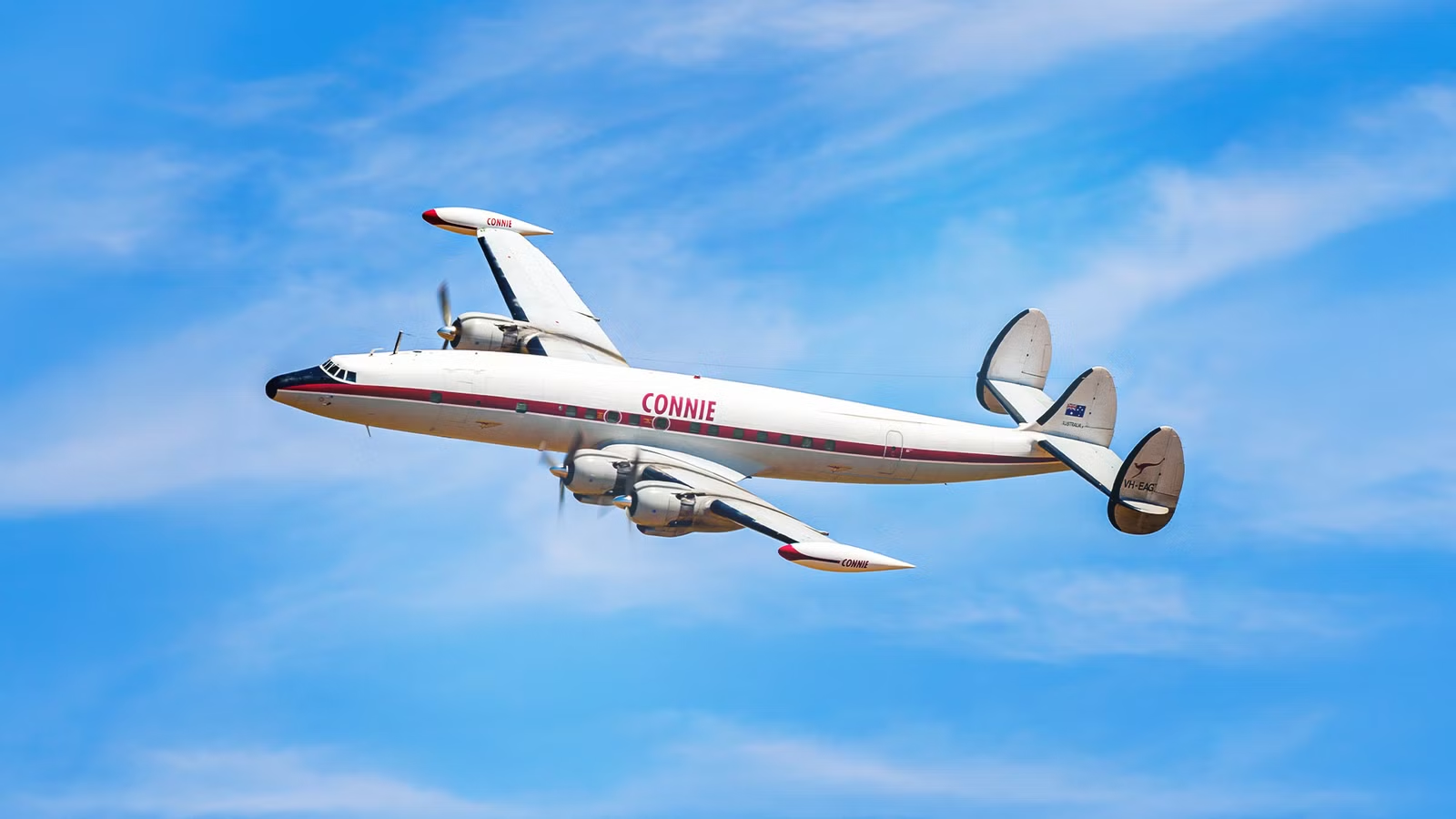
The Lockheed Constellation is one of the most recognizable aircraft ever built, and its most distinctive feature, the triple tail, was not an aesthetic choice. It was a solution to a hangar door. When TWA asked Lockheed to design a long-range pressurized airliner in 1939, one of the requirements was that the aircraft had to fit inside TWA’s existing maintenance facilities. A single vertical stabilizer large enough to provide directional stability on a four-engine aircraft of the Constellation’s size and speed would have made the tail too tall to clear the hangar doors.
Lockheed’s engineers split the required fin area across three shorter vertical stabilizers, keeping the aircraft’s overall height to 23 feet 8 inches (7.2 meters). The solution worked; TWA got an aircraft that fit its infrastructure, and Lockheed produced 856 Constellations across all variants before the jet age ended the propeller airliner era. Here is why the triple tail was necessary, how it worked aerodynamically, and what the aircraft contributed to commercial aviation beyond its silhouette.
TWA’s Hangar Problem And How It Shaped The Aircraft

In 1939, Trans World Airlines owner Howard Hughes approached Lockheed with a set of requirements for a new long-range airliner. Hughes wanted an aircraft that could carry a 6,000-lb (2,720 kg) payload, fly 3,500 miles (5,630 km) without payload, and cruise at more than 250 mph (402 km/h) at 20,000 feet (6,096 meters). Those were aggressive specifications for the era and would have produced a large, heavy, four-engine aircraft substantially bigger than anything TWA was operating. Hughes added one additional requirement: the aircraft had to fit inside TWA’s existing maintenance hangars.
That constraint created a specific engineering problem. The Constellation’s four Wright R-3350 engines drove large-diameter propellers that required tall landing gear to maintain ground clearance. The tall gear raised the fuselage, which in turn raised the tail. A conventional single vertical stabilizer providing enough area for directional stability on an aircraft of this size and speed would have pushed the total height well beyond what TWA’s hangar doors could accommodate. Lockheed’s engineers, led by chief engineer Hall Hibbard and chief aerodynamicist Kelly Johnson, needed to provide the required vertical stabilizer area without exceeding the hangar height limit.
The solution was to split the vertical stabilizer into three shorter fins mounted across the horizontal tailplane. Three fins provided the same total surface area as a single large fin while keeping each individual surface short enough to hold the aircraft’s overall height to 23 feet 8 inches (7.2 meters). The design fit inside TWA’s hangars.
How Three Fins Do The Work Of One

The aerodynamic function of a vertical stabilizer is to provide directional stability by resisting unwanted yaw, keeping the tail of the aircraft tracking behind the nose in straight flight and during turns. The size of the fin determines how much yaw resistance it generates. A larger fin produces more stability. The total area required depends on the aircraft’s size, weight, speed range, and the distance between the center of gravity and the tail surfaces. On the Constellation, splitting that area across three fins rather than concentrating it in one did not reduce the total stabilizer area. It redistributed it across three shorter surfaces.
The three-fin arrangement also produced a secondary aerodynamic benefit that a single center fin would not have provided. The two outboard fins sit in the slipstream of the inboard propellers, which means they receive accelerated airflow from the engines at all flight speeds. At low speeds, where a conventional vertical stabilizer is least effective because the airflow over it is slowest, the propeller wash over the outboard fins maintains a higher local airspeed across those surfaces. The result is improved directional stability during takeoff, landing, and low-speed flight, and better yaw authority during single-engine operations when the aircraft needs to counteract the asymmetric thrust of three operating engines against one failed engine.
The triple-tail configuration came with trade-offs. The horizontal stabilizer had to be structurally reinforced to support three fins and the associated loads, which added weight. The flight control system required three rudders instead of one, with corresponding control cables, hinges, and actuators that added mechanical complexity and maintenance requirements. The Douglas DC-6, which competed directly with the Constellation on the same routes, used a conventional single-fin tail and did not pay those weight and complexity penalties.
Kelly Johnson And The Design Team Behind The Constellation

The Constellation was designed at Lockheed’s Burbank, California facility under the leadership of two engineers whose careers extended well beyond the program. Hall Hibbard served as chief engineer and Kelly Johnson as chief aerodynamicist during the initial design phase, with project engineer Don Palmer managing the detailed engineering as the program progressed. Johnson, who was 29 when the Constellation project began, would later found Lockheed’s Advanced Development Programs division, better known as Skunk Works, where he led the design of the P-80, U-2, and SR-71.
The Constellation’s wing was derived from the Lockheed P-38 Lightning fighter, scaled up from a 52-foot (15.8 meters) span to 123 feet (37.5 meters). The structural approach and airfoil design carried over from the fighter program, which gave Lockheed’s team a tested aerodynamic foundation to build on rather than starting from a clean sheet. The fuselage was a pressurized aluminum semi-monocoque structure with the distinctive curved dolphin shape that rose at the nose, dipped at the midsection, and rose again toward the tail. The pressurization system maintained a cabin altitude of approximately 8,000 feet (2,438 meters) while cruising at 20,000 feet (6,096 meters), making it one of the first large commercial airliners to offer pressurized flight as a standard feature.
Power came from four Wright R-3350 Duplex-Cyclone 18-cylinder radial engines, the same engine family that powered the Boeing B-29 Superfortress. Each engine produced approximately 2,200 horsepower in early variants, later increased to 2,700 and beyond in the Super Constellation series. The R-3350 was powerful but temperamental, prone to overheating issues that contributed to several incidents during the Constellation’s early service years. The aircraft also introduced hydraulically boosted flight controls and a thermal deicing system on the wing and tail leading edges, features that were not standard on contemporary airliners.
From Military C-69 To Postwar Airliner

The Constellation first flew on January 9, 1943, from Lockheed’s Burbank field. It flew not as a TWA airliner but as a military transport designated C-69, requisitioned by the US Army Air Forces after the attack on Pearl Harbor redirected Lockheed’s production priorities toward the war effort. The nine L-049 airframes originally ordered by TWA were purchased by the War Department, and 22 C-69s were built between 1943 and 1945. The aircraft spent the war years stateside, used primarily for long-range personnel transport while the Douglas C-54 Skymaster handled the higher-priority overseas airlift missions.
On April 17, 1944, Howard Hughes and TWA president Jack Frye flew the second production C-69 from Burbank to Washington National Airport in 6 hours and 57 minutes, averaging 331 mph (533 km/h) at 65% engine power. The aircraft was painted in full TWA livery despite carrying a military serial number, and the flight was a publicity exercise as much as a delivery. Hughes was required to hand the aircraft over to the Army Air Forces upon landing in Washington. On the return trip, the aircraft stopped at Wright Field in Ohio, where Orville Wright boarded for what would be his last flight, more than 40 years after his first at Kitty Hawk. Wright commented that the Constellation’s wingspan was greater than the distance of that first flight.
When the war ended, TWA bought back every C-69 it could from the government and converted them to civilian configuration. Commercial Constellation service began in February 1946, and the aircraft immediately outperformed the Douglas DC-4, the airliner most carriers were using on long-haul domestic and early transatlantic routes. The DC-4 was unpressurized and cruised at approximately 227 mph (365 km/h). The pressurized Constellation cruised at 340 mph (547 km/h) at 20,000 feet (6,096 meters), above most weather. Douglas responded with the pressurized DC-6 in 1947, and later the DC-7, and the resulting competition between Lockheed and Douglas through the 1950s produced the most intensive period of propeller airliner development in aviation history. Lockheed built 856 Constellations across all variants before production ended in 1958, the same year the Boeing 707 entered service and rendered the entire category obsolete.
The Constellation’s Legacy In Aircraft Design

The Constellation introduced several technologies that became standard across commercial aviation. Cabin pressurization at the scale Lockheed implemented allowed airline passengers to fly above weather for the first time on a production airliner, establishing the principle that commercial aircraft should cruise at altitudes where turbulence and storms are below rather than around the aircraft. Hydraulically boosted flight controls addressed the increasing force required to move control surfaces on larger, faster aircraft, a problem that would only grow as airliners became heavier through the 1950s and into the jet age. The thermal deicing system on wing and tail leading edges replaced the rubber boot deicing used on earlier aircraft with a more reliable heated-air approach.
The triple tail disappeared from commercial aviation when jet airliners arrived. The Boeing 707, Douglas DC-8, and every subsequent commercial jet used a single vertical stabilizer. The hangars that had constrained the Constellation’s designers were replaced or expanded to accommodate the new generation of aircraft, removing the height limitation that had created the three-fin design in the first place. By the time airports were building hangars for the 747 in the late 1960s, no vertical stabilizer height was too tall to accommodate. The engineering problem the triple tail solved ceased to exist.
Of the 856 Constellations built between 1943 and 1958, approximately 55 survive. As of 2026, only two are airworthy. VH-EAG, a C-121C Super Constellation operated by Australia’s Historical Aircraft Restoration Society, flies from Illawarra Regional Airport in a restored Qantas livery and carries passengers on demonstration flights. N422NA, a VC-121A named Bataan that served as General Douglas MacArthur’s personal transport and later flew for NASA during the Apollo program, is maintained by the Air Legends Foundation and appears at US airshows.
Catch what other trackers miss
Emergency squawks, holds, NOTAMs — live signals, no signup.
Open tracker
Catch what other trackers miss
Emergency squawks, holds, NOTAMs — live signals, no signup.
Open tracker