dailynewsnblog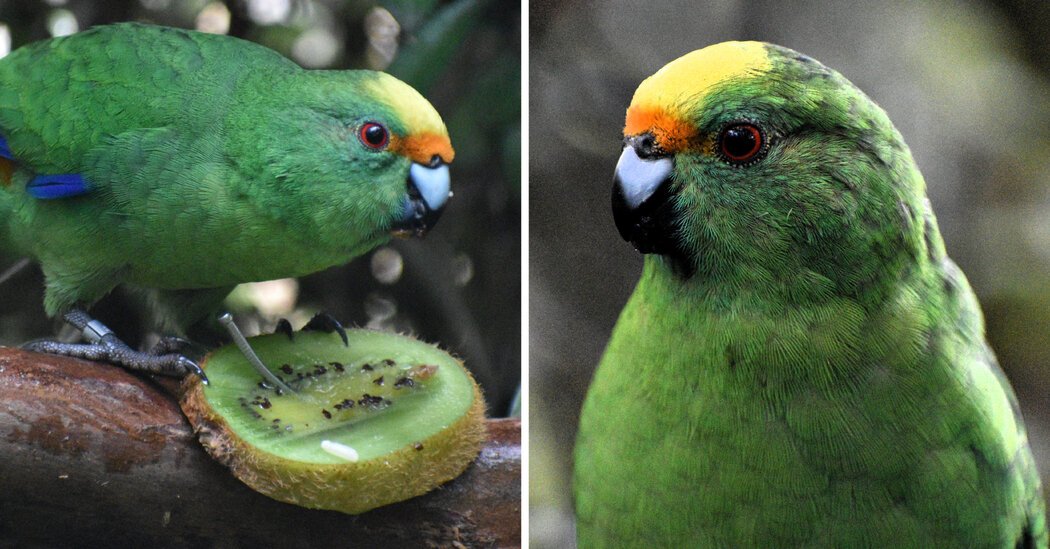
Two critically endangered parakeets have been hailed as “super breeders” in New Zealand after the pair produced 55 chicks in two years — increasing the population by more than 10 percent.
The native kākāriki karaka, or orange-fronted parakeet, was declared extinct in 1919 and 1965, only to be rediscovered both times in the depths of mountainous valley areas. It is the country’s rarest parakeet. Now, there are only about 450 left in the wild and in captivity.
Conservationists are doing all they can to prevent the bird from going extinct a third time by creating predator-free sanctuaries and running breeding programs. Giving them a large helping hand are Trixie and Nacho, two kākāriki karaka who live at the Isaac Conservation and Wildlife Trust in Christchurch, in New Zealand’s South Island.
They were paired in 2024 and of the 55 chicks they produced, 33 alone hatched this season, which runs from December to April. In comparison, other pairs in the breeding program have produced between 10 and 15 chicks, according to Leigh Percasky, wildlife manager at the Isaac Conservation and Wildlife Trust.
Nacho and Trixie, one of eight pairs at the facility, chose each other. The staff had placed several compatible birds together and let them pick their mates, Mr. Percasky said in an interview. That process makes for better pairings, he said.
The two birds are “quite relaxed,” he said, and have distinctive traits that set them apart from other pairs.
“Nacho especially is very inquisitive and is quite interested in what people are doing.” Mr. Percasky said. He noted that Trixie is slightly larger than other females. “As a pair they produce bigger-than-normal-sized chicks,” he said.
Many of Nacho and Trixie’s offspring have been released into the wild, he said.
These efforts are led by the Department of Conservation and Te Rūnanga o Ngāi Tahu, the main Indigenous tribe of the South Island. Together they manage a recovery program focused on monitoring and protecting the sites where the birds live and finding new locations where they can be introduced.
“It’s a really good reason to get out of bed and go to work when you’re trying to save a critically endangered species,” said Wayne Beggs, the department’s kākāriki karaka recovery program lead.
New Zealand is home to 206 breeding bird species, and 94 of them are found nowhere else in the world. Among them are the world’s fattest parrot, the kakapo, and the kiwi, a small bird with a long bill that is the country’s national icon.
Like many native birds, the kakapo and the kiwi are flightless, a trait developed because the country was isolated for millions of years and had no ground dwelling predators like ferrets and rats until humans introduced them.
There are now five established kākāriki karaka populations throughout the island, with officials hoping to increase that to 10 in the next two decades, Mr. Beggs said. The biggest threats to the bird’s survival are predators, habitat degradation, diseases and climate change.
The country’s captive breeding program started in 2003, when conservationists took kākāriki karaka eggs from the wild and gave them to foster birds to raise. Since then, hundreds of kākāriki karaka have been bred in captivity and released.
But the ultimate goal for conservationists is to see the wild bird populations thrive on their own so that captive breeding programs are no longer needed.
Until then, Nacho and Trixie have more work to do.
Mr. Percasky, the wildlife manager, said his priority was making sure both birds remain well.
“We’re keeping a pretty close eye on them and making sure that they seem like they are fit and healthy and it’s not taking too much out of them. But they keep very busy.”