dailynewsnblog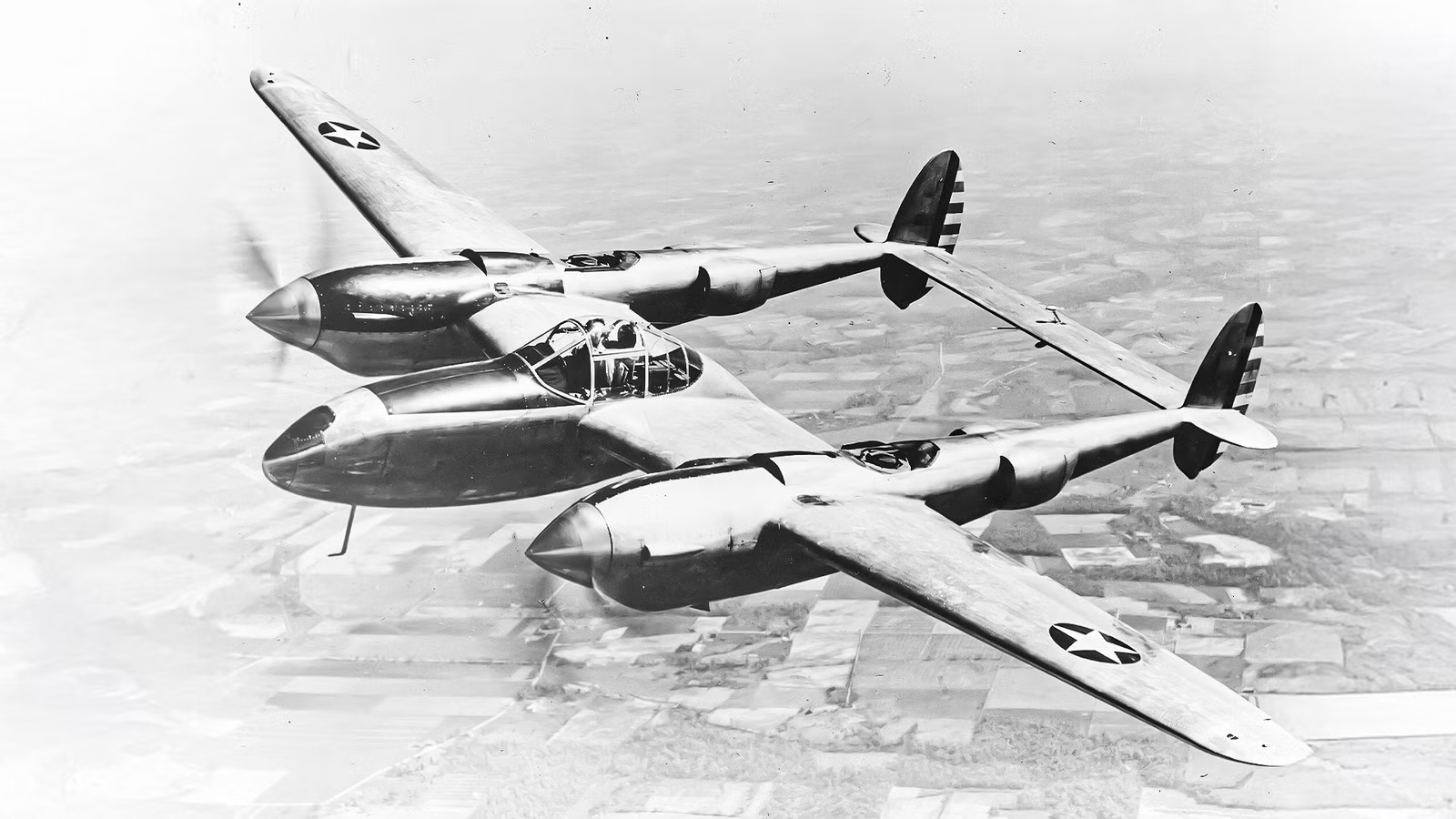
Major Richard Ira Bong was the ‘Ace of Aces’ among US Army Air Corps fighter pilots when WWII finally came to an end. Even before setting foot in a combat theater, he earned notoriety for buzzing Market Street in San Francisco on a training flight. After being officially reprimanded, he was held back from deployment to the United Kingdom with the rest of his training group. As a result, he was instead assigned to the Pacific Theater, where he would serve out the rest of his tenure in uniform.
Bong leveraged the Lockheed P-38 Lightning’s high performance and heavy armament to maximize what came to be known as ‘boom and zoom tactics.’ Over the next two years, he racked up 40 confirmed aerial victories against Japanese aircraft. After mastering the speed and power of the P-38 to defeat the enemy’s nimble dogfighters, he was grounded in early 1945 to begin a new tour of duty on the home front instead.
General Douglas MacArthur personally awarded him the Congressional Medal of Honor for his extraordinary heroism in the air. Tragically, Bong would not live to see the end of the terrible conflict. At the age of 24, he was killed on a test flight of the experimental Lockheed P-80 Shooting Star jet. That very same day, on August 6, 1945, the atomic bomb was dropped on Hiroshima in Japan. Today, in honor of his memory, a replica of his P-38 ‘Marge’ is preserved in his home state of Wisconsin.
Taking Off With A Bang: Bong Buzzes Market Street

After volunteering for the US Army Air Corps at 21 years old, Richard Bong learned to fly the P-38 Lightning at Hamilton Field near San Francisco. After completing the training program, Bong decided to mark the occasion by performing a series of daredevil stunts that were both against regulations and exceptionally dangerous. On the way to buzz the house of another pilot who had just gotten married, he decided to perform a loop around the Golden Gate Bridge.
Bong flew his P-38 between the columns of the bridge and pulled it up into a steep climb before diving back under the Golden Gate. But he wasn’t done yet. After pulling off his first display of airmanship, he pointed the nose at downtown San Francisco. He brought the roaring twin-engine fighter down to rooftop level and passed over Market Street in a show of audacity that would make Top Gun’s Maverick blush.
After he finished his tour of the Bay Area, he finally made a course for San Anselmo, where a recently wedded pilot from his unit lived. Bringing the plane down even lower than his previous flyby, the prop wash from the Lightning’s roaring Allison engines blew the laundry off of the neighbor’s clothesline. Bong was called before General George Kenney to answer for his reckless flying.
Shaping Up And Shipping Out: Bong Goes To Battle

At this moment, the future ‘ace of aces’ was just a trouble-making student pilot. Kenney later wrote in his memoirs that as he looked at the young man who stood before him, he saw the kind of aviator that the Air Corps desperately needed. Tara Ross recounted the stern but encouraging words that the general said to the young pilot before dispatching him to remedy the laundry he soiled:
“If you didn’t want to loop around that bridge or fly down Market Street, I wouldn’t have you in my Air Force. But you are not going to do it anymore.”
Instead of taking away his wings, the general told him to never again perform such stunts and offered to help clean the laundry that his airplane had sent flying. Because of his misconduct, Bong’s original squadron was sent ahead to Europe without him. Instead, Kenney added his name at the very top of a roster of 50 elite pilots that would join him in the Southwest Pacific.
When Richard Bong arrived in the Southwest Pacific in September 1942, he entered a dire battlefield where the Allies were dangerously close to losing the air campaign. He would be stationed in New Guinea with the 9th Fighter Squadron, dubbed the Flying Knights. Bong and the other troops lived in tents alongside the 14 Mile Drome of Port Moresby, where malaria and the jungle heat posed nearly as great a danger as the Japanese night bombing raids.
American Ace: Forged By The Heat Of Battle

In addition to the brutal conditions that the aviators endured every day, and the nightly air raids, the hastily assembled forces were struggling to overcome disarray. Many of the air crew and support troops were battle-weary, while the new rookies were grounded from flying combat missions as senior pilots still needed to complete training to transition into the P-38. Despite just arriving at his first combat squadron, Bong would actually fly his first combat sortie with the 39th Fighter Squadron.
Less than two weeks after arriving in theater, and only days after flying his first combat patrol, Bong would meet a legendary aviator in the flesh. According to Pacific Wrecks, Bong met the WWI ace Eddie Rickenbacker who was famous for being the top-scoring fighter pilot of the last great conflict. Rickenbacker recounted tales of his 26 confirmed air-to-air kills to the young aviators. General Kenney was accompanying him and offered a spontaneous wager with the pilots to encourage their resolve: a case of Scotch.
The terms that Kenney offered to collect the prize were simple. The first fighter pilot to surpass Rickenbacker’s combat record would be the winner. In the spirit of sportsmanship, Rickenbacker doubled down and offered to supply a second case to any aviator who could beat his kill record. To make things even more exciting, when General MacArthur learned of the gambit, he put up his own stakes, offering a case of champagne to sweeten the pot.
Collecting Dues: Bong Wins The Jackpot

Naming his P-38 Lightning after his beloved girlfriend ‘Marge,’ Bong went on to shoot down his first enemy aircraft in December 1942. He would claim his second the same month and by January he was already an ace. As 1943 progressed, he honed his ‘bloom and zoom’ tactics in the Lightning and steadily accumulated more aerial victories. Bong achieved ‘triple ace’ status in a single day on July 26 when he shot down four enemy aircraft in a single battle.
By the end of the year, he had shot down 21 enemy fighters and was considered the top contender in what newspapers dubbed the ‘Great Pacific Ace Race,’ according to The Smithsonian. Bong was awarded a brief leave to return stateside to enjoy the holidays and ring in the New Year. He returned to action in February 1944 and continued his quest to claim the prize that awaited him.
Eight Times An Ace: Bong’s Legacy Of Daring

Upon his return to combat flying, Bong downed seven more Japanese fighters in the spring of 1944. He would officially surpass Rickenbacker’s record in April after defeating three adversaries on a single day. After collecting his reward, Bong was rotated out from frontline missions and assigned as an advanced gunnery instructor. Although technically restricted from pursuing combat assignments, he repeatedly volunteered for dangerous missions during the liberation of the Philippines.
The 23-year-old fighter pilot earned his 29th kill in October 1944 and continued to support his brothers in arms as the Allies fought to free the Philippines from the Imperial Japanese military. He flew numerous sorties over the next three months until claiming his 40th, and final, aerial victory in December, which would also earn him the Congressional Medal of Honor. After this historic mission, General Kenney ordered Bong to be grounded for his own safety and shipped him home to the US to continue his service on the home front.
The Tragedy Of The Shooting Star

Bong returned home to fanfare and the loving arms of his hometown sweetheart, Marjorie ‘Marge’ Vattendahl, whose likeness had emblazoned the nose of his fighter on every combat sortie. The two were officially married in February 1945, and Bong was assigned as an acceptance test pilot to the Lockheed Air Terminal in Burbank, California. The US Army Air Corps intended to protect the life of its national hero, but this duty would prove to be a fatal errand.
Bong was given the chance to fly one of the first operational fighter jets in the history of aviation. By August 1945, he had completed 12 flights in the Lockheed P-80 Shooting Star for a total of 4 hours and 15 minutes behind the stick. To this day, the exact cause behind the mishap that killed him remains debated by historians and even fellow test pilots, including Chuck Yeager.
When Bong took off on the fateful flight that would be his last, witnesses saw the plane emit a puff of black smoke shortly after takeoff from Lockheed’s Burbank Airfield. Accounts say that the primary fuel pump failed. In this event, pilots were trained to engage a backup fuel pump as part of their emergency procedures to prevent a flameout. For unknown reasons, Bong failed to engage this pump and the jet’s engine immediately stalled.
The P-80 reportedly rolled upside down and went into a steep nose dive. Bong did successfully release the canopy and bailed out of the cockpit, but his aircraft’s altitude was too low, and he was unable to deploy his parachute, according to This Day in Aviation. The plane crashed in a clearing between suburban homes set aside for the power company and his body was found 100 feet (30.48 meters) away from the impact site.
Emergency responders at the time said it seemed that he had intentionally pointed the plane at an unpopulated site in order to preserve the lives of those on the ground. Even in his final act, America’s most successful combat ace put the lives of others above his own. Following his untimely death, his selflessness, sense of duty, and incredible airmanship skills remain immortalized in the US Air Force’s annals of history.