dailynewsnblog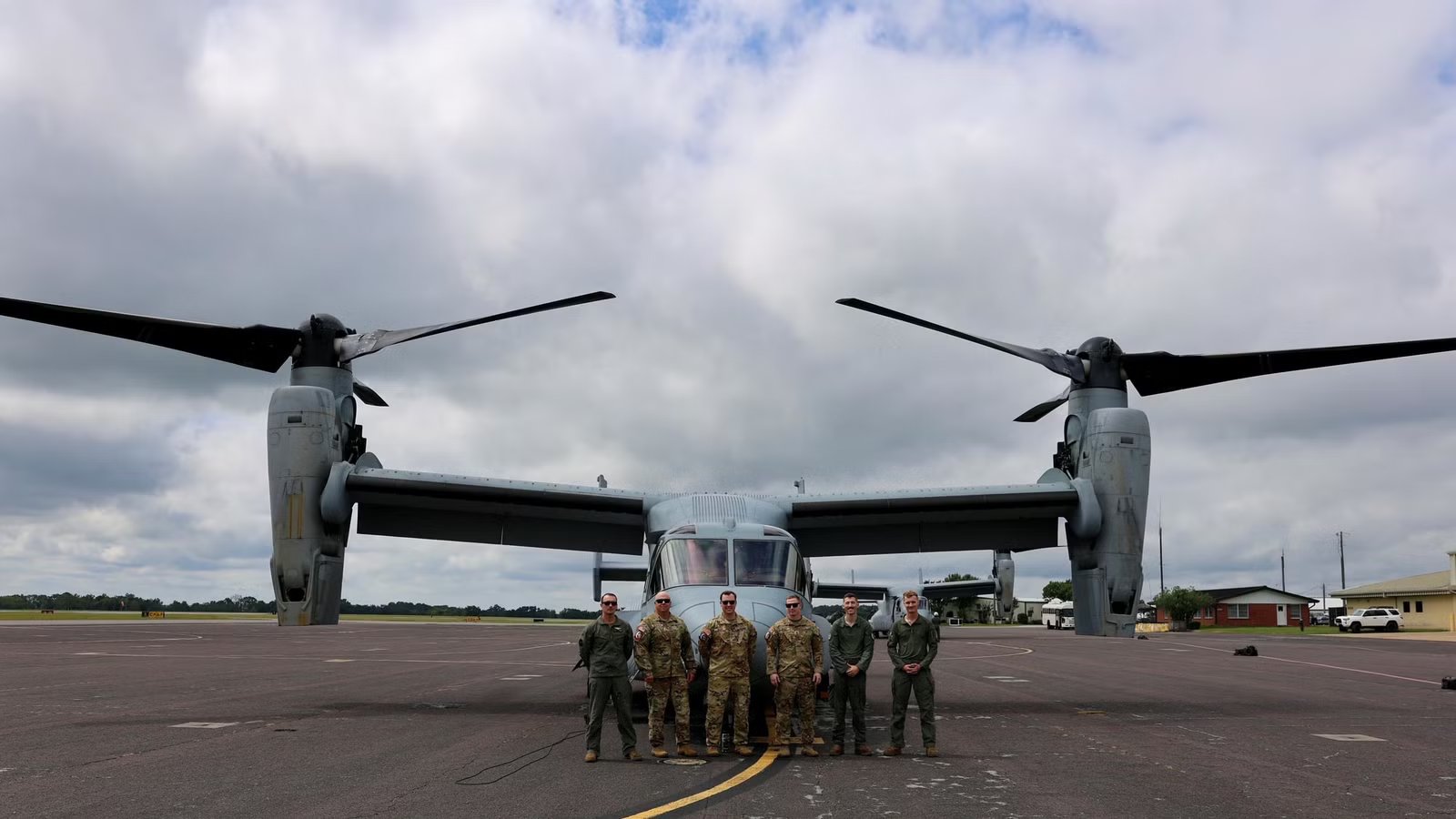
The V-22 Osprey is now a mature tiltrotor aircraft, and the program is nearing the end of production. In 2025, the US Air Force received its final CV-22 Ospreys, while the Marine Corps received the last of its much larger order in July 2026. As of this writing, only about 11 US Navy Ospreys remain to be delivered before production is expected to shut down. But the Osprey tiltrotor did not emerge in isolation, and the US aviation industry’s efforts to combine the advantages of helicopter and turboprop aircraft can be traced back to the 1950s.
Two of the leading tiltrotor developers in the early Cold War were Bell and Curtiss-Wright. Bell’s efforts would go on to produce the V-22 Osprey and the incoming MV-75 Cheyenne II tiltrotors. However, Curtiss-Wright’s efforts were also important, but were ultimately canceled and overshadowed by Bell. Here is what to know about the forgotten Curtiss-Wright X-100 and X-200/XV-19 tiltrotors, which helped lay the foundation for tiltrotors to become practical.
The 1950s Bell XV-3

In the 1950s, Bell Helicopter set to work on developing the early Bell XV-3 experimental VTOL aircraft. This was one of the first tiltrotors to fly and was a joint research program for the US Air Force and Army. Two experimental aircraft were built, with the first flight taking place in August 1955. However, the prototype had issues and crashed two months after its first flight.
More tests were carried out on the second example, which successfully demonstrated the tiltrotor concept and completed 110 transitions from helicopter mode to aircraft mode between 1958 and 1962. But the aircraft was badly damaged in 1966, and the program was canceled. The aircraft is on display at the National Museum of the United States Air Force in Ohio.
The aircraft was an important stage that led to the later development of the Bell XV-15. The Bell XV-15 was a tiltrotor VTOL aircraft and was much more similar to the later V-22 Osprey. Two examples were built and operated by NASA, with the first flight taking place in 1977 and the aircraft being retired in 2003. The Bell XV-15 is regarded as the more direct predecessor to the Bell-Boeing V-22 Osprey in service today. But it is not the only predecessor, and Bell’s VTOL lineage often overshadows early work done by Curtiss-Wright.
Curtiss Re-entered Aircraft To Develop Tiltrotors

While Curtiss-Wright was one of the most important US aircraft manufacturers of WWII, it struggled to win contracts afterward. Its engineers saw an opportunity to develop a new tiltrotor design for the Air Force and re-enter the military aircraft market. Curtiss-Wright initially privately developed the X-100 in 1960. It then won a contract from the Air Force to develop the much larger XV-19 tiltrotor based on it. As fate would have it, the X-19 would be the last aircraft of any kind built by Curtiss-Wright.
The Smithsonian explains, “In the late 1950s and early 1960s, several aircraft manufacturers developed Vertical Takeoff and Landing (VTOL) aircraft under military research contracts. One unexpected VTOL program participant was the Curtiss-Wright Corporation, which had abandoned its aircraft division in 1952 after failing to earn any significant post-war military contracts.” The X-100 design offered a significant potential advantage over other tiltrotor designs (e.g., the Bell XV-3).
Curtiss-Wright engineers realized that short propellers with wide blades magnified the radial force effect by increasing the propeller disk’s surface area without the compressibility issues of longer rotor blades. The Bell XV-3 had longer, narrower blades that lacked enough surface area to achieve meaningful efficiency. Curtiss built the most aerodynamically efficient contemporary VTOL design, with the added benefit that its smaller propellers were less noisy.
The Groundwork Success Of Curtiss X-100

The chief aerodynamicist for the Curtiss-Wright propeller division was Henry Borst. Borst was one of the engineers who had worked on previous innovative aircraft like the Lockheed XP-88 and the Convair XFY Pogo. It was partly thanks to Borst that Curtiss-Wright decided to re-enter the aircraft business in 1957 and develop the X-100 flying demonstrator.
The X-100 was noted for its ungainly appearance, a hodgepodge of disproportionate components. It had two thin, stubby wings. On each were mounted a sleek propeller nacelle that hinged at the leading edge, allowing it to tilt. A single Lycoming YF53 turboshaft engine powered the aircraft, mounted in the center of the fuselage.
The early tiltrotor had fixed tricycle landing gear and could accommodate two crew. The X-100 began tethered hovering tests in April 1959, with test pilot Bill Furlich making the first rolling takeoff in March 1960. While testing was underway, Curtiss started work on a much-improved version called the X-200. This was redesignated the X-19 under a tri-service agreement between the Army, Navy, and Air Force.
Testing & Cancellation Of XV-19

Although Curtiss-Wright’s new tiltrotor piqued military interest, and it began building two demonstrator X-19s, it lacked the funds to adequately test and refine them. This limited the refinement of essential components like the gearboxes. The first X-19 test flights took place in November 1963.
The test showed the aircraft continued to suffer from the same propeller downwash and slow throttle response that its X-100 predecessor had experienced. The demonstrators also had parts failures and technical problems which delayed the planned first hover-to-cruise transition until 1965. But then one of the two aircraft was lost after a gearbox failure coupled with pilot error.
Tiltrotor-related programs (per Smithsonian) | First flight | Note |
|---|---|---|
Bell XV-3 | 1955 | Major technical foundation |
Curtiss-Wright X-100 | 1959/1960 | Important experimental data |
Curtiss-Wright X-200/XV-19 | 1963 | Important experimental data |
Bell XV-15 | 1977 | Direct V-22 predecessor |
C-130 with rockets (Credible Sport) | 1980 | Need for tiltrotor after Iran |
Bell-Boeing V-22 Osprey | 1989 | First in-service tiltrotor |
Bell MV-75 Cheyenne II | 2017 | To partially replace Black Hawks |
Both pilots were able to eject safely, but the loss of the aircraft, with the Air Force’s lackluster interest, saw the program canceled before the second X-19 could fly. In the end, the X-19 never achieved hover-to-cruise transition, although it did demonstrate the practicality of VTOL aircraft. The X-19 ended Curtiss-Wright’s long tradition of innovative aircraft development. The surviving demonstrator was transferred to the National Museum of the United States Air Force in 2007.
The Requirement For Tiltrotors

According to NASA, the X-19 completed 50 flights, with its fastest flight at 454 mph and its highest at 25,600 feet. NASA says, “Within the limited flight envelope explored by the X-19 prior to its demise, the aircraft demonstrated the general feasibility of the tandem tilt-rotor concept. The program successfully verified the dynamic and longitudinal stability, hover, and transition performance of the basic design.”
NASA also notes that much of the data later proved useful during the development of the XV-15 and the V-22 Osprey. One reason for the cancellation was the lack of a pressing requirement for a tiltrotor in military service. Helicopters and conventional helicopters were good enough. But this changed in 1979 with the Iranian hostage crisis. Rescue plans called for an aircraft with the range and speed to fly to Tehran and back while landing and taking off from a stadium.
The US attempted the disastrous rescue mission (Operation Eagle Claw) with its helicopters. But as an interim measure, it experimented with the Hercules for a second rescue attempt. The US attempted to fix rockets on a C-130 Hercules as part of Operation Credible Sport to dramatically reduce its takeoff and landing distance. Test flights proved the concept but also resulted in a crash, leading the US to shelve the idea. Following the debacle, the US dusted off tiltrotor designs and eventually developed the V-22 Osprey.
Tiltrotors Are Central To The Military Future

While Curtiss-Wright would not survive as an aerospace company that could design and manufacture aircraft (today it mostly builds actuators, aircraft controls, valves, and provides surface-treatment services), its early tiltrotor designs helped set the stage for today’s tiltrotors. While the V-22 Osprey’s rollout and early years have often been beset by safety concerns, mishaps, and groundings, popular media has arguably overemphasized them, and the design is now mature.
Going forward, tiltrotors are seen as an important part of military aircraft design. They are valued for being runway-independent and for their range and speed. The incoming MV-75 Cheyenne II is set to partially replace the Army’s Black Hawk fleet, allowing assault missions to go “twice as far, twice as fast.” At the same time, numerous eVTOL air taxis (e.g., Joby, Archer) are also leveraging tiltrotor designs.
Those eVTOL air taxis are often being produced with dual-use in mind, with Archer and other companies developing hybrid versions of the aircraft for the military. Roles for these next-generation tiltrotor designs range from cargo drones providing the Marines with the “last mile” of resupply, to troop movement, to loyal wingman drones for Apache helicopters. In 2025, a prototype tiltrotor appeared in China, suggesting that the US military will no longer be the only one operating tiltrotors.