dailynewsnblog
The April 8, 2026, incident involving  Southwest Airlines Flight 568 stands out as one of the more unusual and concerning cockpit safety events in recent aviation history. The aircraft, a Boeing 737-700 registered as N200WN, was departing Las Vegas at approximately 2:20 PM PST when a critical piece of cockpit equipment, the Heads-Up Display (HUD), detached during the takeoff roll. In a matter of seconds, what is normally a precision instrument became a hazard, striking the captain in the head with significant force and immediately disrupting the operation of the flight.
The consequences were serious but ultimately contained due to decisive crew action. The captain suffered a mild concussion along with disorientation and vomiting, rendering him unable to continue his duties at a critical moment. The first officer took control, coordinated a return to Las Vegas with medical priority, and air traffic control formally declared an emergency on the crew’s behalf. The aircraft landed safely, the captain was removed via wheelchair, and after approximately 1.5 hours on the ground, the flight later continued to Reno with a replacement pilot, arriving roughly two hours late. Early findings from the Federal Aviation Administration suggest that a failure of the HUD’s mounting latch allowed the heavy unit to swing down, raising serious questions about cockpit equipment security and certification standards.
A Routine Takeoff Turns Critical

Southwest Airlines Flight 568 began under entirely routine conditions, with standard pre-departure procedures completed, and the aircraft cleared for takeoff from Las Vegas McCarran International Airport (LAS). As with any commercial departure, the takeoff roll represented a highly structured and procedural phase of flight, with both pilots focused on speed calls, engine performance, and runway alignment. From the passenger cabin, the acceleration would have felt normal, offering no indication that an abnormal event was unfolding just ahead of them in the cockpit.
That normalcy was abruptly broken when the Heads-Up Display unit detached without warning. According to air traffic control communications, the first officer later described how the HUD “came down during the takeoff roll and smacked him pretty hard on the head,” a statement that underscores both the suddenness and severity of the event. The captain reportedly “saw a few stars” immediately after the impact and began vomiting shortly thereafter, indicating a significant blow with immediate physiological consequences.
The timing of the incident amplified its seriousness. The takeoff roll is one of the most time-critical phases of flight, where decisions must be made within seconds, particularly if an abort becomes necessary. With the captain incapacitated at that precise moment, the first officer was forced to instantly transition from a supporting role to full command authority, maintaining aircraft control while simultaneously assessing the situation and preparing for an abnormal return.

The physical consequences of the impact were both immediate and operationally significant. A mild concussion, while not always externally visible, can impair cognitive processing, spatial awareness, and decision-making ability, skills that are essential for safe aircraft operation. The captain’s disorientation and vomiting made it clear that he was no longer capable of contributing meaningfully to the flight at that time.
In modern commercial aviation, crew resource management is designed to handle this type of scenario precisely. The first officer quickly assumed control of the aircraft, ensuring that flight path stability was maintained while simultaneously addressing the unfolding emergency. This required a rapid mental shift, as the first officer had to prioritize flying the aircraft while also communicating effectively with air traffic control and monitoring the captain’s condition.
The decision to return to Las Vegas was both logical and necessary. Initially requesting medical priority, the first officer conveyed the urgency of the situation without immediately escalating to a formal emergency declaration. However, air traffic control recognized the severity of the circumstances and declared an emergency on behalf of the crew, ensuring priority handling, expedited routing, and immediate access to emergency services upon landing.
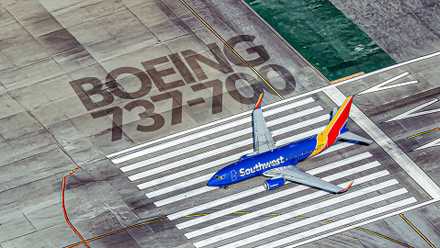
Heads Up: Southwest Pilot Incapacitated By Falling Display During Takeoff
The unlucky Captain got a concussion on lift-off.
Inside The Heads-Up Display System

The Heads-Up Display is a key piece of avionics designed to enhance pilot situational awareness by projecting essential flight information directly into the pilot’s forward line of sight. This allows pilots to maintain visual focus outside the aircraft while still monitoring critical parameters such as airspeed, altitude, and guidance cues. In demanding conditions, particularly low visibility, the HUD can significantly improve safety and operational precision.
On the Boeing 737-700, the HUD is mounted above the pilot’s seat and can be lowered into position when required. Its placement is carefully engineered to balance visibility, accessibility, and ergonomics. When not in use, it is secured in a stowed position, and when deployed, it must remain stable despite vibration, acceleration, and normal aircraft movement.
However, the system’s complexity and physical construction mean that it is not a lightweight component. The HUD includes optical elements, projection hardware, and structural supports that give it substantial mass. Under normal circumstances, its mounting system is designed to securely support that weight. Still, if the securing mechanism fails, the same mass that contributes to its durability becomes a potential hazard.
The Latch Failure And Mechanical Vulnerability

Preliminary findings from the Federal Aviation Administration suggest that the incident was likely caused by a failure of the HUD’s mounting latch. This latch is a relatively small mechanical component, but it performs a disproportionately important function: it is responsible for keeping a relatively heavy and centrally positioned avionics unit securely fixed during all phases of flight, including vibration, turbulence, and high-acceleration events like takeoff. In certification and design terms, such components are typically assumed to be highly reliable, and their proper function is often treated as a given within the broader system. Its failure, therefore, represents not just a single part malfunction, but a breakdown in a fundamental assumption about system integrity and retention reliability.
When the latch failed, the HUD was no longer restrained in its intended position, effectively freeing a mass located directly above the pilot. During the takeoff roll, the aircraft is accelerating rapidly, and that forward acceleration can significantly influence how unsecured objects behave. Combined with gravity and the pivoting geometry of the mounting arm, this likely caused the HUD to swing or drop downward with amplified force rather than simply falling straight down. The result was a concentrated, forceful impact into the captain’s head, illustrating how even a brief loss of mechanical restraint, under the right conditions, can translate into a high-energy event inside the confined cockpit environment.
This scenario highlights a classic single-point failure risk. If the mounting system relies on a single latch without redundancy, the failure of that component can lead to complete detachment. Investigators will likely examine whether the design included any secondary retention mechanisms and whether such mechanisms should be standard for equipment of this size and placement.
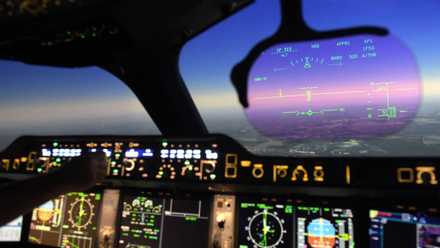
How Do Aircraft Heads-Up Displays Work?
When Cockpit Equipment Becomes A Hazard

The incident highlights a category of risk often overlooked in aviation safety discussions: internal hazards originating within the aircraft itself. While extensive effort is devoted to protecting aircraft from external threats, less emphasis is typically placed on what happens if internal components fail in unexpected ways.
In this case, the HUD effectively became a localized projectile. Although its movement was limited to the cockpit area, the confined space meant that even a short swing translated into a direct and forceful impact. The combination of mass, proximity, and acceleration created a scenario where injury was almost unavoidable once the mounting failed.
This raises broader questions about how such risks are evaluated during the design and certification process. It suggests that engineers and regulators may need to consider not only how components perform when functioning correctly, but also how they behave when they fail, and whether those failure modes introduce new hazards.
Certification, Maintenance, And The Path Forward

Aircraft certification standards are among the most rigorous in any industry, requiring components to meet strict performance and durability criteria. However, this incident suggests that certain edge cases, particularly those involving mechanical detachment, may not be fully accounted for in existing frameworks. Regulatory bodies such as the Federal Aviation Administration may now examine whether current standards adequately address the risk that cockpit-mounted equipment could become hazardous if it breaks free, potentially leading to revised load requirements, failure-mode testing, or mandatory redundancy in mounting systems.
At the same time, maintenance practices will be a central focus in understanding how such a failure could occur. Mechanical components like latches are subject to wear, fatigue, and misalignment over time, particularly in high-cycle aircraft. Investigators will assess whether the latch showed signs of degradation, whether those signs were detectable during routine inspections, and whether existing maintenance procedures were sufficient to identify and correct the issue before failure occurred.
Looking ahead, the incident is likely to influence both design philosophy and operational practice. Airlines may adopt more stringent inspection protocols for cockpit-mounted equipment, while manufacturers could incorporate fail-safe features such as secondary restraints or lighter materials to reduce impact risk. Although the safe outcome of Flight 568 highlights the effectiveness of pilot training and system redundancy, the event itself underscores a broader lesson: even small mechanical failures can have significant consequences when they intersect with human factors at critical moments in flight.