dailynewsnblog
The Airbus A380 is a mathematical anomaly in the world of aerospace. On paper, the aircraft was a financial disaster for its manufacturer, representing roughly €25 billion (approx. $27.3 billion) in unrecouped development costs and ending its production run in 2021 after only 251 units were delivered. Yet, across the industry today, a strange phenomenon has taken hold of the global travel market. The very plane that Airbus could not sell is now the one that passengers refuse to let go of, forcing airlines to invest millions to keep the giant in the sky.
This guide explores the unique A380 effect, where passenger demand has effectively overruled the cold, hard logic of airline accountants. Fuel-efficient twin-jets like the Boeing 787 and Airbus A350 have risen to the top of airline priority lists, but the traveling public remains enchanted by the double-decker’s promise of space and stability.
Where The Aircraft Itself Is The Destination

In an era defined by the exceptional efficiency of modern narrowbody jets, the Airbus A380 stands as a rebellious architectural statement. Passengers today actively filter their search results on booking platforms specifically to find A380-operated flights, a level of brand loyalty that no other commercial aircraft, including the efficient A350, has managed to replicate in today’s offering of aircraft.
Plenty of iconic aircraft have come and gone, many of which gained their own respective cult followings, but not quite in the same way as the A380 has managed to achieve. The Concorde offered the prestige of speed, yet its cabin was notoriously cramped, with seats measuring only 17 inches (43 cm) wide and a ceiling so low it induced claustrophobia in taller travelers. The Boeing 747, while legendary, still relied on a single-deck feel for most passengers, often transmitting the rumble and vibration of its four engines directly into the cabin floor. The A380 was the first aircraft to treat volume itself as a luxury, offering a wider cabin and higher ceilings that make the experience totally different from anything offered before.
This demand has created a scenario where airlines like Qantas and  Lufthansa are performing massive D-checks, the most comprehensive maintenance possible, to bring stored jets back into service. These checks involve stripping the aircraft to its bare metal and can require over 100,000 hours of labor per airframe. For an airline to commit to such an expensive resurrection, the passenger demand must be more than just a trend, becoming a reliable revenue driver that ensures every one of the 500+ seats is filled on every leg of the journey.
Keeping The Noise Down

In an industry where jet engines produce a continuous, high-frequency roar that contributes significantly to traveler fatigue, the A380 achieved a level of acoustic engineering that even the newest twin-jets struggle to beat. The cabin environment is a result of the aircraft’s massive physical dimensions, which allowed engineers to place the four engines further from the fuselage and install heavier, more effective sound insulation than is economically viable on lighter, composite aircraft.
The engineering behind this silence is multifaceted, involving a complex layer of acoustic blankets and a specific engine mount design that dampens vibrations before they reach the passenger deck. Modern twin-jets like the Airbus A350 and Boeing 787 use advanced aerodynamics to reduce wind noise, but these often suffer from a more noticeable engine hum due to their lighter, carbon-fiber fuselages, which resonate differently than the A380’s traditional aluminum skin. For passengers, this translates to a reduction in ambient noise by as much as 3 dB to 5 dB compared to older widebodies, creating an environment where a normal conversation can be held without raising one’s voice, a psychological luxury that remains a primary reason travelers filter their bookings to prioritize the superjumbo.
This acoustic advantage has a direct physiological impact on travel fatigue. Studies have shown that lower decibel levels during flight lead to deeper sleep cycles and reduced cortisol levels, meaning passengers arrive feeling significantly more refreshed. The newer composite jets like the 787 offer better humidity and lower cabin altitudes, but the A380’s sheer mass provides a heavy stability that mutes the world outside.

Why The Airbus A380 Has Such A Quiet Cabin
Features in the cabin and the science behind it.
Space Beyond The Seats

The defining characteristic of the Airbus A380 is not its total seat count, but the way it utilizes dead space that on any other aircraft would be too costly to upkeep. In the aviation world, floor space is the most valuable commodity on a balance sheet, yet the A380’s double-deck architecture creates pockets of the cabin that are not designed for seating. This has led to the rise of the in-flight third space, social areas like the iconic  Emirates horseshoe bar or the
  Etihad Airways lobby, where passengers can escape the confines of their seats to stand, mingle, or even shower.
The Boeing 747 pioneered the concept of an upper-deck lounge in the 1970s. Eventually, those spaces were quickly converted into high-density seating as airlines prioritized profit over prestige. Modern twin-jets like the A350 and 787 follow a similar efficiency-first philosophy, where every square inch is optimized for a lie-flat bed or a premium economy seat. The A380 remains the only aircraft where the social experience is hard-coded into the airframe; for example, Emirates is currently retrofitting 60 of its A380s with a new, more enhanced lounge that can accommodate up to 26 passengers.
|
Feature |
Airbus A380 (Emirates/Etihad) |
Boeing 777-9 / Airbus A350 |
Impact on Experience |
|
Dedicated Social Lounge |
Yes (Stand-up bar and sofas) |
No (Usually galley self-serve) |
Encourages mobility and social interaction |
|
Onboard Showers |
Yes (First Class Spa) |
No |
Allows for total refreshment before landing |
|
Floor Area per Passenger |
~4.2 sq ft (0.39 sq m) |
~3.1 sq ft (0.29 sq m) |
Reduces the feeling of cabin density |
|
Staircase Access |
2 (Grand Front and Spiral Rear) |
Creates a multi-story home-like feeling |
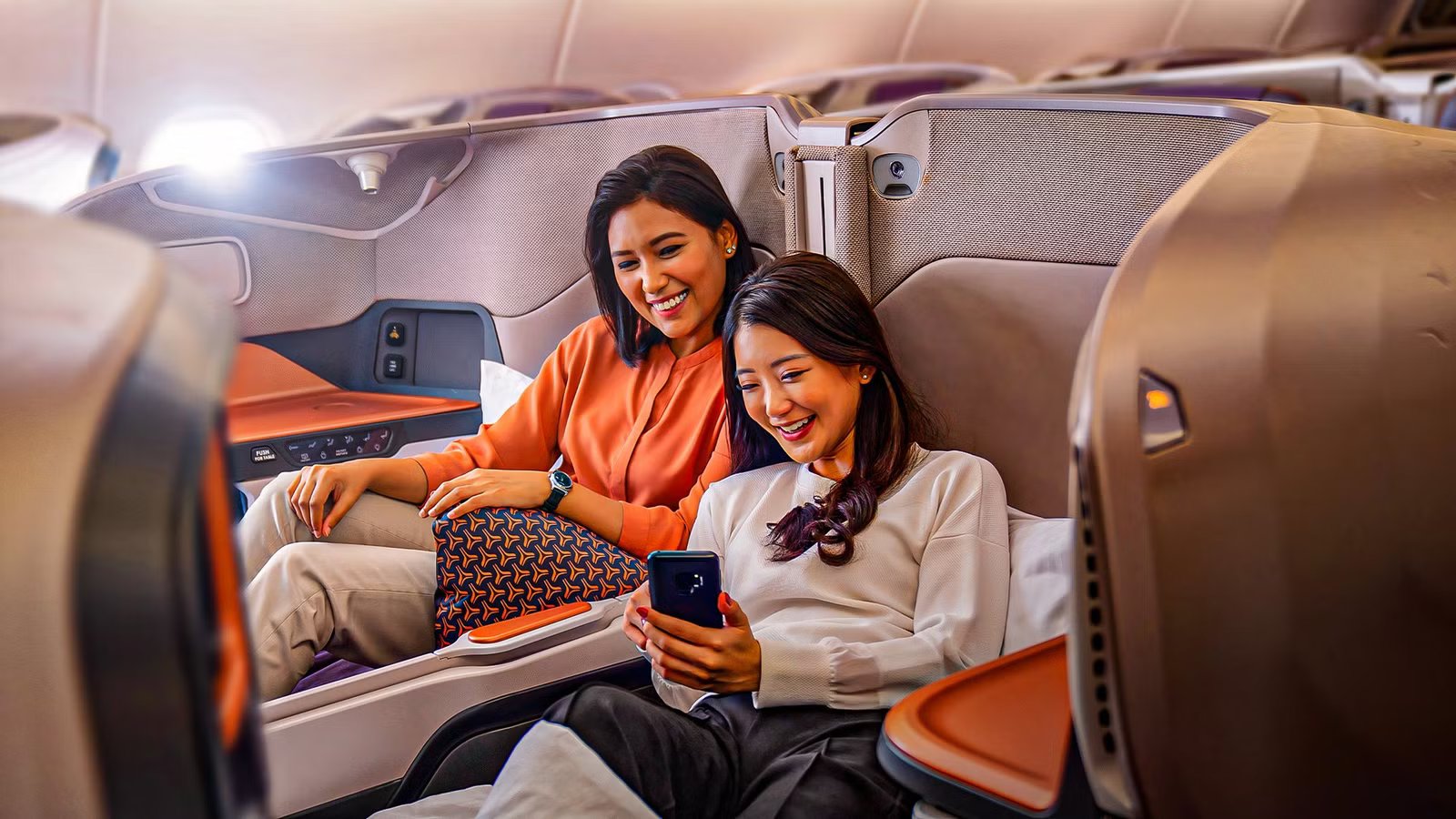
Constructing this architectural freedom allows for The Residence on Etihad or the massive  Singapore Airlines Suites, which offer 50 sq ft (4.6 sq m) of private living space. These are products that physically cannot fit inside the narrower fuselage of a Boeing 777 without removing entire rows of revenue-generating seats. The differential factor here is that the A380 offers a variety of environments within a single flight, allowing passengers to shift from a workspace to a social space and then to a sleeping space. It’s no wonder, therefore, that the A380 remains a bucket list aircraft for travelers, even as more modern and efficient alternatives dominate the market.
Economic Realities Of Scale

Despite the romanticism surrounding the superjumbo experience, no airline CEO keeps such a heavy aircraft in the fleet simply because passengers like the onboard lounge. In reality, the A380’s survival is dictated by the brutal mathematics of global airport infrastructure, specifically at slot-constrained hubs like  London Heathrow (LHR). When an airport is operating at 99% capacity, a single landing slot becomes a multi-million-dollar asset, and the only way for a carrier to increase revenue without adding more flights is to maximize the number of people sitting on each individual arrival.
This is where the A380’s economic viability shines. At London Heathrow, where a pair of daily slots can trade for tens of millions of dollars, flying one A380 with 500 passengers is significantly more profitable than flying two smaller Boeing 787s with 250 passengers each. By consolidating those travelers into a single airframe, the airline saves on landing fees, pays for only one flight crew, and frees up the second slot for a completely different route. For carriers like  British Airways or Emirates, the A380 is a mechanical force multiplier that allows them to squeeze more capacity out of airports that physically cannot build new runways fast enough to meet demand.
However, this math only works if the seats are filled. To remain viable, the A380 typically requires a load factor of at least 85% to 90%. In the pre-pandemic era, this was a struggle on many routes, but the surging global travel demand of 2026 has made selling out a 500-seat jet surprisingly routine. For passengers, this means their favorite plane is safe for now, not because of its quiet cabin, but because it is the only tool in the shed capable of cracking the bottleneck of global aviation infrastructure.

The Real Reason Why The Airbus A380 Production Ended
What do you think is the real reason Airbus discontinued the A380?
Changing Times

The decision to reactivate an aircraft that has been baking in the Victorville desert for three years is not as simple as recharging a battery and taxiing to the runway. This is a real financial gamble for airlines that can cost an airline upwards of $30 million (approx. €28 million) per airframe just to achieve flight-readiness, a figure that does not even include the ongoing fuel and landing fees that follow.
The technical reality of these resurrections centers on the dreaded D-check, a maintenance event so heavy that the aircraft is essentially taken apart and put back together again. Qantas recently highlighted this intensity when it spent 100,000 hours of labor to return its final stored A380, VH-OQC, to the skies after it spent 1,000 days in storage. During these checks, technicians must inspect every structural rivet, swap out massive landing gear sets, and often deal with a burgeoning parts crisis. Since Airbus stopped producing the A380 in 2021, the supply chain has tightened, forcing carriers to rely on cannibalizing retired airframes, stripping one dead plane to keep ten others alive, which creates a ticking clock on the fleet’s ultimate longevity.
This massive investment is largely a hedge against the continued delays of the Boeing 777X, which was supposed to replace the A380 but has left airlines like Emirates and Lufthansa with a capacity hole they cannot fill. However, with global fuel prices currently skyrocketing due to conflict in the Persian Gulf, the four-engine A380 would instantly transform from a cash cow into a white elephant. For airline boards, the A380 possesses museum-grade architecture that bridges the gap until the next generation of twin-jets finally arrives, but it remains a fragile economic miracle that could vanish the moment the market softens.
An Iconic Story Still Ongoing

The roadmap to retirement for the Airbus A380 is no longer a monolith of immediate withdrawals but very much a staggered timeline based on fleet age and regional market demand. The incredible resurgence has provided a much-needed lifeline, but the A380 is entering its twilight years for most carriers. British Airways, which relies heavily on the A380 for its capacity-heavy routes from London to Los Angeles and Johannesburg, is expected to maintain its 12 aircraft until roughly 2030. Meanwhile, Qantas has suggested a more gradual exit, with its refurbished fleet likely remaining a staple on the ‘Kangaroo Route’ until the early 2030s when the ultra-long-haul Project Sunrise flights begin to dominate the network.
In the East Asian market, the perspective is slightly different, as the A380 has become a unique symbol of leisure and prestige that defies the standard point-to-point trend. All Nippon Airways has turned its three A380s into a destination in their own right, operating exclusively between Tokyo and Honolulu. These aircraft, painted in vibrant sea turtle liveries, are frequently booked to capacity months in advance, showing that when an aircraft is treated as a branded experience rather than a mere transport vehicle, it can defy traditional economic gravity.
The final A380 may soon touch down for the last time, but it will have served for over three decades, outlasting many of its contemporary skeptics. It serves as a testament to the idea that in a world obsessed with the smallest possible carbon footprint, there is still a profound human desire for the largest possible flying experience. The A380 created a market of its own, one that was defined by the quality of the journey rather than just the efficiency of the arrival.