dailynewsnblog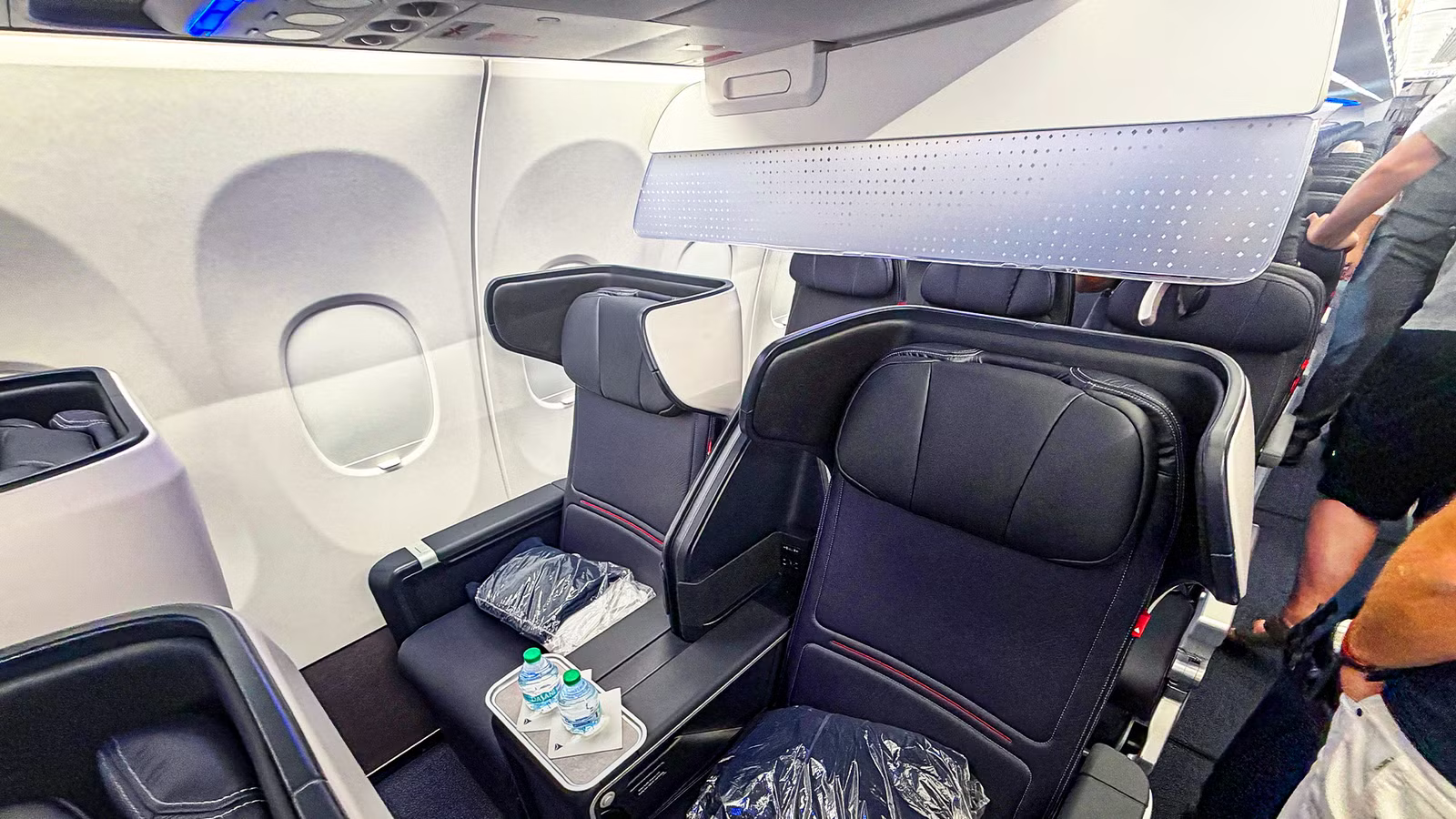
 Delta Air Lines has turned a certification delay into one of the most unusual cabins in the US airline industry. Seven Airbus A321neo aircraft that were intended to receive Safran VUE lie-flat suites are instead flying with 44 conventional domestic First Class recliners. That number is more than twice the 20 First Class seats installed on Delta’s standard A321neo. The temporary arrangement was created after certification of the VUE seat failed to arrive in time, leaving Delta with new aircraft that could either remain idle or enter service in a very different configuration.
The seven aircraft entered revenue service during May 2026, with scheduled operations beginning June 7 on routes from  Hartsfield-Jackson Atlanta International Airport (ATL) to Los Angeles, San Diego, San Francisco, and Seattle. Delta said the interim solution was designed to put new aircraft into customers’ hands for the summer rather than keep them parked. However, what began as a workaround is now producing an unexpected, yet promising commercial result which is encouraging Delta to reconsider its domestic premium seating plans. Delta still intends to install the original lie-flat product when certification and delivery issues are resolved.
The Cabin Was Created By A Certification Delay

The unusual cabin exists because Delta’s original plan was fundamentally different. The seven A321neos were intended for a premium-heavy configuration built around Safran Seats’ VUE, a lie-flat business-class seat designed for single-aisle long-haul aircraft. Delta planned these aircraft for markets where customers would value a true bed rather than a conventional domestic recliner, in particular, transcontinental routes.
However, the first aircraft arrived before that seat was ready for airline service. Delta took delivery of the relevant A321neos beginning in 2024, but the aircraft could not be completed in the intended passenger configuration while the VUE certification process remained unresolved. Rather than leave finished airframes in storage, Delta substituted a seat already approved for domestic First Class.Mauricio Parise, Delta’s Vice President of Customer Experience Design, described the decision as a response to an unpredictable supply chain. The airline said the objective was to get customers onto some of its newest aircraft in time for summer while retaining the ability to introduce the planned flat-bed product later.
While supply chains are responsible for the pivot, there is a broader regulatory landscape at play. A new aircraft seat must demonstrate compliance with applicable airworthiness requirements before an airline can install it for revenue service. Safran’s certification operation covers areas including supplemental type certificates, continued-airworthiness documentation, and electrical wiring documentation for cabin modifications.That delay transformed a cabin-design problem into a fleet-management decision. Delta had already committed capital to the aircraft, but could not use the product that justified the unusual configuration. The temporary First Class cabin allowed the airline to recover some productive capacity while the certification issue continued.
Delta Replaced A Lie-Flat Concept With An Unusually Large First Class

The substitute configuration is striking because Delta did not simply install its normal A321neo interior. Instead, it filled 11 rows with 44 First Class recliners in a 2-2 arrangement. The aircraft also has traditional Comfort+ and Main Cabin seats, for a total of 164 passengers, but it is the size of the First Class cabin that stands out.
Delta A321neo Cabin Configuration Comparison | ||
|---|---|---|
Domestic First Class Seats | Total Cabin Seats | |
Temporary Premium Configuration | 44 | 164 |
Standard Configuration | 20 | 194 |
A standard Delta A321neo carries only 20 First Class seats, but holds a much greater total number of passengers. The temporary configuration sacrifices 30 seats overall while more than doubling the number allocated to First Class. Main Cabin accounts for only 66 seats, compared with 114 on the standard layout. The result changes the economics of the aircraft before it ever leaves the gate, as Delta is dedicating a much larger share of the cabin to passengers willing to pay for additional space, service, and priority treatment.
Catch what other flight trackers miss
Emergency squawks, holds, NOTAMs — live signals, no signup.
Open tracker
Catch what other flight trackers miss
Emergency squawks, holds, NOTAMs — live signals, no signup.
Open tracker
Despite the premium bias, the physical product is still domestic First Class, not Delta One. The recliners do not convert into beds, and the cabin lacks the privacy and sleeping capability that would have defined the original VUE-based configuration. The added seats nevertheless give Delta a much larger inventory of premium seats on selected long domestic flights. Delta specifically targeted West Coast markets from ATL for the aircraft. The airline has continued to retain aircraft with Delta One suites on certain widebody peak Atlanta-Los Angeles flights, preserving a lie-flat option while the temporary aircraft serve additional premium demand.
The Workaround Is Selling Better Than Expected

The most consequential development came after the aircraft entered service. Joe Esposito,Delta’s Chief Commercial Officer, said the airline is selling approximately 80% of the 44 First Class seats to paying customers. That measure matters because it excludes seats occupied through complimentary upgrades, making it a clearer indicator of customers purchasing the premium product directly.
The figure does not mean every flight is consistently four-fifths full in First Class, nor does it establish that Delta should put 44 premium seats on every narrowbody. It does, however, show that a much larger paid premium cabin can work on carefully selected markets. Atlanta is Delta’s largest hub, and the West Coast destinations served by these aircraft are among the airline’s longest domestic markets. Customers on those flights have more reason to value additional space, especially when the alternative is several hours in a standard economy seat.
Delta’s own explanation anticipated strong interest in premium travel. Parise said customers on coast-to-coast routes want more premium seat options, and the subsequent sales performance gives the airline actual operating data to validate that assumption rather than relying solely on forecasts. The temporary fleet is therefore functioning as a live experiment. Delta can observe booking patterns, paid demand, upgrade behavior, revenue performance, and customer response without committing its entire narrowbody fleet to a new cabin formula. The airline has effectively gained a controlled test group from a problem it did not intend to create.
The Aircraft Are Exposing A Larger Shift In Delta’s Premium Strategy

Delta’s decision also fits a broader strategy of increasing premium capacity across its fleet, of which the A321neo is central to that effort. The airline describes it as the largest-gauge next-generation narrowbody in its fleet and says it has the lowest unit cost of any Delta narrowbody. The airline has also expanded its A321neo order book, with deliveries from a 34-aircraft option exercise scheduled to begin in 2029.
The temporary aircraft provide a useful contrast between two approaches to premium growth. The planned VUE cabin would have used fewer seats but offered a substantially more sophisticated product. The interim layout instead maximizes the number of customers receiving conventional First Class. Those models serve different commercial purposes. Lie-flat seating can command a higher fare and strengthen an airline’s position on premium transcontinental markets, but it also requires more complex equipment, certification, maintenance, and cabin space per passenger. Recliners offer less differentiation, yet allow Delta to sell more premium seats without waiting for the new seat to clear certification.
Delta’s broader cabin investments suggest it is not abandoning premium differentiation while this experiment runs. The airline expects most of its Delta One seats to become suites with privacy doors by 2030 and is introducing new-generation suites on the Airbus A350-1000 while expanding suites to additional Airbus A330 aircraft. The A321neo experiment therefore sits between two strategies. It tests the revenue potential of premium volume while Delta continues investing in premium product quality. Ultimately, the airline’s main objective is to deliver a valuable product to its customers.
“For nearly 20 years, Delta has set the standard for the U.S. industry – first with flat beds and direct aisle access, and first again with suites – each time building a multi-year lead in execution. There are no shortcuts, and we will never compromise on safety or comfort. Our teams design with intent, listening closely to our people and customers to deliver an exemplary experience at every step of the journey.” – Ranjan Goswami, Chief Marketing & Product Officer
Temporary Cabin Could Outlive Its Original Purpose

Delta originally presented the 44-seat arrangement as a limited solution, but the airline has not committed to a firm end date. That flexibility has become useful because the certification timeline for VUE remains uncertain, with industry reporting pointing to 2028 as the earliest likely timeframe for the intended configuration. The delay creates an unusual incentive for Delta. If the temporary aircraft were performing poorly, the airline would have a strong reason to complete the transition quickly. Instead, the large, paid First Class load factor gives Delta a commercial reason to keep the aircraft in their current form while certification continues.
The eventual configuration is expected to be substantially different. The 21 A321neos planned for the premium layout are designed to carry 16 Delta One suites, 12 Premium Select seats, 54 Comfort+ seats, and 66 Main Cabin seats, for 148 passengers. That is 16 fewer seats than the temporary configuration, but the premium product would move from conventional recliners to lie-flat suites. Delta will therefore have to determine whether the revenue and customer value generated by a smaller number of higher-end seats outweighs the strong performance of the temporary First Class cabin.
That decision could also influence future aircraft orders. Esposito has described the 44-seat experiment as a way to assess how large a domestic First Class cabin should be, with the results informing future fleet planning. Delta has already increased First Class capacity planned for some future narrowbody aircraft, suggesting that the test is affecting thinking beyond these seven A321neos.
A Certification Problem Became A Fleet Experiment

The unexpected result is more significant than the temporary cabin itself. An 80% paid load factor gives Delta evidence that premium demand on selected domestic routes can support a much larger First Class section than the airline normally installs. It does not prove that 44 seats is optimal, but it gives Delta a valuable data set that could shape future narrowbody layouts.
The next phase will depend on both certification and economics. If VUE eventually enters service, Delta will have to decide whether to restore the original premium-heavy design exactly as planned or incorporate what it has learned from the interim aircraft. The seven jets have turned a seat certification delay into a rare real-world experiment, and the outcome could influence how Delta allocates scarce cabin space long after the original problem is resolved.