dailynewsnblog
Why The Aft Section Is The Achilles’ Heel Of Any Stealth Aircraft

Stealth aircraft are usually discussed in terms of radar cross-section (RCS), but modern air defenses increasingly rely on infrared search-and-track (IRST) systems that detect heat rather than radar returns. A jet engine operating at altitude produces an intense thermal plume that can remain visible even when radar signature is heavily suppressed. For aircraft such as the B-21 Raider, managing what an adversary sees behind the aircraft may matter as much as what they see from the front.
The aft section compounds the challenge. A direct view into the exhaust exposes some of the aircraft’s hottest components: the combustor, turbine stages, and nozzle, while the rotating fan and turbine blades are also strong radar reflectors. Managing this area means suppressing radar returns, blocking direct thermal visibility to the hot section, and dispersing the exhaust plume quickly enough to reduce detectability from the primary threat axis: below and behind.
Each of those surfaces radiates heat across a wide spectral band, and most of them are also strong radar reflectors. The rotating fan and turbine blades are among the highest-return features on any aircraft. Managing the aft section means simultaneously suppressing radar returns from inside the engine, preventing a direct thermal line-of-sight to the hottest components, and dispersing the exhaust plume quickly enough to reduce its detectability from the threat axes a penetrating bomber would actually face: below and behind.
This is precisely why, as The War Zone noted when the April 2026 image was published, the exhaust section is the last part of any stealth bomber program to be shown publicly, and the most likely to be altered before release. An adversary that can characterize your exhaust geometry can model your thermal signature, identify your optimal detection angles, and tune their sensor systems accordingly.
What The B-2 Spirit Solved — And The Cost Of Solving It

The B-2 Spirit’s exhaust system was, for its time, one of the most sophisticated thermal suppression architectures ever placed on an operational aircraft. According to The Aviationist, Spirit’s four General Electric F118-GE-100 non-afterburning turbofans, each producing approximately 17,300 lbs (76,950 N) of thrust, are buried completely within the flying-wing airframe. The exhaust gases travel through long internal ducts before being expelled through broad, shallow slot-like outlets on the upper wing surface, positioned at the trailing edge. No round nozzles, no exposed hot sections. From below, the primary threat axis for a bomber at altitude, the hottest engine components are invisible.
The outlet configuration does more than simply hide the exhaust path. As The National Interest has reported, secondary air inlets scoop cooler ambient air and mix it with the hot exhaust before it exits, accelerating thermal dissipation. The exhaust then passes over the “aft deck,” a specialized surface built from titanium and carbon-fiber composite, covered in V-Trough carbon tiles that further diffuse residual heat — preventing it from soaking into the airframe or radiating as a detectable signature. The absence of afterburners eliminates the most intense thermal source of all.
What the engineering worked, but it came at a price that nearly destroyed the program. The B-2’s exhaust duct and aft deck structure proved notoriously difficult and expensive to maintain. The specialized materials degraded under repeated thermal cycling, the trough-like structure required frequent depot-level attention, and the tight integration of the exhaust architecture with the rest of the airframe made any modification slow and costly. As Simple Flying has detailed, these maintenance burdens were a core driver of the B-21’s design philosophy: the Raider’s exhaust ducts are shielded with next-generation composites, and the engines are buried even deeper in the wing than the B-2’s were, reducing both the infrared contrast against a cold high-altitude sky and the structural thermal stress on the aft section.
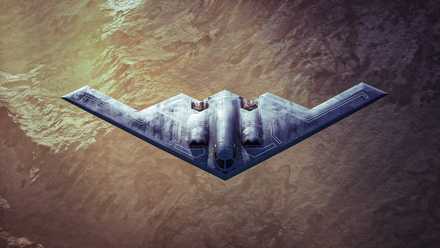
From 19 B-2 Spirits To 145 B-21 Raiders: How Much Bigger America’s Stealth Bomber Fleet Is About To Get
A $4.5 billion production deal signal the Air Force’s commitment to building its next-generation bomber
What The B-21 Does Differently — And Why The Shape Changed

The April 2026 overhead image confirmed two exhaust features of the B-21 that had previously been visible only in fragmentary ground-based imagery. While some observers initially described the exhausts as chevron-shaped, clearer imagery confirmed the B-21 uses a straight-edge trailing edge rather than the saw-tooth (chevron) design found on the B-2 Spirit. Second, and more significantly, those outlets are oriented in an inverse direction compared to the B-2’s exhaust geometry, and positioned substantially further forward of the aircraft’s trailing edge than on any previous stealth bomber.
According to Aircraft Insider, this forward placement physically increases the distance between the hot exhaust plume and the rear edge of the aircraft, reducing the detectable infrared signature from below and behind, the exact threat axis that surface-to-air missile systems and rear-hemisphere IRST sensors would exploit.
The trailing edge geometry tells a related story. The B-2’s characteristic W-shaped trailing profile, while aerodynamically effective, created complex radar scattering at its sawtooth features, a known engineering tradeoff that the designers accepted because the B-2 was required to fly at low altitude as well as high. The B-21 carries no low-level penetration requirement; it is designed exclusively as a high-altitude platform, which freed its engineers to simplify the trailing edge into a cleaner W geometry. That simplification, per The War Zone, reduces the radar hot spots associated with the B-2’s more complex profile, while also making the aft section easier to manufacture and maintain.
What the image notably does not show is any visible active cooling material, trough-like structure, or planar cooling surface behind the exhaust, the features that defined the B-2’s aft deck and were so maintenance-intensive in service. Whether those features are absent by design, replaced by classified alternatives, or simply edited out of the released photograph before publication remains unknown. The War Zone explicitly noted that the image “very well could have been altered to not give certain features of the B-21’s exotic exhausts away“, a standard practice for sensitive program imagery, and one that leaves the most important thermal engineering questions unanswered.
The High-Bypass Engine: A Cooler Plume By Design

The geometry of the B-21’s exhaust outlets is only part of its thermal suppression strategy. The other part lies upstream, in the propulsion system itself. The Northrop Grumman B-2 Spirit uses the General Electric F118-GE-100, a low-bypass turbofan derived from the F110 fighter engine with a bypass ratio of roughly 0.87:1. That choice was driven less by thermal efficiency than by stealth constraints: the B-2’s deeply curved radar-absorbing inlet ducts had to conceal the engine fan faces from radar, and higher-bypass engines would have introduced airflow distortion challenges that 1980s computational tools struggled to solve.
In practical terms, the B-2 received the engine its inlet design could support, not necessarily the one best suited for infrared suppression. The Northrop Grumman B-21 Raider was developed in a different era. Modern computational fluid dynamics allows far more precise management of airflow through complex inlet geometries, opening the possibility of using a higher-bypass propulsion architecture without compromising stealth. According to Aviation Week, analyst Bill Sweetman has described the implications directly:
“A higher bypass ratio provides much better specific fuel consumption than the B-2’s fighter-type engine, improving range, and would enable a cooler, lower-velocity exhaust, not only lowering the B-21’s infrared signature but also alleviating thermomechanical stress on the open aft deck area of the exhaust, immediately ahead of the trailing edge.”
Northrop Grumman has described the B-21 as “the most fuel-efficient bomber ever built,” consuming a fraction of the fuel used by fourth- and fifth-generation aircraft — a claim consistent with a high-bypass architecture. That efficiency also translates directly into thermal signature: a higher-bypass engine moves more mass of cool bypass air per unit of hot core exhaust, producing a lower average exhaust temperature at the nozzle exit. The B-21 begins suppressing its IR signature at the engine core itself, before the exhaust reaches any specialized aft deck material. That is a fundamentally different approach from the B-2, where the engine was treated as a given and the thermal suppression architecture was built around it.

7 Reasons Why The US Air Force Still Operates The B-52
From nuclear deterrence to missile truck missions, the B-52 Stratofortress remains essential to US airpower even in 2026.
The Spy Who May Have Made A Redesign Strategically Necessary

The engineering rationale for moving beyond the B-2’s exhaust architecture stands on its own. But there may have been another factor pushing Northrop Grumman toward a fundamentally different solution: the B-2’s thermal suppression system had already been compromised long before the B-21 entered development.
In August 2010, former Northrop propulsion engineer Noshir Gowadia was convicted on 14 federal counts, including communicating national defense information to aid a foreign nation. According to NBC News, Gowadia was sentenced to 32 years in prison in January 2011. Gowadia worked on the B-2’s exhaust system during development and later made six trips to China between 2003 and 2005, during which he provided Chinese engineers with classified data on low-signature exhaust nozzle design and, according to prosecutors, helped the People’s Republic design a cruise missile exhaust system optimized to evade US heat-seeking missiles.
The implications for the B-21 program, which was taking shape in the same period, were direct. If China’s engineers understood the thermal suppression principles behind the B-2’s exhaust architecture, they could model its infrared signature, identify its most detectable aspects, and design their IRST and missile seeker systems to exploit them. An adversary that knows exactly how your exhaust works is an adversary with a significant targeting advantage.
Some defense analysts have therefore argued that the Northrop Grumman B-21 Raider may represent more than an evolutionary improvement over the Northrop Grumman B-2 Spirit. Its visibly different rear-hemisphere design could also serve a strategic purpose: creating separation from an architecture whose principles were potentially exposed. That interpretation remains speculative; Northrop has never linked the redesign to the Gowadia case, but the timeline is notable: Gowadia was sentenced in 2011, the same year the Long Range Strike Bomber program formally began.
What Remains Classified, And Why It May Stay That Way

The April 2026 overhead image is the most revealing photograph the B-21 program has produced, and it may still be showing the public a version of the aircraft that has been carefully edited to conceal the most sensitive engineering. The War Zone noted the striking absence of any visible heat-attenuating material in the aft section, and the possibility that the released image was digitally altered before publication to protect exactly that technology. The exhaust suppression mechanism of the B-21, whatever actually happens between the engine outlet and the external atmosphere, remains among the most tightly guarded technological secrets in the US defense inventory.
That classification posture reflects a lesson the B-2 program learned the hard way. The most detailed technical knowledge an adversary can obtain about a stealth bomber is not its radar cross-section, which can be estimated through external observation, or its flight performance, which can be characterized during encounters. It is the thermal signature management architecture: the specific materials, geometries, and airflow patterns that determine what an IRST sensor actually sees when the bomber is overhead. That knowledge directly informs the sensitivity requirements of detection systems and the seeker algorithms of missiles. Keeping it classified makes the difference between a penetrating strike aircraft and an expensive target.
What the B-21 program has shown, across everything that is publicly known, is a systematic effort to improve on the B-2’s exhaust solution in every dimension simultaneously: a lower-temperature exhaust from a more efficient engine, outlets positioned further forward and shaped to break up the thermal plume more aggressively, and a simpler trailing edge that reduces radar returns. As the Raider approaches its first delivery to Ellsworth Air Force Base in 2027, the exhaust section will remain the last thing Northrop Grumman shows anyone — and almost certainly the first thing an adversary’s engineers are trying to reconstruct from the images already released.