dailynewsnblog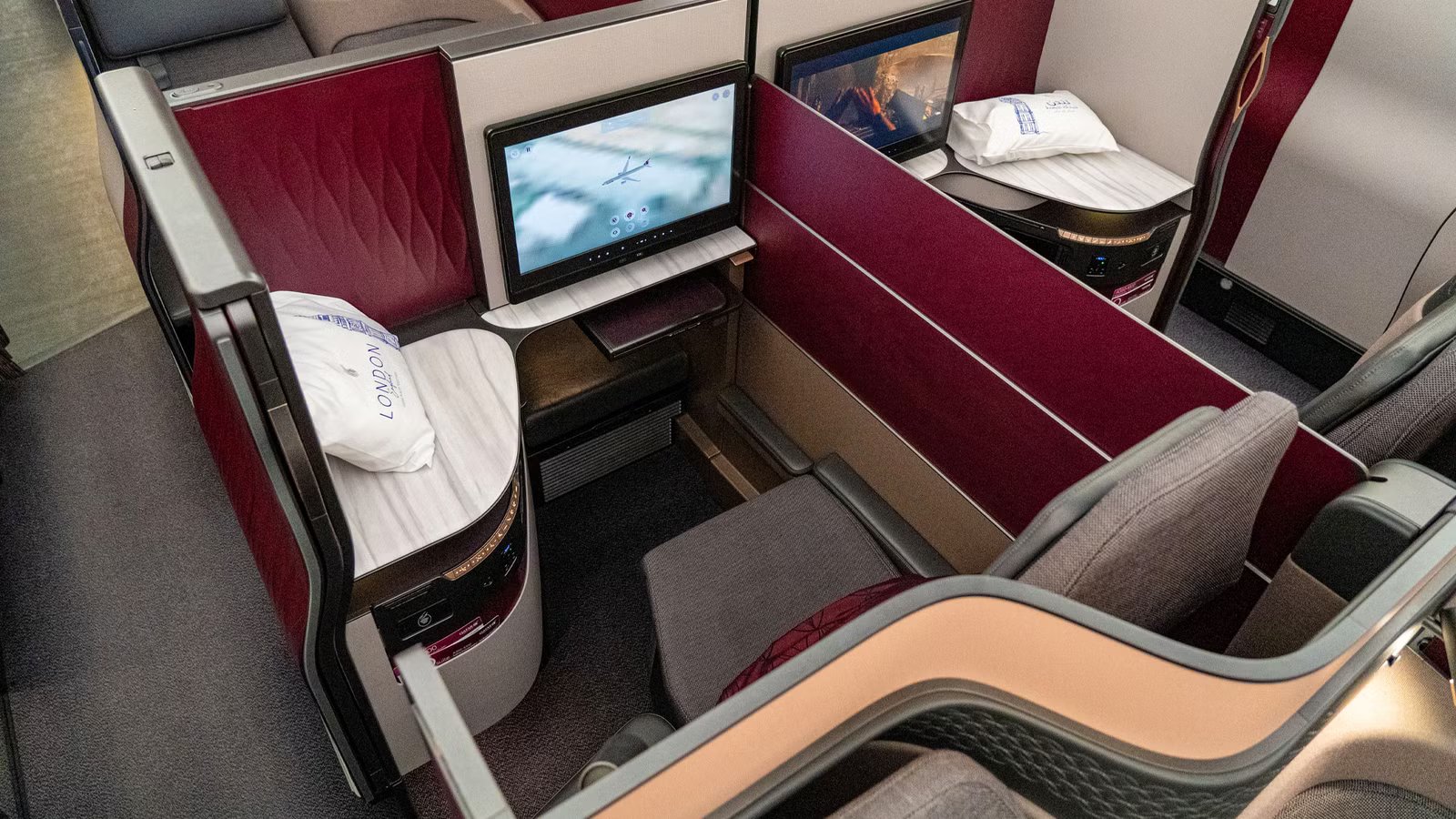
At the ITB Berlin trade show in March 2017,  Qatar Airways unveiled Qsuite and completely changed the trajectory of premium travel. By introducing a sliding privacy door in business class, the carrier erased the traditional boundary between the business cabin and the exclusivity of first class. In this article, we will explore the story behind the decision, from the open-plan layouts of the 1990s to the motorized, high-definition rooms that define the skies today.
The Qsuite served as a global equalizer, bringing the fully enclosed suite, previously a first class luxury, to a wider audience. This innovation sparked an industry-wide race to catch up, forcing competitors across the United States, Europe, and Asia to accelerate their own cabin redesigns. Its inception was not without its engineering challenges and fierce rivalry that transformed the long-haul experience into the private, apartment-style transit we see today.
Constant Progression

The early decades of business class were defined by a communal atmosphere that offered little more than a wider seat and slightly better catering than economy. In the 1980s and 1990s, the cradle seat was the industry standard, providing a generous recline but no privacy from the passenger sitting just centimeters away. During this era, the cabin was a sea of exposed headrests and shared armrests, where the only way to achieve seclusion was through the use of a bulky eye mask.
The turn of the millennium brought the first lie-flat seats, yet these designs remained largely open to the aisle. Seats were often arranged in a 2-2-2 or 2-3-2 configuration, per One Mile At A Time, meaning many passengers still had to climb over a sleeping neighbor to reach the lavatory. The physical comfort of the bed improved, but the psychological comfort of privacy remained elusive, as travelers were still visible to anyone walking down the aisle or sitting in the adjacent row.
By the early 2010s, reverse herringbone and staggered layouts began to offer more personal space, yet they still lacked vertical privacy. These seats utilized small shells or wings near the headrest to block peripheral vision, but they could not prevent light or noise from the rest of the cabin. It was this persistent lack of a true enclosure that set the stage for a radical rethinking of the business class architecture.
One Simple Goal

Developed over a period of three years in collaboration with seat manufacturer B/E Aerospace, the goal for Qsuite was to create a modular environment that could adapt to the varying needs of solo travelers, couples, and even groups of four. This required a complete departure from off-the-shelf seating products, forcing engineers to design a bespoke frame that could house the revolutionary sliding door without compromising the strict weight and safety requirements of modern aviation.
One of the most significant technical hurdles involved the certification of the privacy door itself. Aviation authorities are notoriously cautious about anything that might impede a rapid evacuation, leading to rigorous testing of the door’s release mechanisms and structural integrity during turbulence.
Feature | Standard Business Class (2017) | Qatar Airways Qsuite |
Privacy Door | None | 127 cm (50 inches) high |
Bed Length | 183–193 cm (72–76 inches) | 201 cm (79 inches) |
Seat Width | 48–51 cm (19–20 inches) | 55 cm (21.5 inches) |
Configuration | Open / Semi-Private | Fully Enclosed |
Per Runway Girl Network, to satisfy these safety standards, the team engineered a fail-safe system that allows the door to be easily popped open from the outside by cabin crew or from the inside by passengers. Additionally, the use of lightweight composite materials ensured that the added weight of the suite walls did not significantly impact the fuel efficiency of the Boeing 777-300ER and Airbus A350 aircraft that would first carry them.
When the product launched, the industry realized that Qsuite had achieved something previously thought impossible. A 1-2-1 configuration that felt like a series of private rooms was now something that could be made mainstream. Alternating the direction of the seats, some facing forward and others facing the rear, the designers maximized every square cm of the cabin floor. This clever arrangement provided enough space for the signature sliding doors while maintaining a high density of 42 suites on the 777.
Packed Full Of Features

The innovation of the Qsuite extended outside the comfort of the enclosed suite and out into the social dynamics of the widebody cabin. To do so, the quad configuration was added, allowing four passengers traveling together to transform their individual suites into a shared social or meeting space.
This was achieved through a unique arrangement of center seats, with adjustable panels and movable television monitors that could be retracted to create a communal area in the middle of the aircraft, perfect for family dining or business collaboration. For couples, the center suites offered another industry first for business class with a genuine double bed.
Lowering the privacy partition and aligning two adjacent seats into a fully flat position, travelers could share a continuous sleeping surface measuring 201 cm (79 inches) in length. This feature was previously the exclusive domain of ultra-expensive first class products. Such a capability remains a benchmark for luxury, providing a level of intimacy that outclasses any predecessor. The physical dimensions of these beds are supported by a 1-2-1 layout.
This ensures that every passenger has direct aisle access, even when the double bed is fully deployed. Each suite provides a 55 cm (21.5-inch) seat width, which expands significantly when the armrests are lowered in bed mode. This design philosophy, which some describe as first-class lite, ensures that the 42 business class passengers on a Boeing 777-300ER enjoy a footprint that is nearly 50% larger than the standard business seats found on many transatlantic competitors.
The Origins Of The Suite Door

The concept of a closing door was not entirely new when the industry shifted in 2017. The architectural DNA of the suite actually dates back to 2003, when  Emirates made aviation history with its Airbus A340-500. This flagship aircraft introduced the first fully closing doors in a first class cabin, establishing a new pinnacle for high-net-worth travelers who demanded total isolation from the rest of the aircraft.
This early iteration of the suite was a mechanical marvel for its time, featuring a motorized door, something that was truly special for this product. For more than ten years, this level of separation remained the exclusive privilege of those paying for first class tickets, creating a massive gap in the passenger experience between the two premium cabins.
The genius of the 2017 innovation was not the invention of the door itself, but the radical decision to democratize that level of privacy for a significantly larger number of travelers. Making this transition required a significant reduction in the thickness and weight of the suite walls.
The original 2003 suites were heavy and complex, but modern engineering has allowed for slimline panels that provide a psychological barrier without the massive fuel penalty. By shrinking the footprint of the suite while maintaining the door, the industry has now moved toward a future where business is the new first, leaving many carriers to wonder if a dedicated first class cabin is even necessary moving forward.
Global Catch Up

The success of the Qsuite sparked an immediate race among global carriers, as the privacy door shifted from a luxury novelty to a competitive requirement.  Delta Air Lines was the first of the three major United States carriers to respond, launching its Delta One Suites on the Airbus A350 in late 2017. Even the highly competitive North American market recognized that the era of the exposed, open-aisle cabin was coming to a rapid end.
 British Airways followed in 2019 with the introduction of its Club Suite, a product that finally replaced its aging, high-density layout with a modern configuration featuring a sliding door. This transition was particularly significant as it represented a legacy carrier acknowledging that the Middle Eastern leaders had set a new global benchmark that could no longer be ignored.
Airline | Product Name | Door Height | Seat Configuration |
Qatar Airways | Qsuite | 127 cm (50 inches) | 1-2-1 (Staggered) |
Delta Air Lines | Delta One Suite | 117 cm (46 inches) | 1-2-1 (Staggered) |
British Airways | Club Suite | 114 cm (45 inches) | 1-2-1 (Reverse Herringbone) |
All Nippon Airways | The Room | 114 cm (45 inches) | 1-2-1 (Forward/Rear) |
Meanwhile, in Asia, All Nippon Airways (ANA) unveiled The Room on its Boeing 777-300ER, a massive suite that provides almost twice the width of a standard seat, further pushing the boundaries of what a business class enclosure could achieve. The impact of this craze reached beyond the traditional global titans, influencing boutique and low-cost long-haul carriers as well.
JetBlue integrated privacy doors into its Mint Suite for transatlantic narrowbody flights, while carriers like  Etihad Airways and LATAM began retrofitting their fleets with similar high-walled enclosures. The absence of a door in a newly delivered long-haul business class cabin is often viewed as a significant competitive disadvantage, as the traveling public has decisively embraced the room in the sky philosophy.
More Still To Come For Qsuite

The evolution of the private cabin reached a new milestone with the unveiling of the Qsuite Next Gen, commonly referred to as Qsuite 2.0. The original product relied on manual sliding mechanisms, but the latest iteration introduced at the Farnborough International Airshow features fully motorized doors that operate with a silent, fluid motion.
This technological advancement represents the transition from a mechanical seat to a smart environment, where the boundaries of the suite are controlled via integrated touchscreens. Today, these high-walled rooms have become the standard for the airline’s next flagship Boeing 777-9 fleet, ensuring that the pioneer of the business class door remains at the forefront of cabin architecture. The practical benefits of the 2.0 version extend into the realm of digital security and enhanced ergonomics.
The new suites feature digitally lockable storage drawers that allow passengers to secure their personal electronics and travel documents with a custom code, providing peace of mind during rest periods. Additionally, the bed surfaces have been widened to offer a more expansive sleeping area, complemented by 4K OLED screens that measure 56 cm (22 inches) across.
These technical refinements address the minor pain points of the original 2017 design, focusing on a seamless blend of high-tech utility and residential comfort that makes the long-haul transit feel less like a flight and more like a private office in the clouds. The legacy of the sliding door is likely to evolve into fully immersive, AI-driven environments. Future cabin concepts are already exploring the use of smart glass that can transition from transparent to opaque at the touch of a button.
This will potentially replace the physical weight of a sliding panel with electronic light control. As the industry moves toward lighter materials and sustainable propulsion, the challenge will be maintaining this level of heavyweight luxury while reducing the overall carbon footprint of the aircraft. However, the precedent set in 2017 remains unshakable, a key point in not only Qatar’s history but the entire history of commercial aviation.