dailynewsnblog
Pinpointing exactly where the most military air traffic flies in the world typically corresponds to armed conflicts and humanitarian crises. However, a number of the busiest are located in the continental United States, where there is an overlap between large bases that belong to the Air Force, Navy, or Marines. Although the US military does not publicly publish flight schedules at virtually any airfield, they do release annual activity estimates.
Using what little information is publicly revealed while corresponding it with historical trends and other data accessible through websites such as FlightAware and Flightradar24, it is possible to estimate the volume of traffic in military air corridors around the world. Following geopolitics and correlating that with both public flight data and military situation reports lends a glimmer into operational tempos.
5
The US Military’s Mid-Atlantic Air Bridge
50+ Daily Flights

The US military maintains the largest presence of forces and overseas bases of any nation in the world. In order to sustain this colossal apparatus, the US maintains continuous airlift operations around the world. The transatlantic artery of airlift is anchored on one side by Dover AFB in Delaware, on the east coast of the United States, and Ramstein Air Base in Germany on the other side. A large number of transport planes like the Lockheed C-5 Galaxy or Boeing C-17 Globemaster III transit to the UK.
There are also many American forces in Germany. Depending on overseas ops, strategic strike aircraft like the Boeing B-52 Stratofortress or Northrop Grumman B-2 Spirit also make the same transit. As with any area that experiences a heavy concentration of military sorties, activity surges depending on deployments or active conflicts. The heavy bombers regularly cross the ocean on their way to expeditionary deployments or non-stop combat missions.
Fighter jets also follow these tracks, depending on their home base. Some of these planes will also pass through the other busy corridors across the ocean on their Journey, whether that’s in Eastern Europe or in the Middle East. Since the US military has a very large permanent presence in Europe and frequent deployments to the Middle East, privately contracted airlift is also commonly seen on this corridor.
Defense charter flights operating Boeing 747-8F transports flown by carriers like Kalitta or Atlas Air are also frequently seen flying these tracks as they support US armed forces on deployments. Diplomatic aircraft are also frequently seen making this transit, with Air Force One often making the trip ‘across the pond’ to Europe or the Middle East.
4
Ukraine & Eastern European Border
50+ Daily Flights

In addition to the thousands of military aircraft maintained by the air forces of Europe, as part of its commitment to the North Atlantic Treaty Organization, the US Armed Forces maintain significant numbers across the continent. The Mach Loop in the United Kingdom is a well-known location where many military aircraft fly every day, and Ramstein Air Base in southern Germany is also a hub. However, many of these planes spend much of their time in the skies over Eastern Europe after they take off.
When Russia invaded Ukraine in 2022, overflights increased dramatically across the theater. Obviously, for security reasons, there are no official numbers published about the sortie rate of any combatant engaged in the ongoing battle for Ukraine. Russia and Ukraine have both deployed their air forces extensively for standoff strikes, close air support, and surveillance.
Although the United States and NATO are not officially involved in the conflict, there is a much higher rate of military sorties than before the fighting started. As a function of normal air policing to maintain the safety of flight for all, the North Atlantic Treaty Organization carried out 500 quick reaction alert scrambles in 2025. A large portion of these flights occurred over the North Sea, the Baltics, and wider Eastern Europe.
Even before the current conflict broke out, the US and NATO have historically flown intelligence aircraft like the RC-135 Rivet Joint and the E-3A AWACS frequently throughout the region. These big specialized multi-engine jets carry large aircrews that operate complex suites of electronics to support fighters and perform around-the-clock surveillance. Many of these planes cross the North Sea from the UK as they fly through the Baltics.
Catch what other flight trackers miss
Emergency squawks, holds, NOTAMs — live signals, no signup.
Open tracker
Catch what other flight trackers miss
Emergency squawks, holds, NOTAMs — live signals, no signup.
Open tracker
3
The Persian Gulf
100+ Daily Flights

The United States and Israel have been engaged in armed conflict for decades across the Middle East. A major function of the expeditionary military forces deployed by the US into the region is permanent, shared, and temporary airfield operations that sustain massive troop levels as well as flying unit concentrations. Since shots were fired earlier this year, commercial aviation has been almost completely evacuated from this region, and it is solely saturated by military aircraft and armed drones.
This region has historically experienced a significant amount of air traffic by US military aircraft, including the Air Force, Navy, and Marines. Other operators have also been very active for many years due to hostilities between regional actors like Israel, Iran, Iraq, and Syria, among others. Many fighter jets fly through this airspace, such as the Boeing F-15 Eagle, Lockheed Martin F-16 Fighting Falcon, and even strike platforms like the legendary Northrop Grumman B-2 Spirit stealth bomber as they conduct combat missions.
Since the beginning of Operation Epic Fury, the US Armed Forces, Israeli Defense Forces, and Saudi Air Force have significantly increased sortie volume. Before hostilities broke out in February of this year, the Iranian Air Force also flew a large number of daily sorties, but its inventory has been decimated by the conflict. Much of the American flying activity in the region originates from Al Udeid Air Base in Qatar and Al Dhafra in the United Arab Emirates.
Which Country Has The Most Superior Military Aircraft In The World?
In a world where air power means everything, one country reigns supreme. See the cutting-edge technology and strategic advantages that set it apart.
2
Taiwan Strait & East China Sea
100+ Daily Flights

The primary source of intensive military activity in the East China Sea is military operations conducted by the People’s Liberation Army Air Force and the Navy of China. China routinely conducts massive drills of both naval vessels and aircraft along the edges of territorial waters owned by Taiwan, or the Republic of China, as well as Japan and even the Philippines. There have been numerous occasions when Chinese aircraft and even ships have penetrated territorial airspace or waters.
The reason for this is the insistence by the government of China that its nation is the rightful claimant to a number of island chains hundreds of miles offshore in the East China Sea. Some of these remote and rocky outcrops in the middle of the Pacific Ocean are already owned by nations like the Philippines or Japan. Looking closer to home, the ongoing conflict over the sovereign status of Taiwan is also a major source of overflights by both Chinese land-based aircraft and carrier-capable planes.
The steadily growing fleet of fifth-generation Chengdu J-20 Mighty Dragon stealth jets, combined with China’s rapidly growing naval aviation branch, forecasts a future where this will only continue to increase. The fleet of stealth fighters owned by China is estimated to reach over 1,000 in the coming decade, with these aircraft capable of very long-range patrols that allow them to overfly much of the Taiwan Strait.
Meanwhile, the Chinese Navy is preparing to launch its first nuclear-powered aircraft carrier in hopes of having a true blue water fleet that can certainly navigate the globe in the coming years. This will also dramatically spike sortie volume in the region.
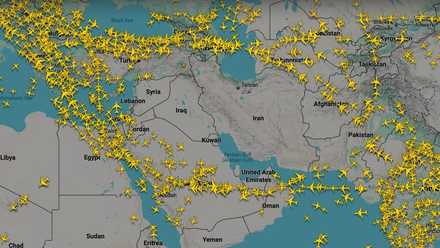
No Fly Zones: The Global Tensions Adding Hours To Your Flight
A major up swing in state-on-state violence coupled with the proliferation of air defense systems is reshaping connection corridors and adding hours.
1
Southeast Flight Training Corridor
250+ Daily Flights

The primary hub of flight activity that feeds this artery of training flights over Mississippi, Alabama, and Florida is Columbus Air Force Base. Activity from Naval Air Station Pensacola and Whiting Field, as well as Eglin AFB, also contributes to the dense traffic of military training sorties. Because of this, the region is home to the highest concentration of student pilots in the world.
The area around Pensacola, known as the Florida Panhandle, is home to a number of smaller bases where the US Air Force, Navy, Marines, and even Coast Guard conduct a massive amount of flight training for new aviators. Eglin and some other bases, such as the naval station in Key West, also conduct operations with test platforms for the fleet and host active combat-capable units for training or other activities.
Columbus AFB and Whiting Field both manage huge fleets, around 250 strong. Columbus specializes in fixed-wing training with the T-6A Texan II, T-38C Talon, and T-1A Jayhawk. Whiting is home to a large number of helicopters as well as turboprop T-6Bs like Columbus. Pensacola has a smaller number of T-6 A and B models, but is also home to the T-45C Goshawk jet trainer. Meanwhile, Eglin hosts between 60 and 100 aircraft, including F-35A stealth fighters and C-130J Super Hercules airlifters.