dailynewsnblog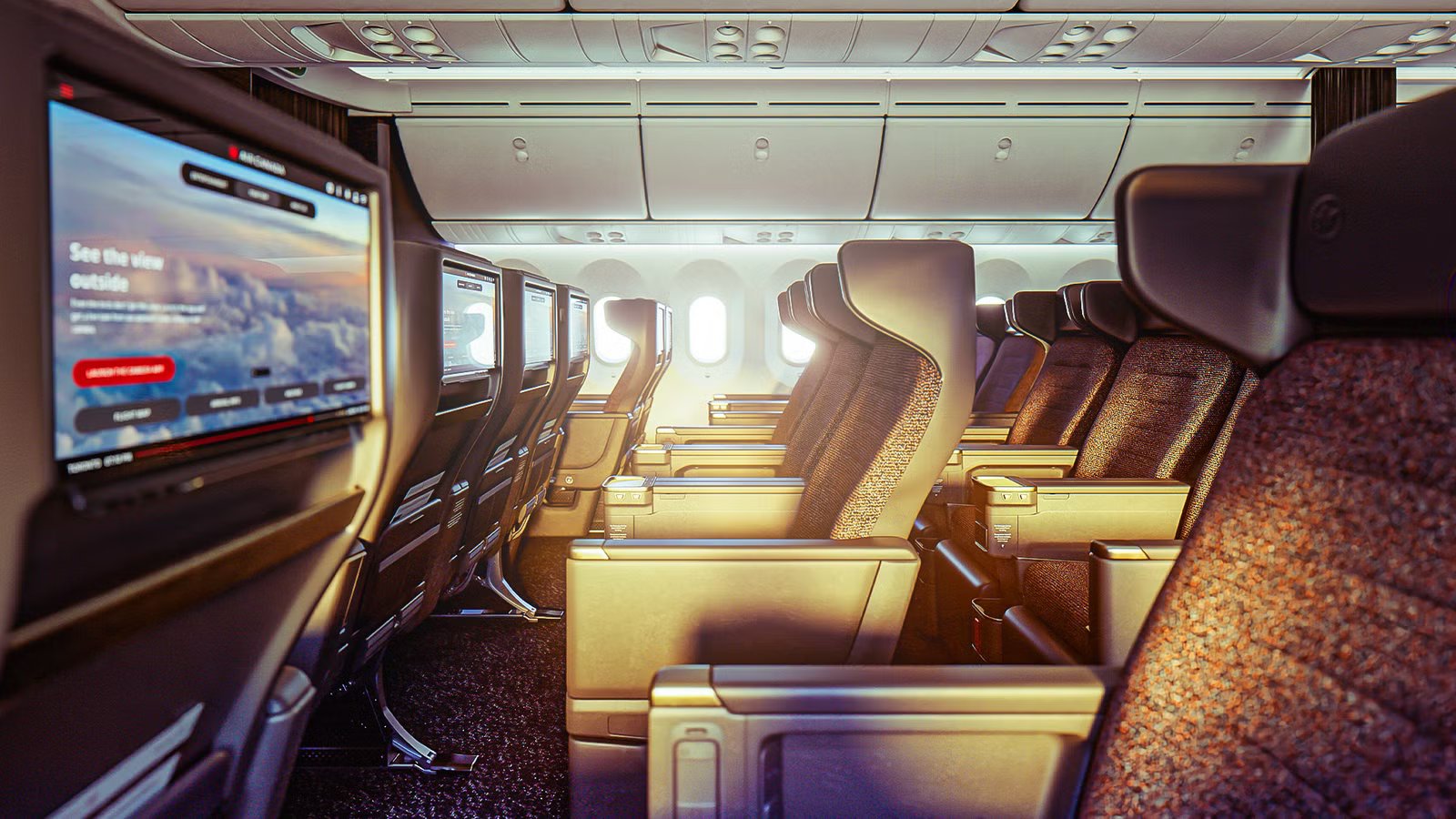
For years, premium economy has been one of aviation’s fastest-growing cabin classes. Yet despite the segment’s increasing popularity and size, innovation has increasingly become incremental. Airlines have introduced slightly better recline, marginally wider seats, improved meal service, and subtle privacy enhancements, but truly standout developments have become rare.  Air Canada‘s upcoming Boeing 787-10 may change that dynamic by introducing something the industry has lacked: a clear, measurable technology benchmark.
At the center of the airline’s new “Glowing Hearted” cabin concept is a 16-inch (41 cm) 4K OLED seatback display for premium economy passengers. Combined with Bluetooth audio connectivity, USB-C charging, AC power outlets, enhanced privacy features, and next-generation Recaro seating, the product represents more than another cabin refresh. It establishes what could become the first major benchmark in a new premium economy technology race, creating a specification that competitors can no longer ignore.
The First Real Benchmark Of 2026

Air Canada’s premium economy announcement stands out because it introduces a metric that passengers can immediately understand. Cabin comfort is often subjective. Travelers disagree about seat firmness, recline angles, and even preferred cabin layouts. Screen size, however, is objective.
The airline’s new 787-10 fleet will feature 16-inch 4K OLED displays in premium economy, making them among the largest publicly announced screens in the segment. While the difference between a 15-inch (38 cm) and 16-inch (41 cm) display may appear minor on paper, airline products are frequently separated by much smaller margins, in a category where innovation has recently focused on refinements rather than breakthroughs; a new benchmark matters.
That benchmark becomes even more significant because in-flight entertainment remains one of the most heavily used features on long-haul flights. Passengers may interact with their tray tables only a handful of times during a journey, but many spend hours watching movies, television shows, flight maps, or other content. By elevating the screen itself into a headline feature, Air Canada is placing technology at the center of its Premium Economy proposition.
Technology Is Becoming The New Battleground

The display may be the most visible upgrade, but it is only one part of a broader technology package introduced across the entire new cabin style. Each premium economy seat will feature Bluetooth audio capability, allowing travelers to pair wireless headphones directly with the in-flight entertainment system. The cabin will also offer USB-C charging and standard AC power outlets at every seat.
These additions reflect changing passenger expectations. Travelers now routinely board aircraft carrying smartphones, tablets, laptops, smartwatches, wireless earbuds, and portable batteries. The ability to keep devices charged and connected throughout a long-haul flight has become a baseline expectation rather than a premium perk.
What makes Air Canada’s approach notable is the integration of these features into a single ecosystem. The airline is not simply installing a larger screen; it is creating an environment built around modern digital habits. For passengers accustomed to high-resolution displays and wireless connectivity on the ground, the experience onboard becomes far more familiar.
Why In The World Does Air Canada Fly The Boeing 787 And Not The Airbus A350?
Talk of tariffs earlier this year caused a panic for Air Canada, but the airline did not commit to a switch from the 787 to the A350.
A Cabin Designed For Growth

Beyond the technology upgrades, Air Canada is also making a significant capacity bet on premium economy. The 787-10 will feature 28 premium economy seats, representing a 33% increase compared with many of the airline’s 787-9 aircraft. While much of the attention has focused on the new 16-inch OLED screens and upgraded seating, the additional capacity may be the clearest indicator of how Air Canada views the future of the segment. Airlines rarely dedicate more cabin space to a product unless they believe demand will support it over the long term.
The decision reflects the growing importance of premium economy within the airline revenue mix. Positioned between economy and business class, the cabin has evolved from a niche offering into a mainstream product for long-haul travel. It appeals to a broad range of passengers, including travelers seeking more comfort on overnight flights, families willing to pay for additional space, and business travelers whose companies may no longer cover the cost of business-class tickets. That versatility has made premium economy one of the most resilient premium segments in international aviation.
The 787-10’s larger cabin allows Air Canada to capitalize on that demand. Rather than filling the extra space with economy seats, the airline has chosen to expand one of its higher-yield cabin categories while simultaneously upgrading the passenger experience. The combination of increased capacity and enhanced amenities suggests Air Canada sees premium economy as more than a supplementary product. Instead, the carrier appears to be positioning it as a core component of its long-haul strategy as new aircraft enter the fleet.
Recaro’s Latest Premium Economy Vision

The new seats are supplied by  RECARO Aircraft Seating, one of the largest aircraft seat manufacturers in the world. The German company has delivered more than one million aircraft seats since entering the aviation market and counts over 300 airlines among its customers. Recaro products are used by a wide range of carriers, from low-cost operators to full-service international airlines, giving the manufacturer a significant footprint across the commercial aviation industry.
For Air Canada’s 787-10, Recaro will provide 28 premium economy seats as part of the airline’s new “Glowing Hearted” cabin concept. The seats feature extended privacy wings designed to reduce distractions from neighboring passengers while creating a more personal seating environment. They also incorporate adjustable headrests, supportive armrests, calf rests, and footrests, features aimed at improving comfort on long-haul routes where passengers may remain seated for extended periods.
Beyond comfort, the seats have been designed around practicality. Each seat integrates a 16-inch 4K OLED entertainment screen, Bluetooth audio connectivity, USB-C charging, and AC power access. Multi-use tray tables and dedicated storage areas further support the needs of modern travelers, whether they are working on a laptop, watching entertainment, dining, or resting. Together, the package reflects a broader industry trend toward creating Premium Economy cabins that offer a distinctly different experience from economy class rather than simply providing additional space.
A New Era: Air Canada’s First Airbus A321XLR Takes To The Skies
One step closer to the first delivery!
The Wider Fleet Strategy

The premium economy upgrades are part of a broader fleet renewal strategy that extends beyond the 787-10. Air Canada unveiled its new “Glowing Hearted” cabin concept for both the 787-10 and the Airbus A321XLR, two aircraft that will play very different but complementary roles within the airline’s network. While the A321XLR is designed to open thinner long-haul routes with fewer passengers, the larger 787-10 will be deployed on markets where demand can support significantly higher capacity.
Catch what other flight trackers miss
Emergency squawks, holds, NOTAMs — live signals, no signup.
Open tracker
Catch what other flight trackers miss
Emergency squawks, holds, NOTAMs — live signals, no signup.
Open tracker
That distinction helps explain why the 787-10 is receiving particular attention. Air Canada already operates Boeing 787-8s and 787-9s, but the -10 variant adds substantially more seating capacity while maintaining commonality with the rest of the Dreamliner fleet. The aircraft is expected to become a key asset on busy international routes, allowing the airline to increase passenger numbers without adding frequencies.
Together, the A321XLR and 787-10 represent two sides of Air Canada’s long-haul growth plan. The A321XLR gives the airline the ability to profitably serve lower-demand transatlantic and long-thin routes that would be difficult to support with a widebody aircraft. The 787-10, meanwhile, is focused on maximizing capacity in established markets. By introducing the same cabin design language and technology ecosystem across both aircraft types, Air Canada is creating a more consistent passenger experience while simultaneously expanding its flexibility to match aircraft size with route demand.
Why The Industry Will Be Watching Closely

The implications of Air Canada’s latest premium economy product extend far beyond the arrival of a new aircraft type. Over the past decade, premium economy has evolved from a niche offering into a mainstream cabin class, and most leading international airlines now provide a broadly similar experience. Wider seats, additional recline, upgraded dining, and dedicated cabin sections have become expected features rather than differentiators, making it increasingly difficult for airlines to stand out.
As physical seat products become more standardized, technology is emerging as one of the few areas where meaningful differentiation remains possible. Airlines can upgrade displays, improve connectivity, introduce wireless functionality, and add new charging options without completely redesigning their cabins. These enhancements are also highly visible to passengers, making them valuable marketing tools in a competitive market where comfort claims are often subjective.
That is why Air Canada’s 16-inch 4K OLED screen may prove to be more significant than it first appears. The display is not simply another feature added during a cabin refresh; it establishes a new reference point for future premium economy launches. As airlines introduce their next-generation products over the coming years, comparisons will be unavoidable. Whether competitors respond with larger screens, enhanced connectivity, or entirely new digital experiences, Air Canada has effectively set an early benchmark. In a segment where innovation has increasingly become incremental, the next phase of competition may be defined less by seat dimensions and more by the technology passengers use throughout the flight.