dailynewsnblog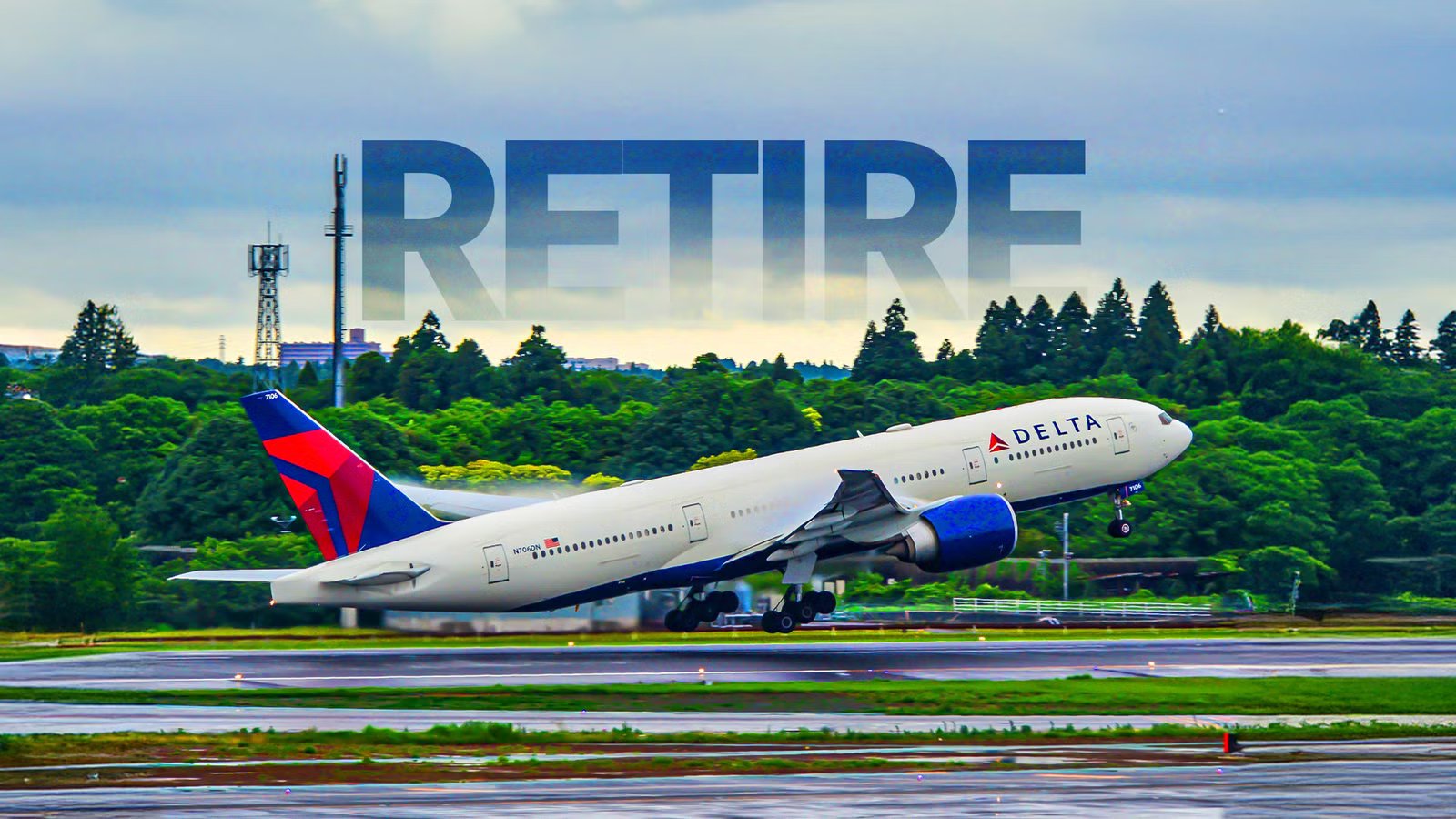
For most airlines, retiring an entire fleet type is a gradual process over several years, often driven by age, maintenance costs, or the arrival of a newer replacement, but Delta Air Lines’ decision to remove all of its Boeing 777s from service in 2020 was different. The carrier effectively abandoned one of its most capable long-haul aircraft families almost overnight, despite having recently invested heavily in modernizing the cabins.
While the move was announced during the depths of the COVID-19 crisis, the story is not simply about collapsing passenger demand. Instead, it highlights how quickly economics can reshape fleet planning when a newer aircraft offers dramatically better efficiency.  Delta Air Lines ultimately chose to walk away from a fleet that had received a $100 million cabin retrofit because the Airbus A350-900 delivered fuel burn figures that fundamentally changed the equation.
A Fleet Simplification Plan Born In Crisis

By the spring of 2020, airlines around the world were facing an unprecedented collapse in demand, and Delta Air Lines was no exception. International travel had effectively ground to a halt, fleets were being parked in deserts and storage facilities, and carriers were searching for every possible way to reduce costs.
In May 2020, the  SkyTeam carrier announced that all 18 of its Boeing 777s would be retired by the end of the year. The decision formed part of a broader fleet simplification strategy that also accelerated the retirement of the McDonnell Douglas MD-88 and MD-90 fleets. At the height of the crisis, Delta Air Lines parked more than 650 mainline and regional aircraft as schedules were dramatically reduced.
The urgency of the situation was reflected in the carrier’s financial position, as during the worst period of the pandemic downturn, Delta Air Lines was reportedly burning approximately $50 million in cash every day. Under those circumstances, the carrier’s management team was forced to evaluate every aircraft type through the lens of long-term operating economics rather than historical importance or fleet prestige.
The Boeing 777 had occupied an important place within Delta’s international network, with the carrier deploying both the Boeing 777-200ER and the long-range Boeing 777-200LR variants on routes that stretched across the Pacific and to destinations requiring exceptional range. For years, these aircraft had been among the most capable tools available in Delta Air Lines’ fleet.
However, when demand evaporated and management examined the future shape of the airline, the Boeing 777 suddenly became difficult to justify. The aircraft was not being retired because it could no longer perform operationally, but because a newer aircraft could perform far more efficiently.
The 21% Fuel Burn Figure That Changed Everything

Delta Air Lines was unusually direct when explaining the economics behind its decision, and rather than relying on vague references to modernization or sustainability, the airline highlighted a specific statistic. Specifically, the Airbus A350-900 burns approximately 21% less fuel per seat than the Boeing 777s it was replacing.
That figure helps explain why the retirement happened so quickly. Fuel has traditionally been one of the largest operating expenses for any airline, and a double-digit improvement in fuel efficiency can transform route profitability. A 21% reduction in fuel burn per seat is not an incremental improvement: it represents a significant advantage that becomes greater every year an aircraft remains in service.
The timing made the difference even more dramatic, as during normal market conditions, airlines sometimes tolerate less efficient aircraft because demand is strong and replacement capacity is limited. In 2020, however, airlines had the opposite problem – demand had collapsed, aircraft utilization was falling, and carriers suddenly had the opportunity to reshape their fleets around their most efficient assets.
Delta Air Lines’ Airbus A350 fleet was already proving itself as a highly capable long-haul platform, with the aircraft combining substantial range with lower fuel consumption and newer technology. As the airline looked toward an uncertain recovery, management saw little reason to retain a fleet type that required significantly more fuel for every seat offered.
The fuel burn gap also had implications beyond direct operating costs. Lower fuel consumption meant reduced emissions, an increasingly important consideration for airlines facing environmental scrutiny and long-term sustainability targets. While environmental benefits were not the primary reason behind the retirement, they reinforced the economic case for shifting toward newer-generation aircraft.
What made the situation particularly striking was that the  Boeing 777 remained a respected and successful aircraft worldwide, and many carriers continued operating the type successfully. Delta Air Lines’ decision was therefore less an indictment of the 777 itself and more a reflection of how compelling the Airbus A350’s economics had become within the airline’s specific fleet strategy.
Catch what other flight trackers miss
Emergency squawks, holds, NOTAMs — live signals, no signup.
Open tracker
Catch what other flight trackers miss
Emergency squawks, holds, NOTAMs — live signals, no signup.
Open tracker
The $100 Million Investment That Was Abandoned

One of the most remarkable aspects of the retirement decision was how recently Delta Air Lines had upgraded its fleet. Just two years earlier, the airline had completed a major cabin modernization program across its Boeing 777s, which reportedly cost around $100 million and introduced Delta One Suites alongside Premium Select seating.
These upgrades aligned the aircraft with Delta Air Lines’ broader premium-cabin strategy and significantly improved the onboard experience for long-haul passengers. Normally, airlines expect to spread the cost of such investments across many years of future service. Cabin retrofits are expensive precisely because they are intended to extend an aircraft’s commercial relevance.
As such, when the carrier approved the upgrades in 2018, few observers would have expected the fleet to disappear entirely by the end of 2020. The retirement of the Boeing 777 represented a willingness to accept substantial sunk costs in exchange for better long-term economics, and rather than attempting to recover the retrofit investment by keeping the aircraft in service, Delta Air Lines focused on future operating performance.
That decision illustrates a principle frequently seen in airline management but rarely on such a visible scale. Once money has already been spent, the key question becomes whether continued operation makes economic sense going forward. The $100 million retrofit could not change the fact that the Airbus A350 offered materially better efficiency.
From a public perspective, retiring recently upgraded aircraft appeared wasteful, but from a fleet-planning perspective, it was concluded that preserving a less efficient fleet simply because of a previous investment would create even greater costs in the years ahead. The result was an unusually abrupt ending for aircraft that had only recently received some of the carrier’s most modern cabin products.
The Operational Challenge Of Replacing The Boeing 777-200LR

Although the economics favored retirement, replacing the Boeing 777 was not entirely straightforward. The aircraft had been selected for certain routes precisely because of its exceptional capabilities, particularly in the case of the 777-200LR. The LR variant was among the longest-range commercial aircraft ever produced and enabled nonstop operations on some of Delta Air Lines’ most demanding international services.
These included  Hartsfield-Jackson Atlanta International Airport (ATL) to Johannesburg O. R. Tambo International Airport (JNB). Simply removing the fleet required the airline to rethink how certain routes would be operated, as the Boeing 777-200LR had unique performance characteristics that were difficult to duplicate exactly.
However, Delta Air Lines’ management clearly concluded that occasional operational adjustments were an acceptable tradeoff given the broader efficiency gains available across the network. Airlines routinely make scheduling, routing, and payload modifications when introducing new aircraft types, particularly if those aircraft deliver significant cost advantages.
The important point was that the airline found workable solutions without needing to retain a dedicated subfleet of Boeing 777s. Once those operational challenges were addressed, the economic rationale for maintaining the older aircraft became even weaker. As a result, the retired 777 fleet never returned to passenger service with Delta Air Lines, despite periodic speculation during the industry’s recovery phase.
Why The Airbus A350 Fit Delta Air Lines’ Future Better

The Boeing 777 retirement also reflected broader changes in airline fleet philosophy, and over the last decade, manufacturers have increasingly focused on delivering lower operating costs rather than simply maximizing size or range. The Airbus A350 emerged as one of the clearest examples of that trend.
Built with extensive use of advanced materials and powered by newer-generation engines, the aircraft was designed around efficiency from the outset. Airbus has consistently positioned the A350 as a replacement for older long-haul widebodies, including earlier generations of the Boeing 777.
The European manufacturer has cited substantial reductions in operating and maintenance costs compared with previous-generation aircraft, helping carriers improve profitability while reducing fuel consumption. For Delta Air Lines, the Airbus A350 aligned closely with a fleet strategy centered on fewer aircraft families and greater commonality, as simplifying fleets can reduce training requirements, streamline maintenance operations, and improve scheduling flexibility.
Those benefits became especially attractive during the post-pandemic recovery period. Rather than rebuilding around a diverse collection of aircraft types, Delta Air Lines increasingly concentrated investment on newer Airbus widebodies and other efficient fleet assets, and the retirement therefore represented more than a reaction to temporary market conditions. It was also a statement about which aircraft the airline believed would define its future long-haul operations.

Delta Air Lines, Simple Flying
The strongest evidence supporting Delta Air Lines’ 2020 decision arrived years after the Boeing 777 left service. Instead of reconsidering the retirement or seeking another large twin-engine aircraft to fill the gap, the airline continued expanding its Airbus widebody presence. In January 2026, Delta placed an order for 31 additional Airbus widebodies, consisting of 15 A350-900s and 16 A330-900s.
The purchase reinforced the airline’s commitment to the Airbus long-haul product and provided a clear indication of management’s confidence in its fleet strategy. The order also highlighted how thoroughly the Boeing 777 had disappeared from the carrier’s future plans, as six years after retirement, the aircraft remained absent from its long-term vision, while Airbus products continued gaining prominence.
Looking back, the decision can be seen as one of the most consequential fleet moves made by a major airline during the pandemic era. Delta Air Lines willingly abandoned recently upgraded aircraft, absorbed the loss of a $100 million retrofit investment, and retired a fleet that had once been central to its intercontinental network. At the time, the move appeared dramatic.
However, with hindsight, it increasingly resembles an early recognition of where long-haul economics were heading. When demand collapsed and every cost came under scrutiny, the 21% fuel burn advantage offered by the Airbus A350 proved powerful enough to render an established flagship fleet uneconomic almost overnight, setting a course that Delta Air Lines has continued to follow ever since.