dailynewsnblog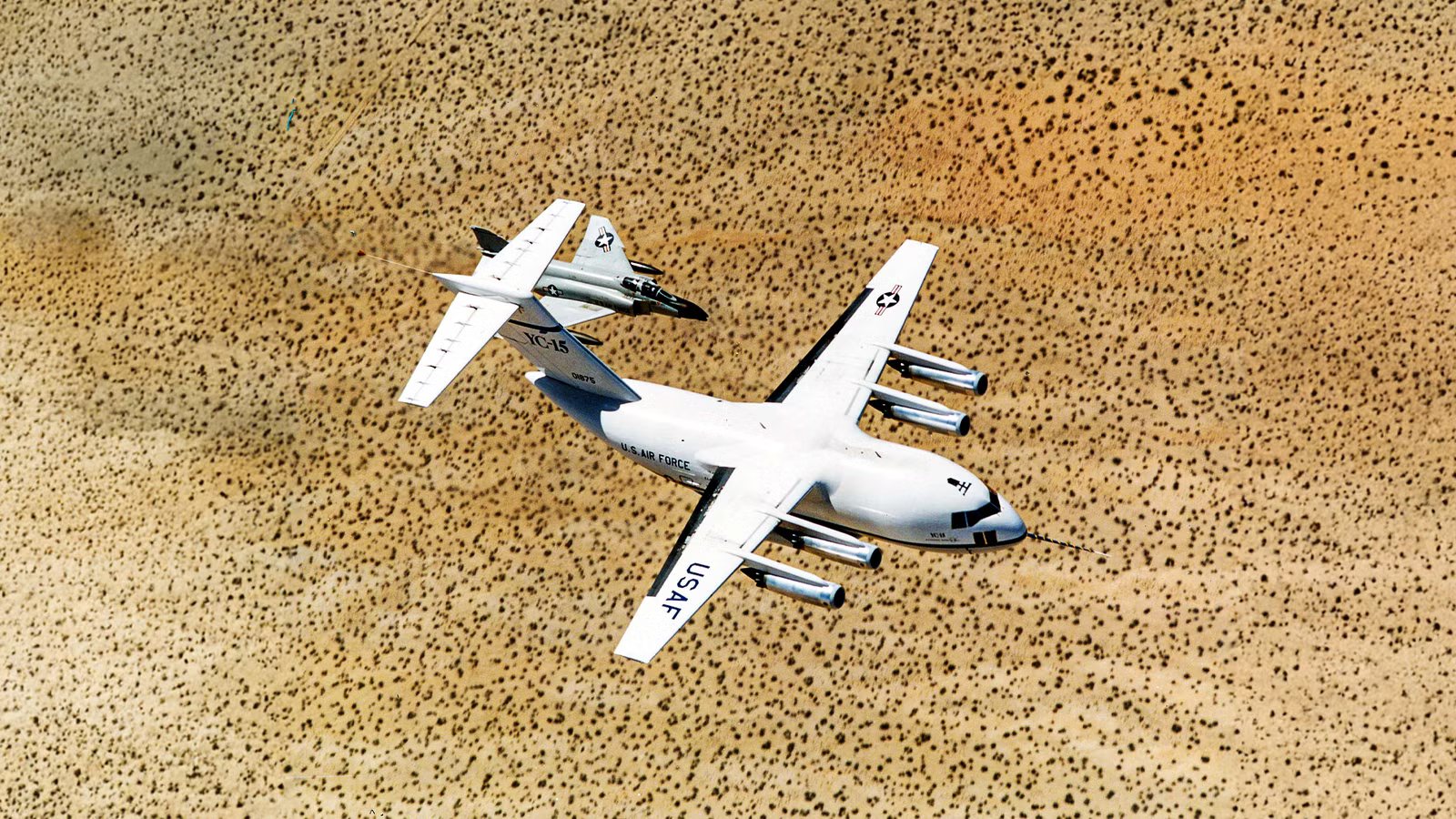
The origin story of McDonnell Douglas’ famous C-17 Globemaster III harkens back to a competition that failed to launch years before the mighty jet even left the drawing board. The 1976 Advanced Medium STOL Transport did not lead to a production grade jet for the US Air Force (USAF) but it did lay the foundation to create what is now the service’s most versatile airlifter. During the AMST trials, the prototype YC-15 impressed the USAF with its Short Take-Off and Landing performance by maximizing its four jet engines’ thrust with Externally Blown Flaps.
The C-17 inherited that EBF design and scaled it up by applying the same STOL engineering features to a larger airframe with bigger, better engines. AMST had set out to replace the Lockheed C-130 Hercules, but it failed. Even today, the Herc has continued to prove itself indispensable and, instead of being replaced, it serves alongside the YC-15’s successor as two pillars of the USAF airlift strategy.
In a curious case of successfully failing a task, McDonnell Douglas did not win the bid to replace the C-130, but it was instead upgraded to a replacement for a larger, jet-powered transport. When the C-17 was selected in 1981, it replaced the Lockheed C-141 Starlifter to take over the mission of intercontinental airlift. The Globemaster outperformed its predecessor across the board but, most notably, brought far superior STOL capability to the larger class within Air Mobility Command’s fleet.
The Roundabout Success Of The C-17

The C-17 transformed AMC’s strategic capability by introducing a new concept of direct delivery. The Globemaster III blends the high-capacity, long-range power of a strategic airlifter with the STOL tactical agility of a much smaller aircraft. Legacy strategic airlifters like the C-141 required massive, pristine runways. Cargo had to be flown to large hub bases, unloaded, and reloaded onto smaller Lockheed C-130 Hercules aircraft to reach forward environments.
Critically, McDonnell Douglas’ high-performance quadjet allowed the US Armed Forces to pick up a main battle tank in the States, fly nonstop to the front line, and drop it off virtually anywhere on Earth. It effectively eliminated the need to transfer cargo from large long-haul planes to smaller tactical planes, allowing the military to fly heavy equipment directly from home bases straight to austere, short, forward-deployed runways.
Although the Air Force canceled AMST without buying either the YC-15 or Boeing’s competing YC-14 to replace the C-130, McDonnell Douglas later leveraged its prototype data. When the Air Force pivoted to replace the C-141 via the C-1X program, the maker used its proven concepts to win an equally massive contract.
The 1976 AMST Fly Off

In 1972, the US Air Force sought an advanced tactical lifter to replace the Hercules. The program pitted the twin-engine Boeing YC-14 against the four-engine McDonnell Douglas YC-15. To stay within budget, McDonnell Douglas built the YC-15 using off-the-shelf components, including a Douglas DC-8 nose gear and a modified Douglas DC-10 cockpit. The YC-15’s secret ingredient was its world-first application of EBF technology.
McDonnell Douglass built the first jet-powered aircraft in history to successfully implement EBF, and it did it with four engines. The prototype utilized a cooler turbofan, not a turbojet, exhaust directed through double-slotted titanium flaps to create massive low-speed lift via the Coandă effect. The AMST program was canceled in 1979 not because the planes failed, but because military airlift doctrine fundamentally changed.
The Air Force realized that the existing fleet of C-130s was still structurally sound, but they had a critical vulnerability in strategic, outsized airlift. The C-141 Starlifter fleet was aging rapidly and lacked the fuselage width to carry outsized armored vehicles like the M1 Abrams tank. Because McDonnell Douglas had hundreds of hours of real-world flight test data from the YC-15, they could readily prove their STOL systems worked flawlessly during the C-1X trials.
The Radical Boeing Twinjet Lost To History

The Boeing entrant to the AMST competition was just as revolutionary as the YC-15 quadjet that it flew head-to-head against. The YC-14 featured two large turbofan engines mounted above its wings to use upper-surface blowing aerodynamics and achieve a similar STOL profile as the McDonnell Douglas prototype. The aircraft featured a fuselage that looked much like a C-130, but its cutting-edge wings and T-tail gave it far superior performance.
The YC-14’s USB configuration also leveraged the Coanda effect to pull jet exhaust down over the flaps, but also featured the bonus of foreign object debris protection. Over the course of the 600-hour AMST flight-testing battery, the YC-14 proved capable of hauling a greater payload than the YC-15 that the C-17 was later based on. But unlike its competitor, the Boeing prototype would never lead to a full-rate production platform.
Boeing’s jet could haul a 55-ton M-60 Patton tank, and during flight testing it flew as slowly as 59 knots and took off in as little as 800 feet. Owen continuously refined the plane’s aerodynamics until the end of the AMST competition. In the end, the Air Force declared both prototypes satisfactory. When the USAF chose not to move ahead with either design, Boeing toured its YC-14 around Europe to showcase its performance and entice buyers from the North Atlantic Treaty Organization, but to no avail.
Size Matters: The C-X Program

An Air Force prototype competition is usually designed to produce a loser, and AMST instead produced two aircraft that did what they were asked. The AMST flight-test program at Edwards ran through 1977 and logged roughly 600 hours between the two prototype pairs, including trials on dirt strips at the base’s Graham Ranch test site. The elimination came from outside the flight-test data, as Military Matters writes.
In late 1977, the Army released its own study concluding that the C-130 remained adequate but that the services urgently needed more capability to move outsized equipment. Continuing to produce the already-paid-for C-130 was, on a pure cost basis, cheaper than fielding either new tactical jet. The AMST program was formally terminated in 1979, under driven from the Carter administration.
Within weeks, the Air Force stood up the C-X Task Force to define a genuinely strategic successor. The resulting Cargo Experimental request for proposals asked industry for jet transport that could move armored vehicles across intercontinental distances with meaningfully better short-field performance than the C-141 Starlifter.
Three competitors answered the call for the C-X challenge. Lockheed offered both a scaled-down C-5 derivative and an enlarged C-141. Boeing bid for a stretched, three-engine evolution of the YC-14, and McDonnell Douglas chose not to simply enlarge the YC-15 but to design a new airframe around its proven lifting power.
Simplicity Saves The YC-14’s Legacy

Owing to the long and tumultuous path from AMST to C-X, McDonnell Douglas absorbed roughly billions in losses on the program before the first C-17 flew in September 1991. The airframe that started it all, however, was revived as a test platform in 1997. Only one of two YC-15s was briefly again used to test C-17 technology, while the second prototype was scrapped. Its former rival fared less well. One YC-14 has never left display at Pima Air & Space Museum; the other was relegated to the boneyard.
McDonnell Douglas won the C-X competition precisely because the YC-15 configuration was highly scalable. They did not start from scratch. The C-17 completely copied the Externally Blown Flaps of the YC-15. It also replicated a highly automated, two-pilot crew with lower windows near the pilots’ feet. They greatly enhanced visibility during steep descent. The same flight deck layout and interface was used on the C-17 cockpit.
The heavy-duty, high-impact landing gear arrangement tested on the YC-15 to survive rough dirt runways was scaled up for the much heavier C-17 frame. During later AMST growth studies, McDonnell Douglas had actually flight-tested a larger, modern CFM56 turbofan engine on one wing of a YC-15. This gave them immediate data on how a wide-body variant would handle modern, high-bypass engines, which eventually became the Pratt & Whitney F117 engines used on the C-17.
The Fate Of An Innovative Airframe

One of the YC-15 jets, tail number 72-1875, had a fascinating second life. After sitting in the Boneyard at Davis-Monthan AFB for years, McDonnell Douglas actually pulled it out of retirement in 1996. They made it airworthy again to use as a flight testbed for advanced C-17 technology development. After suffering a catastrophic engine failure in 2000, it was permanently retired.
In 2008, it was moved to Edwards Air Force Base, California, where it sits today on static display near the West Gate. Serial 72-1876, the shorter-wingspan prototype, was moved to the 309th Aerospace Maintenance and Regeneration Group. It was unfortunately scrapped and destroyed in April 2012. Notably, although neither one of the Boeing YC-14 jets ever flew again, neither one has been scrapped to date.
After the program ended, YC-14 Serial 72-1873 was meticulously preserved and is proudly on public display at the Pima Air & Space Museum in Tucson, Arizona, right across from Davis-Monthan AFB. Meanwhile, tail 72-1874 was sent into storage at the 309th Aerospace Maintenance and Regeneration Group boneyard. It remains there in open storage, stripped of its engines but structurally intact.
Catch what other trackers miss
Emergency squawks, holds, NOTAMs — live signals, no signup.
Open tracker
Catch what other trackers miss
Emergency squawks, holds, NOTAMs — live signals, no signup.
Open tracker