dailynewsnblog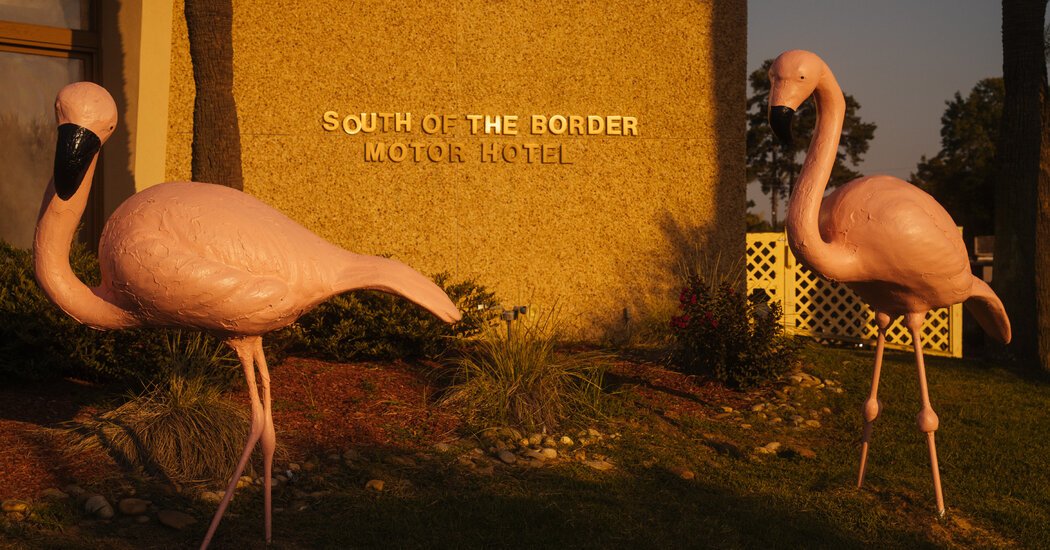
On a long, long highway, right where one land turns into another, a place called South of the Border has welcomed weary travelers for generations, beckoning them with a towering, neon-lit sombrero. Underneath its brim: cheap motel rooms and restaurants serving burritos, tacos and margaritas.
The border in question is the one between North and South Carolina. And the approximation of Mexican culture that the rest stop offers has the feel of a Speedy Gonzales cartoon, or if Willy Wonka decorated for Cinco de Mayo.
“What is this place?” Steve Crenshaw recalled asking his friend in the 1970s, when he first visited. Now he was there again, lured by nostalgia.
Indeed, South of the Border in Dillon, S.C., is a relic of American road travel, echoing midcentury highway oddities like Wall Drug in South Dakota and the world’s largest of just about anything across the Midwest. It harks back to a different time in the South, before the region diversified and exploded in growth.
Now, authentic Latin American spots abound, as do popular chains like Buc-ee’s and Wawa, adding to the many challenges for the aging attraction. And at a time when the country is mired in debates over immigration and identity, the kitschy, Mexican aesthetic that South of the Border embraced in its early years feels culturally fraught, and to some, offensive.
The business challenges have recently taken on more urgency for the owner, Ryan Schafer. He has offers to sell the entire place and spare him the headaches from people who ridicule it online as a “haunting past that stays frozen in time.” But then he considers his grandfather Alan, who opened the rest stop in 1949 and died in 2001.
“Some days, I want to cash out, go live on a beach in Mexico and open something small out there,” said Mr. Schafer, 49. “But it’s also kind of a family member. You’re supposed to take care of it. You’re supposed to honor it.”
South of the Border, which spans more than 200 acres, does not fit neatly into one motif. There is Pedro, the stereotypical, mustachioed mascot, peppered all over the place: Pedro statues, Pedro bags, Pedro taco Tuesday T-shirts, Pedro baseballs.
But there are also sculptures of dinosaurs in sombreros, a fireworks store, a motocross training facility and enough alligators in a reptile exhibit to impress Floridian visitors.
Is the owner Mexican? (No.) Was the attraction built for fans of Disney World on their way to Orlando? (It predates that theme park, as well as construction of I-95.)
“It’s like a Mexican wonderland,” Vincent Toigo, 27, who is of Portuguese descent, told his family as they perused Pedro’s Mexico Shop, spotting Día de Muertos art.
His grandmother visited in the 1950s; his mother, Margaret, first visited in the ’80s, when she said it was “more rundown.”
Did her children think that description held up?
“That’s part of it,” said her daughter, Mercedes Toigo, 29, who derided Buc-ee’s as too cookie-cutter. “This has character.”
Mr. Schafer believes that character is worth preserving, but it is getting harder. At one point, South of the Border’s restaurant division alone had 350 employees. Today, the entire business has about 180, and Mr. Schafer has struggled to find workers.
One of the restaurants, the Hot Tamale, burned down in April and will not be rebuilt. The attraction has also downsized, recently dropping its small theme park. About 30 acres of the complex are listed for sale for $2.85 million.
Online, some falsely claim that the alligators are fake, or that Room 305 in the motel is haunted.
“Some of our businesses, I understand very well and don’t mind running them,” Mr. Schafer said. Others, he added, might as well have instructions in another language.
South of the Border opened at a time when North Carolina banned selling beer in stores. Mr. Schafer’s grandfather believed a beer stand right below the state line would do well. Business boomed. Over time, he introduced food and lodging and adopted the Mexican theme.
Mr. Schafer retells stories from his grandfather of how the Ku Klux Klan burned crosses in the family’s front yard because they were Jewish and refused to segregate their establishment during Jim Crow.
“Alan met the Klansmen armed with a rifle and told them to go away,” Alan Schafer’s niece wrote in an essay. “To me that is a mitzvah on steroids.”
Over the years, some have found aspects of South of the Border problematic. The mascot was named after Mexican men who worked at the attraction decades ago and whom visitors called Pedro, no matter their real names. Alan Schafer once recalled that the Mexican embassy had complained that the attraction was spreading ethnic stereotypes.
A book about consumer culture in the South captured how Alan faced criticism in the 1980s for having billboards that parodied Hispanic accents. He changed them, he said at the time, because “baby boomers do not have a sense of humor.”
Rosa Grijalva, 30, who is Mexican American, recently visited after her family was intrigued by the sight of a towering, neon Pedro statue.
“I do think it’s offensive,” she said of the theme, standing underneath the mascot’s arched legs that straddle the road. But such caricatures, she added, “don’t really bother me.”
Ryan Schafer, whose politics skew left, says he sees the aesthetic as celebratory.
He says he has visited Mexico multiple times, handpicking items to bring back to his business, like pottery and piñatas. And he speaks highly of “hard-working” immigrants in America, saying he wished they had a pathway to legal citizenship.
Most of the people who visit South of the Border aren’t familiar with its history. All they know is that its tacky charm is still intact.
“It’s kind of like going back to visit where you grew up,” said Emmaline Figeroa as she buckled in her two children to hit the road again. The family had just purchased sombreros.
Pam Oxendine, 65, has been working at the rest stop for 50 years. She said Mr. Schafer had once told her that when “all of us old folks are gone, he’s going to close it.”
“Lot of things change,” she said, opening an old brochure that included a photo of Mr. Schafer as a boy with his family. “But we’re still holding on.”
Earlier this summer, as Claudia Grey was traveling from Connecticut to Florida along I-95, she told her husband about a strange pit stop she had visited decades ago featuring dozens of odd billboards.
Suddenly, they spotted one such billboard declaring, “You never sausage a place!”
“Oh my gosh,” she said. “It’s still here.”
Of course, they pulled over.
Kirsten Noyes and Kitty Bennett contributed research.