dailynewsnblog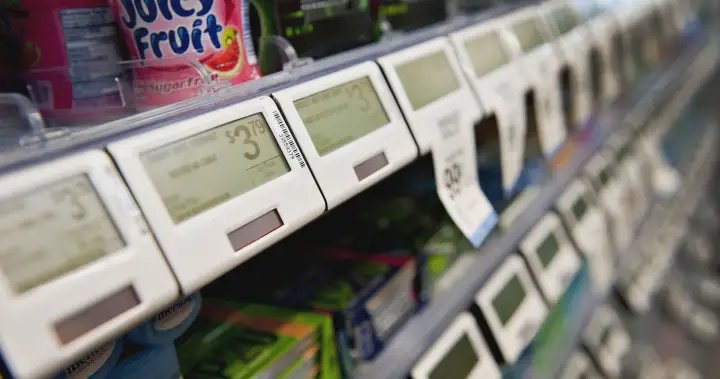
You’ve likely seen them up and down the grocery aisle, and if you haven’t, there’s a good chance they’ll be coming to a store near you.

Digital price tags, also known as electronic shelf labels (ESLs), are replacing traditional paper price tags at many grocery retailers.
ESLs use wireless technology and are touted for being more efficient, allowing grocers to adjust prices across a store within seconds. “The technology of digital shelf labelling can help save labour time. It’s onerous to go around and change all the stickers and the fact that this can occur in real time actually brings an online reality to a brick and mortar context quicker,” said Canadian Shield Institute managing director Vass Bednar.
However, ESLs are not without controversy. Digital price tags could be a game-changer for consumers with the use of dynamic pricing, where prices fluctuate based on supply and demand.
“Dynamic pricing is basically about optimizing the exchange between supply and demand. If inventories go up, prices go down, inventories are low, prices go up,” said Sylvain Charlebois, director of the Agri-food Analytics Lab at Dalhousie University.

Airlines, ride-sharing companies, and ticket retailers already use this type of pricing strategy. While ESLs can allow grocers to instantly discount food nearing expiry and curb waste, the worry is that this type of technology could allow retailers to change prices based on market conditions like weather, for example, charging more for ice cream on a hot summer day.

Get breaking National news
Get breaking Canada news delivered to your inbox as it happens so you won’t miss a trending story.
“For pricing efficiencies, I’m sure retailers could argue the ability to discount quickly is fundamentally good for people and that’s true. But where will the transparency come from? How many times per day could a digital shelf label be advertised?” said Bednar.
“The risk is also people losing that sense of price anchors and the ability to comparison shop.”
Perhaps, more troubling, industry analysts say, is surveillance pricing. “Surveillance pricing is dynamic pricing on steroids,” said Charlebois.
With the use of artificial intelligence, there is growing concern that digital price tags could open the door to surveillance or personal pricing where different prices are set for different shoppers based on several factors, including demographics, personal interests, and transaction history.
“Surveillance pricing would likely discriminate against some consumers while favoring others,” said Charlebois. “There’s no evidence that it is happening right now in Canada, but online it’s not impossible,” he added.
Back in December, Instacart in the U.S. was heavily criticized after an investigation revealed an AI-based pricing experiment where different shoppers were given different prices for the same groceries on the platform. It’s why, going forward, some are calling for a proactive approach to protect consumers.
“My worry would be that we wait for more proof, more evidence, and read through more privacy policies instead of recognizing that it is something that has occurred in the past could become more part of our every day and that we proactively set the terms, set the right guardrails,” said Bednar.
Recently, the federal NDP introduced a motion to ban surveillance pricing in Canada, but it was voted down. However, the party has since launched an online petition calling for a national ban on the practice.

Consumer Matters reached out to some major grocers, asking about the use of ESLs and the impact on customers.
Loblaw stated in part:
“…These labels generally improve in-store operations by automating updates and reducing our paper usage. For customers, they aren’t materially different from paper tags. We’ve seen improved price accuracy, especially on sale items, as updates are applied consistently across all products overnight rather than manually.
Our pricing and promotional practices have not changed with these labels.”
Sobeys stated:
“Electronic shelf labels improve efficiency and accuracy by allowing our teams to update prices and product information throughout the store. This simplifies day-to-day store operations by reducing the time our teams spend on manual updates and freeing up more time to support customers in-store. In any particular store, pricing will not vary by customer, time of day, or demand—everyone in a store pays the same price for the same product. The use of electronic shelf labels is about clearer, more modern pricing displays—nothing more.”
Save-On-Foods:
“We have not installed electronic shelf labels in any of our Save-On-Foods stores. While we don’t currently have plans to install them, like many retailers, we actively monitor industry developments and regularly assess whether emerging technologies are the right fit for our business.”
Meantime, the Canadian Competition Bureau says it’s closely looking into how pricing algorithms are used, and how they can affect competition. The Bureau says it’s committed to approaching its work in the grocery industry “with heightened vigilance and scrutiny.”
© 2026 Global News, a division of Corus Entertainment Inc.