dailynewsnblog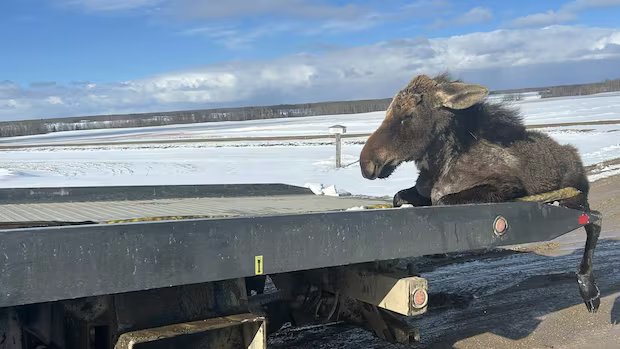
“Bring some blankets out — I’ve got a moose.”
Clint Gottinger hadn’t envisioned having to say those eight words to his wife after a long day’s work last Saturday. But there he was, pulling up to their family home with a cold, tired moose on the deck of his tow truck.
Gottinger, who owns Rebel Towing, said he was on his way to do a couple of tow jobs around 5 p.m. CST.
His plans quickly changed.
He spotted a moose that had fallen through some ice not far from his home in Kelvington, Sask., about 200 kilometres east of Saskatoon.
“I can’t leave him,” Gottinger remembered thinking. “Everyone has to wait. This is a priority.”
He turned his truck around and backed up as close as he could to the beleaguered animal.
His plan was to slide the deck of the tow truck down and use a soft sling to pull the moose out. The animal appeared leery, but was also clearly exhausted.

Gottinger took his sling and threw it around the moose’s neck area.
“I started wenching and towing. He was kind of helping a bit,” he said.
The moose’s bottom half was the first to pop out of the ice. Gottinger said some neighbours showed up to lend a hand.
“We got the sling around his butt and popped him right out and then onto the deck,” he said.
He said the moose was out by around 5:30 p.m. Gottinger then took it home so it could rest and warm up. He phoned his wife on the way.
“Once I pulled up there, this moose sitting on the deck, she [came] running out with blankets,” he said.
Gottinger set the moose down on the pile of blankets, wrapping one of them over it, before leaving it to recover. He said he would come check on the moose periodically. The moose would even let him give some ear and cheek scratches.
The moose finally stood on its feet around 11 p.m.
“I thought, well, I’ll see if I can walk up and scratch his cheek again. But he kind of grunted and put his leg up.”
He said the moose stuck around his house all of Sunday, lingering just across the road. It finally left Monday morning.
Gottinger took to social media to share his encounter. He named the moose “Rebel” after his towing company.
The post racked up more than 1,000 likes and 100 comments.
“It’s a happy story,” Gottinger said.
“Everyone needs a happy story.”
‘A very good chance of recovery’
Dr. Ryan Brook, a professor in the college of agriculture and bio resources at the University of Saskatchewan, said higher temperatures and the fact the moose is still young make for a higher chance of it surviving, but it’s not out of the woods yet.
Brook said that when a moose goes through a traumatic event, it can be prone to “capture myopathy.” The often fatal metabolic condition can result in severe muscle damage, kidney failure and heart failure, and show up within hours or weeks after an incident occurs.
“I’m sure it was quite a traumatic experience for the moose, and so I think there’s certainly gonna be a recovery,” Brook said.
He said the moose lingering near Gottinger’s home in the aftermath is not unusual. He said traumatized moose will often stay in an area for days at a time to rehydrate, rest, and recover mentally and physically.
“They will often find some kind of heavy hiding cover. They might duck underneath the big spruce tree or or hit a big clump of aspen forest and bed down in there,” he said.

Brook said that when a moose does recover, releasing it back into the wild is the most dangerous part.
“That’s when they get back on their feet and that’s when they, if they feel like they’re in danger, then they can certainly, moose will attack,” he said.
Brook said it’s important to call wildlife experts, especially when dealing with larger animals like a moose. He said experts can ensure a safe capture, keep the animal calm and prevent conditions like capture myopathy, giving animals the greatest chance at survival.
As for Rebel the moose, Brook is optimistic.
“As long as it’s able to drink and find something to eat and rest, my sense is there’s probably a very good chance of recovery for it.”