dailynewsnblog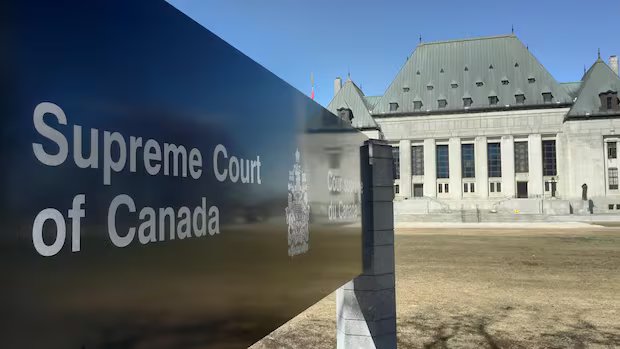

Listen to this article
Estimated 4 minutes
The audio version of this article is generated by AI-based technology. Mispronunciations can occur. We are working with our partners to continually review and improve the results.
The Supreme Court of Canada dismissed two challenges to the Jordan framework on Friday, ruling that the time limits put on criminal trials before charges be thrown out of court are justified under Section 11(b) of the Charter.
In a 2016 ruling the Supreme Court set strict time limits for criminal trials — 18 months for proceedings at provincial court and up to 30 months at Superior Court, calling those “ceilings” the Jordan framework.
Friday’s rulings are tied to two cases brought to the Supreme Court.
The first is the case of R. v. Vrbanic, which was large and complex, involving 18 co-accused in 10 different prosecution groups who are facing charges related to drug trafficking.
In the second case, R. v. Jacques-Taylor, two men were being tried together on drugs and firearm charges.
Both cases were tried at provincial court and stayed when they went on past the 18-month deadline. In Vrbanic’s case the delay was four days past the deadline, in Jacques-Taylor the delay was only two weeks past the deadline.
In Vrbanic’s case, the Crown asked the Supreme Court to give courts “residual discretion” to extend trials based on a judges’ discretion, so that trials are not thrown out for minor overruns.
In a unanimous decision, Chief Justice Richard Wagner dismissed that call, saying “the Jordan framework already provides the flexibility necessary to address the Crown’s concerns.”
To provide clarity to lower courts going forward, the Supreme Court clarified exactly what qualifies as exceptional circumstances meriting a trial delay beyond the Jordan limit.
Case complexity considered
Wagner said there are two categories of exception permitting a trial to be extended beyond its ceiling. The first is that the case is particularly complex.
“The case complexity exception recognizes that certain cases, because of their inherent time requirements, cannot reasonably be completed within the presumptive ceilings,” Wagner wrote.
Some of those requirements, the court clarified, include:
- A large number of witnesses and/or charges.
- Joint proceedings against multiple co-accused.
- Significant requirements for expert evidence.
- Novel or complex legal issues.
“The Crown must prove that the case is particularly complex in light of the nature of the issues, evidence and proceedings and also that it has taken reasonable proactive steps to mitigate delay,” Wagner wrote.
“If the threshold stage is met, at the justification stage, the Crown must then prove that the overall complexity of the case justifies the amount of net delay.”
Discrete exceptional circumstances
Wagner said the second category of exception is “discrete exceptional circumstances.”
The Supreme Court defines that exception as a delay that lies outside the Crown’s control because it can’t be reasonably foreseen or addressed by the Crown.
In Jacques-Taylor’s case, the trial for him and his co-accused was delayed for two weeks because the co-accused’s defence attorney was unavailable.
Wagner said COVID-19 is an example of this kind of exception, but the cause of delays do not need to be rare or catastrophic to be justified. They just need to be out of the court’s control.
At the Supreme Court, the Crown argued that Jacques-Taylor and his co-accused’s trial shouldn’t have been thrown out because it met the standard for “discrete exceptional circumstances.”
Justice Suzanne Côté, writing for the six majority justices, agreed with the Crown and said the time the co-accused’s lawyer was not available should have been deducted from the total length of the trial, bringing it under the 18-month threshold.
To clarify the circumstances for a justifiable violation of the Jordan framework where there are co-accused involved, the Supreme Court adopted a definition from the Ontario Court of Appeal made in 2023.
The R. v. Tran ruling says that for the complexities of a joint trial to justify a delay beyond the Jordan framework they have to meet four benchmarks:
- The joint trial has to be in the interest of justice.
- The delay is a result of the joint trial.
- The delay was unavoidable.
- The Crown didn’t to anything that made the delay worse.
While the integrity of the Jordan framework was upheld, in both cases the Supreme Court allowed the appeals and ordered new trials.