dailynewsnblog
In 2026, the battle for air supremacy is dominated by fifth-generation stealth jets with everything else racing to catch up. There are a number of 4.5-Gen fighters that lack the stealth capabilities of their more advanced peers but feature the technology performance and weapons capability to compensate for it. These two classifications of fighters are the most dominant warbirds on the 21st-century battlefield.
There are many legacy aircraft that are still in use as workhorses for the US and other advanced air forces in permissive environments, as well as many militaries that lack the capacity to procure and sustain advanced aircraft. Yet, these fighter jets would not survive in a high-end conflict regardless of tactics and are therefore essentially irrelevant to this comparison. If there were an outbreak of hostilities between near-peer nations, the only tactical airframes that would be survivable and combat effective are 5th and 4.5-gen.
The class of 4.5 gen fighter jets is a mix of both new airframes designed to give capabilities to operators that do not require or cannot afford stealth platforms and legacy airframes that have been significantly upgraded with as many advanced capabilities as possible. The best examples are the Dassault Rafale F4 omnirole and the Boeing F-15EX Eagle II multirole fighters. The Eurofighter Typhoon has also been upgraded to Tranche 5 iteration, but all of these pale in comparison to true 5th-gen fighters.

The reality is that a 5th-Gen fighter jet is unquestionably far more survivable and lethal in a conflict where all of the most advanced weapon systems are on the battlefield. At the same time, these jets cost exponentially more to operate, repair, and arm than their counterparts in the 4.5 gen class. For that reason, even in a high-end conflict, it is not reasonable or sustainable to field a fleet composed solely of the most ‘exquisite’ airframes.
The US Air Force is the best example of the high-low fleet mix now being adopted by both its allies and its adversaries around the world. The rapid advance of stealth, weapons technology, automation, and sensors is making the modern-day arms race an exponential competition. For that reason, a modern air campaign requires the capacity to both field a bleeding-edge state-of-the-art fighter jet packed with all of the best technology available and workhorse warbirds that can carry out the dirty, boring, and messy missions.
The global fleet of 4.5 gen fighter jets may well end up outliving their 5th-gen counterparts as air forces around the world invest in developing 6th-Gen platforms. The United States awarded Boeing the contract for the Next Generation Air Dominance program in early 2025, with the first example of the F-47 expected to fly in 2028 and production slated for the early 2030s.
In Europe, the United Kingdom has partnered with Italy and Japan on the global combat air program, also known as the BAE Tempest, to create a successor to the Typhoon. This program will completely skip the 5th gen of fighters and take the partner nation’s air forces from 4.5 to the 6th-Gen era of technology. Similarly, France, Germany, and Spain are still in the early stages of developing the future combat air system, in a 6th-Gen program that parallels the GCAP.
Meanwhile, the People’s Liberation Army Air Force of China has been seen testing at least two prototypes of tailless stealth fighters that fit the profile for a 6th-Gen fighter. Although Russia has several theoretical 6th-Gen platforms that have been announced, virtually all of these are considered ‘paper planes’, which may never leave the drawing board. The Russian economy has been devastated by the invasion of Ukraine that began in 2022, and today the nation has produced a paltry number of 5th-Gen fighters, with only one type making it to the production stage despite a second that continues to be publicized.
The New Tactical Standard: Lockheed Martin’s F-35 Lightning II

Lockheed Martin’s F-35 stealth fighter, the Lightning II, is the single largest defense industrial project in the history of the world. Not only is it one of the most complex military aircraft that was constructed, but the procurement program is also on a massive scale, seen only by a handful of preceding projects. The global fleet already has 19 partner nations, with even more being considered. Today, there are more than 1,300 examples in service, and there will be more than 3,000 delivered when the current backlog is finally fulfilled.
The F-35 is an invaluable asset in the era of the 5th-gen arms race for both stealth aircraft and advanced air defense weapons. Yet it is a compromise between capability and price. That may sound strange considering the program’s total cost. However, the ‘fly away’ price of a single jet is comparable to previous generation airframes like the Boeing F-15, Eurofighter Typhoon, and even lower than some like the Dassault Rafale. This has allowed Fat Amy, as the F-35 is endearingly known, to provide a defense en masse for the US. and its partners around the world while they pursue the development of even more capable 6th-Gen fighter jets.

From 76 F-22 Raptors To 200 Next-Gen Fighters: How Much Larger America’s Air Superiority Fleet Could Get
A closer look at the future of air power in the US Armed Forces.
Still On Top: Skunk Works’ F-22 Raptor

The world’s first fifth-generation fighter remains the apex predator of the air warfare domain. The Lockheed Martin F-22 Raptor is the final word in air power. Despite being decades older than its competition, the incredible stealth fighter from Skunk Works is still the gold standard in aerial combat. The incredible F-22 Raptor boasts a lower radar profile than anything else. Its signature is roughly the size of a marble, putting it in a league of its own, even among other 5th-Gen stealth fighters.
The F-22’s tactical advantage is further enhanced by its superior weapons employment envelope, longer range, higher top speeds, all-around stealth, and even greater maneuverability. The Raptor can easily defeat almost any opponent in a close-quarters ‘knife fight,’ in addition to having the upper hand. The Raptor also makes use of the fact that it has more engine power than any other aircraft in its class, even if all the cunning strategies fail.
The majority of 5th-gen fighters are compromises, trading stealth for payload or speed for fuel. The only aircraft that refused to sacrifice kinematics was the F-22. It is the fastest, highest-flying, tightest-turning, and most difficult-to-see aircraft ever constructed. It was intended to put an end to the air war before the enemy even realized it had begun, not just to take part in it.
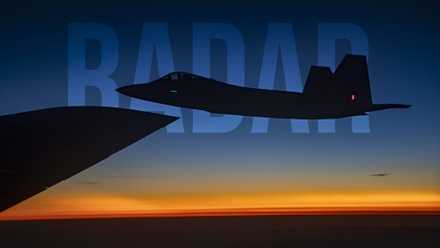
5 Fighter Jets With The Most Advanced Radar Systems
A closer look at some of the fighters with the longest striking range.
The Chengdu J-20: China’s Mighty Dragon

China’s J-20 Mighty Dragon was designed to be a low-observable, long-range interceptor capable of challenging US and allied air operations throughout the Western Pacific. It has a large canard with plenty of internal space for fuel and a wide delta wing behind it. Because China does not have the same tanker support as the USAF and Western forces, its unrefueled combat radius is remarkably long.
According to the World Directory of Modern Military Aircraft, the People’s Liberation Army Air Force of China may have up to 210 stealth J-20 Mighty Dragon fighters. The J-20’s range enables it to loiter on the flight paths of tankers, AWACS, airborne early warning aircraft, or stand-off bombers, threatening them with extended-range PL-15 missiles. Roughly matching the F-22’s six AIM-120s, but with an unverified seeker range good for shots over 62 miles (100 kilometers).
Low observability is central to its mission profile. It features serpentine air intakes, serrated bay doors, and edge alignment to reduce frontal radar returns. The canards and overall airframe size, and substandard RAM coating mean its signature is less suppressed than the Raptor’s. In practice, this means the J-20 is expected to be very difficult to detect from ahead, crucial for closing on support aircraft, but still less stealthy from the side or rear.
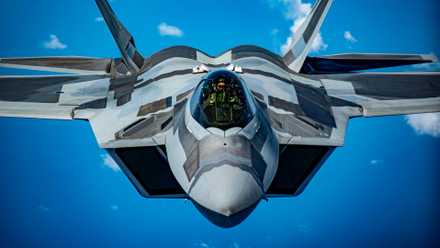
Here’s Why Air Forces Are Expanding Their Stealth Fighter Programs
The global race for the ultimate stealth jet.
Russia’s Felon: The Sukhoi Su-57 Stealth Fighter

The Su-57 is the pinnacle of Russian fighter jet design. It follows the same engineering philosophy as the F-22, combining stealth technology with supermaneuverability, but true to Russian form, Sukhoi’s first 5th-gen fighter pushes performance to the limit. The Izdeliye 177 engine, which has better thrust-to-weight ratios and supercruise capability than the previous AL-41F1 engines, was recently upgraded for the Su-57 fleet.
The Su-57 has a significant advantage in gaining an altitude “perch” during a dogfight because it can muscle its way through maneuvers that would cause other jets to stall during a vertical climb. However, sensitive stealth coatings and composite materials mean pilots are often limited in preserving the skin of the aircraft. The new engines aim to improve this area as well with a serrated exhaust nozzle, designed to reduce the infrared and radar signature, improving the aircraft’s overall stealth profile.
The Su-57 has consumed all of the available resources in Russia under its sanctioned aerospace economy to produce such an exquisite airframe. As a result, the Sukhoi Su-75 Checkmate, a single-engine 5th-Gen stealth fighter, has never been produced despite never being officially canceled.
While the Felon was an answer to the Raptor, the Checkmate was meant to be a parallel to the American F-35. Given the state of the Russian economy, there are many doubts that more Su-57 jets will ever make it off the assembly line, let alone a single Su-75 factory ever being stood up.

Before The F-35 Vs. After: How Air Combat Changed
Examining a paradigm shift in air warfare.
The Incoming Generation Of Air Power

The United States and its allies worldwide are currently advancing the development of sixth-generation stealth fighters because the Pentagon believes that Chinese 6th-generation aircraft, tentatively named the J-36 and J-50, could enter service as early as 2035. Due to industrial choke points caused by sanctions and the prolonged invasion of Ukraine, the Mikoyan PAK DP, an interceptor that Russia is still developing to replace the MiG-31, is not a threat at this time.
The Air Force chose Boeing to lead its NGAD program in early 2025, naming the future fighter the F-47 in honor of the Republic P-47 Thunderbolt, which flew during WWII. According to current estimates, the United States may build a fleet of approximately 500 sixth-generation aircraft. Along with the F-47 will be the new Northrop Grumman B-21 radar bombers. Working together, the two advanced platforms will maintain air superiority in a future conflict against even the most advanced adversary, such as China or Russia. According to Air & Space Forces Magazine, the first F-47 is expected to fly in 2028, while the B-21 is set to enter service next year.
Leading lawmakers have claimed that the Navy’s F/A-XX and the F-47 won’t be fully operational until the mid-2030s. The Navy’s F/A-XX carrier-based fighter is developing more slowly due to financial limitations. The program was shelved in early 2025 to make room for the Air Force’s F-47, but Congress revived it in early 2026 by adding nearly $900 million to the budget. Northrop Grumman and Boeing are the final two contenders for the contract.