dailynewsnblog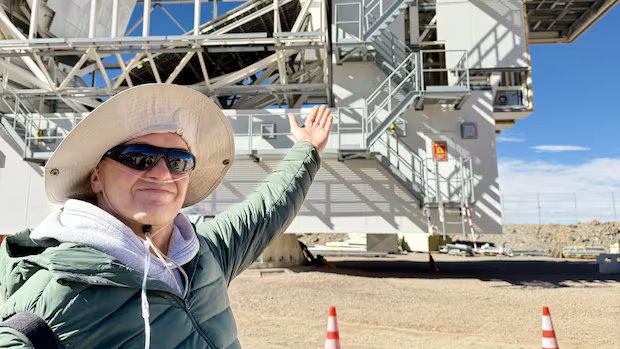

Listen to this article
Estimated 5 minutes
The audio version of this article is generated by AI-based technology. Mispronunciations can occur. We are working with our partners to continually review and improve the results.
The work of researchers from across Canada is at the heart of a massive new telescope that could help unlock some of the biggest mysteries of the universe from its perch at one of the highest elevations in the world.
“It’s one of those rare moments when you, in some sense, get to open up a new window on the universe,” Scott Chapman, Killam professor in astrophysics at Halifax’s Dalhousie University and a member of the Canadian project team, said in an interview.
About 5,600 metres above sea level — higher than the Mount Everest base camp — on a peak in Chile’s bone-dry Atacama Desert, the Fred Young Submillimeter Telescope is at such a high altitude that visitors need oxygen tanks.
The lofty height and arid setting are needed to ensure the view from the six-metre diameter device is not likely to be obscured by water vapour and other atmospheric elements.

Mike Fich, Canadian team lead and an astronomer at the University of Waterloo, says the telescope offers a clarity of view that some of his colleagues thought was only possible in space.
“Of course, if you go into space, it costs 100 times more. I mean, satellites just are very, very expensive,” he said in an interview.
The project is set to answer questions about how stars and galaxies form and move through space, along with insights into the nature of dark energy and dark matter. It will also be able to offer a glimpse back in time to the formation of the universe.

It’s being led by New York-based Cornell University’s CCAT Observatory in partnership with universities from Chile, Germany and Canada. Researchers at a dozen Canadian institutions are involved, including those from the University of Toronto, the University of Alberta, McGill University and McMaster University.
Fich says the instrument boasts a much wider field of view than a traditional telescope, allowing it to see and map a larger swath of the sky at any given time.
“We can scan across the whole sky in a few minutes,” he said.
Chapman, who joined the project in 2012, leads a team of researchers from Dalhousie, the University of British Columbia and the National Research Council who have built two of the first cameras to be installed in the telescope.
The device can hold up to seven different instrument modules at a time and they can easily be swapped out, allowing new technologies to be installed as they develop.
Chapman’s group has developed quantum sensor cameras that operate at freezing temperatures just a 10th of a degree above absolute zero, the point at which everything freezes.
The technology, in development for the last three decades and now set for its first practical use, can observe the submillimetre wavelengths of light — faint signals existing between radio and infrared waves that are invisible to the human eye and even other instruments like the Hubble Space Telescope.
“What it’s good at, science-wise, is detecting very cold things in the universe,” said Chapman.
That’s important because stars are formed from collapsing clouds of extremely cold gas. The telescope will be able to see stars forming in the Milky Way as well as in other galaxies much further away.
Because light from distant galaxies takes so long to travel to Earth, the telescope will essentially be looking eons into the past. Chapman says the telescope will be able to trace the movement of galaxies and how they formed in the early universe.
“We’re all tremendously excited about what we might be able to discover from these wide, big surveys in these new wavelengths of light that we’re able to map the sky in,” said Chapman. “We’re hoping for lots of exciting results and we don’t know exactly what those may be yet.”
Telescope costs about $40 million
Fich says the project’s German partners are building a dedicated computing centre to process the terabytes of data the telescope will produce every day, and a second centre in North America will likely be needed as well.
The telescope cost about $40 million US, not including modules like cameras, said Chapman. The high elevation of the site meant workers needed to pass fitness tests and carry a constant supply of oxygen while working in the wind and the cold.

The system’s components, the heaviest of which weighs about 55 tonnes, were built in Germany and shipped to Chile where they were reassembled on the mountaintop.
Chapman, who attended an official launch event last month, said he was happy to get off the summit after about an hour breathing through an oxygen mask. Fich says the team constructed a dedicated power station at a lower altitude to power the site, digging a trench up the mountain to contain the cable.
“We’re at such a high altitude there’s no oxygen so you can’t burn diesel [in generators],” said Fich.
He says a nearby Japanese observatory built a road to the remote site at a cost of about $10 million. The Fred Young project is supplying power to the observatory for the next decade to compensate for the road’s construction.
Chapman’s cameras will be installed on the telescope this summer, with the first data expected by mid-fall. Chapman says there will be a huge amount of work needed to make all that data scientifically useful, and the findings will be released publicly about a year later.
MORE TOP STORIES