dailynewsnblog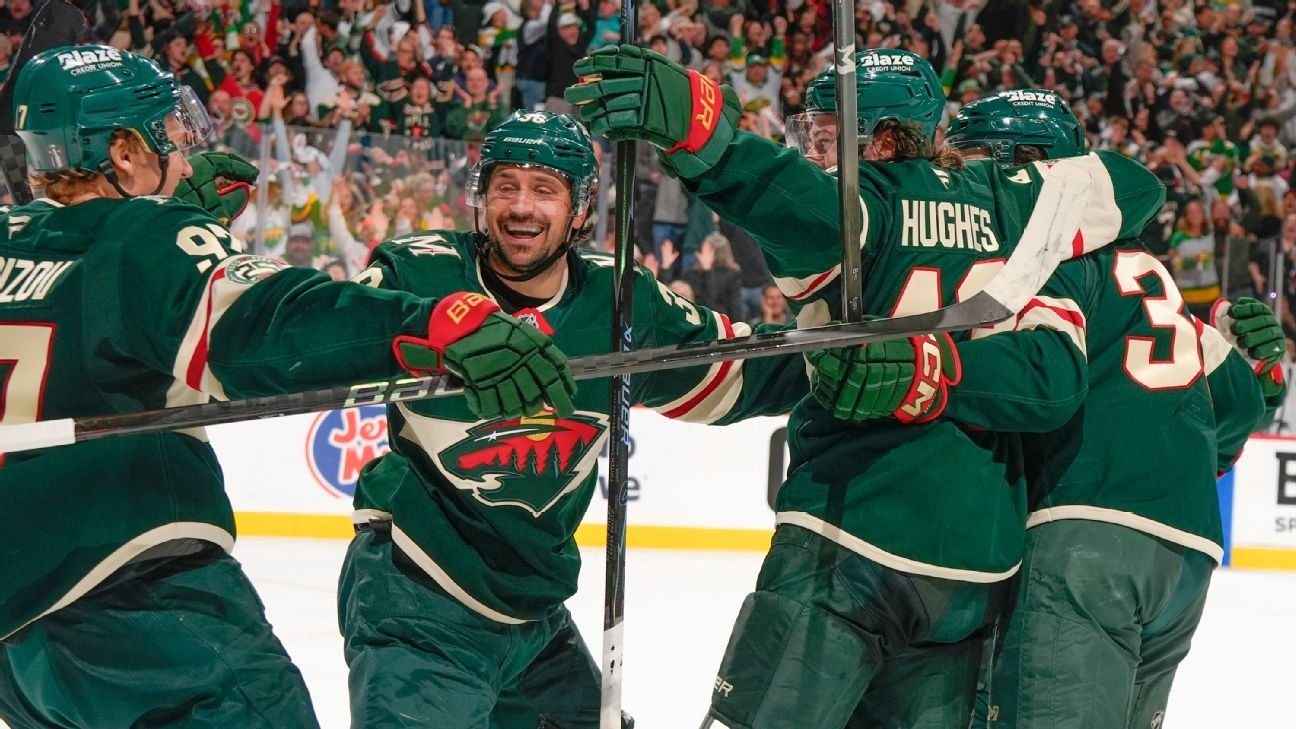
-

Ryan S. Clark
Multiple Authors
ST. PAUL, Minn. — One of the most insightful perspectives about what the Minnesota Wild have done to foster a culture around loyalty comes from someone who just got there.
Veteran forward Nick Foligno, who is now on his sixth NHL team, arrived ahead of the trade deadline in March but knows a lot about how the franchise operates. That’s what happens when you have a brother who has been loyal to that franchise for nine seasons.
For all the times that the brothers have talked about where they could play whenever free agency rolled around, one thing was clear: Marcus Foligno was never going to leave Minnesota.
“One thing about Marcus, and me as well, is when you commit somewhere and put your heart into it, you jump in with two feet, and I think he felt that way,” Nick Foligno said. “They brought him in when they traded for him, and he wanted to help make a difference in bringing this organization success.
“He’s had a lot of great people to work with. He’s had other leaders that he’s talked about and I think he’s just fallen in love with this organization and this fanbase with the way that they have embraced him.”
A number of narratives exist about the Wild, the most pressing being how they have struggled to get beyond the first round of the Stanley Cup playoffs, and are now facing an 0-2 series hole in the second round against the Colorado Avalanche.
Within that narrative, however, lies another: how loyalty was instrumental in the Wild even being in this position. The Wild have drafted homegrown talents like Matt Boldy and Kirill Kaprizov, while trading for others like Brock Faber and Quinn Hughes. All that has been built upon how veterans such as Jonas Brodin, Joel Eriksson Ek, Jared Spurgeon, Mats Zuccarello and Foligno felt the need to stay committed to the organization.
They could have left whenever it came time to enter free agency, or when the Wild underwent a coaching change or there was a new general manager. Instead, they chose to stay through trying times with the intent of helping the Wild become a team that could make a serious push to win the Western Conference, and perhaps, a Stanley Cup.
So what was it that made them decide to stay loyal, while also developing the sort of culture so that when they leave the Wild, the club is in a better place than how they found it?
“It’s through a passion that we all share for the game,” Spurgeon, the team captain, said. “Whether it’s being a good person or a good teammate both on and off the ice. The way you treat people and the way you can be a good teammate. If someone is going through something, you let them know that you are there if they need to talk. But it’s also about the way you do that with everyone within this organization.
“It can be the training staff, everyone within the dressing room or even everyone who works in the building. When you see the same people every day, you treat them with respect and that’s something we’ve done so guys do the same thing when they’re trying to find their own way.”
SPURGEON WAS DRAFTED by the New York Islanders in 2008 but did not sign with them; he inked a deal with the Wild in 2010. Brodin was the Wild’s first-round pick in 2011, and Eriksson Ek was a first-rounder in 2015. Foligno was traded to Minnesota in 2017, and Zuccarello signed as a free agent in 2019 after playing for the New York Rangers and Dallas Stars.
That group has gone through at least three different head coaches and numerous assistants in that time. They’ve heard different visions from different general managers like Chuck Fletcher or Paul Fenton.
They’ve had to suffer through seasons when the Wild didn’t have the salary cap space to make a major move. They’ve had to be part of teams that had to use everything within reach just to qualify for the playoffs. They’ve also been on teams that have done a lot only to then miss the playoffs.
So why stay? What made them each sign multiple contracts with the Wild, if this is what came with playing for the club? Why continue to go through that when they were each more than talented enough to go elsewhere?
Each gives various answers, and it all starts with one person: Wild general manager Bill Guerin.
Guerin, who played 18 seasons in the NHL, was hired by the Wild in August 2019. He joined the organization at a sensitive time. The Wild, who missed the playoffs the season before they hired Guerin, were a perennial playoff team that hadn’t made it to the second round since 2015.
He was taking over a team that had questions about its ceiling, its farm system and how it would navigate the salary cap.
At the time Guerin took over, there were other concerns. Brodin, Foligno and Spurgeon were all within a year of the Wild no longer having team control. That meant they could potentially leave if they were to reach the open market.
“When Billy came in, he had the sort of vision that he put out to us, or at least myself, that was a big reason for staying,” Spurgeon said. “When you’re going through that the summer before [the final year on your contract], you have thoughts that if you’re about to leave or anything like that. But for myself, it never came across my mind. Especially when Billy came in and was having conversations with him about the plan that he had envisioned and where he wanted the team to go.”
Marcus Foligno expressed some similar thoughts when it came to Guerin, his message and how he got everyone to buy into what he was trying to build with the Wild.
“Billy was a big part of the reason why we felt like we had something special here,” Foligno said. “He was loyal to us and we wanted to be really loyal to him. He’s a guy that you want to win for and play for. We knew we had a great team. It was just getting over that hump and we knew that everyone was going to talk about the salary cap issues we had or what some have called those ‘wasted years’ or tough years against us where we were behind the eight ball.”
Guerin signed Spurgeon to a seven-year deal worth $7.575 million annually in September 2019, and signed Brodin to a seven-year contract worth $6 million annually in September 2020. He then signed Foligno to a three-year deal worth $3.1 million annually in January 2021. Eriksson Ek signed an eight-year deal worth $5.25 million annually in July 2021.
That 2021 summer, the Wild bought out the identical 13-year contracts worth $98 million that were signed by Zach Parise and Ryan Suter in 2012. A year after those contracts were signed, the NHL and the NHL Players’ Association agreed on a new collective bargaining agreement that limited maximum contracts to eight years.
Those buyouts, which had four years remaining, brought immediate savings to the Wild. They were able to recoup more than $10 million in cap space. But it came with the caveat that the second year of those buyouts went from costing a combined $4.7 million against the cap to $12.743 million, before surging to $14.743 million in the third and fourth years.
That salary cap strain amplified the need for the Wild to build one of the NHL’s strongest farm systems. Guerin hired Judd Brackett as the Wild’s director of amateur scouting, which led them to draft players like Zeev Buium, Marat Khusnutdinov, Liam Ohgren, Marco Rossi and Boldy.
Brackett was instrumental in helping the Wild identify Faber as a prospect they wanted in return as part of the trade that sent Kevin Fiala to the Los Angeles Kings in 2022.
Although Boldy is the only one from that particular group who’s on the roster, the players that Brackett drafted helped Guerin build the team that’s currently trying to change its fortunes and advance to the Western Conference finals.
The Wild used Buium, Ohgren and Rossi as part of the package that landed them Hughes from the Vancouver Canucks earlier this season, a move that pushed the Wild into the conversation as one of the West’s top contenders.
0:48
Welcome to Minnesota! Quinn Hughes scores his first goal for the Wild
Quinn Hughes scores his first goal for the Wild to give them a 4-0 lead vs. the Bruins.
Every executive has a vision. It might not always come to fruition. But what was it about what Guerin presented — or even about Guerin himself — that made those veterans want to believe that the Wild were steadfast in evolving as a franchise?
“I’ve been around general managers that you might not even talk to them until your contract is up,” Foligno said. “Billy’s one of the guys. I think the way he played is the way he is normally and he wants a group that feels like family and he wants you to be able to talk to him about anything. If you have problems or issues, Billy’s door is always open.
“He’s always joking, but at the same time, he’s honest with you and that’s real. You don’t get that very often. You don’t get someone that’s just like the culture they’re trying to build. But he’s also put this in our hands where you know that this is your team and this is your foundation.”
EVERYTHING ABOUT TRIA RINK in St. Paul points to the culture the Wild have built, and how they make it easy for players to stay. Their practice facility is in the heart of St. Paul, with multiple tinted windows that allow the buildings in downtown St. Paul to be backdrop when the Wild have practice.
It has all the amenities of a contemporary NHL dressing room with the gigantic wooden stalls and padded leather seating. There’s also a spacious players’ lounge and a strength and conditioning facility that’s designed to make players feel welcome whenever they spend countless hours at work.
These things are emblematic of the culture. But what might be the strongest indication of how the Wild feel about their core lies elsewhere. Underneath the stands of their practice rink are a pair of murals that depict the Wild’s dressing room.
The stalls of Brodin, Eriksson Ek, Foligno, Spurgeon and Zuccarello are part of the mural, along with those of Boldy, Faber and Kaprizov. This is how the Wild show — and not just tell — who is at the heart of their organization.
This is, in a sense, another example of what loyalty looks like.
“I love it here and I think it’s the same thing with those guys,” Boldy said. “We have an unbelievable core that wants to win here and make a difference here and loves to be here. The way we’re treated, the staff that we have. It’s everyone from top to bottom. That’s equipment managers, coaches, chefs, everything. It’s the top of the line. I don’t know it any other way but it’s one of those things where the grass isn’t always greener. We got it pretty good.”
Boldy, who debuted during the 2021-22 season, said that the Wild’s veterans have created a culture that has allowed every player who has come into the dressing room to feel comfortable and confident to be themselves.
“Nobody wants to come here and try to be somebody they’re not,” Boldy said. “I think that’s been the biggest thing ever since my first day. … You’re not just showing up and putting on a face. Jared, Marcus, all these guys, that’s a big thing for them. If you’re able to show up as yourself, you can perform like yourself.”
0:58
Matt Boldy’s two empty-netters seal series win for Minnesota
The Wild crowd erupts as Matt Boldy’s two empty-net goals seal it for the Wild to surpass the Stars in Game 6.
Nick Foligno said his brother’s time in Minnesota has allowed him to understand why players feel the need to remain with the Wild. He has seen how Wild fans have treated his brother and how they have nicknamed him “Moose” in a way that bellows throughout the Grand Casino Arena walls.
He has seen the way they have taken those younger players like Boldy, Faber and Kaprizov and treated them as if they’ve been with the Wild forever. Nick Foligno said having fans who care that much does “trickle into our game” while adding how playing for the Wild means something to a lot of people.
His brother Marcus, for example, had a second chance to leave in free agency when the three-year deal he signed with the Wild was slated to end in 2024. Instead, he signed a new four-year deal worth $4 million annually in 2023 that will see him remain with the team through the end of the 2027-28 season.
“When you feel like you have an opportunity to be a core piece of an organization, I think you exert all options,” Nick said. “And I think Marcus felt that. He could be a real difference-maker and understood that impact. There’s not a lot of guys who play like Marcus, and every team wants a guy like that. He’s someone who fights for his teammates and he’s got an identity that’s respected here.
“I don’t think in talking to him, it ever crossed his mind to leave this place. It was always about, ‘How can we get to the next level,’ and now we are here.”
And what was Marcus wearing the day before they faced the Avs? A black hat that read “THE NEXT LEVEL” in white cursive script.
“I’ve been fortunate to be here for nine seasons,” Marcus said. “It’s been an absolute blast. Do I want to complete it and keep pushing here? Absolutely.”