dailynewsnblog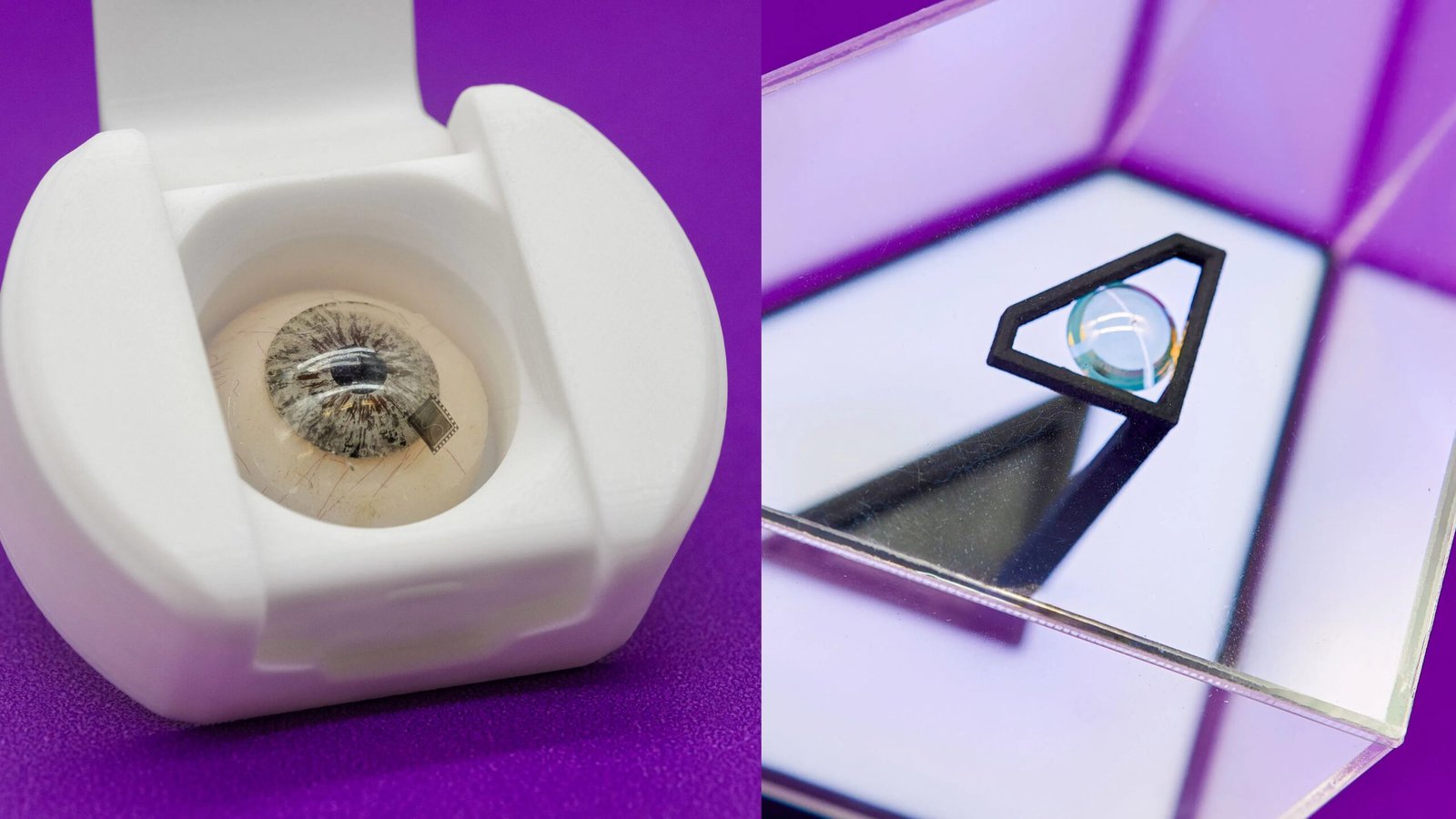
It’s estimated that over 140 million people worldwide wear contact lenses. As a contact lens wearer myself, I was eager to know more when I learned about Xpanceo, a Dubai-based, deep-tech company that has spent the last five years developing AI-powered smart contact lenses. I sat down for a video chat with founder and managing partner Roman Axelrod and founder and CTO Valentyn Volkov.
The smart contact lens is like an AI helper, but directly on your cornea. There are many use cases the company is exploring, from accessing your apps and data, just as you would on your smartphone, to instant identity verification, augmented reality and, with a companion helmet, space missions, aviation and racing. The lens itself can even monitor certain aspects of your health like a wearable, as tear fluid provides biological information.
How smart contact lenses could work
The lens contains a screen, biosensors, a microbattery, an antenna and other service components, but it’s part of a wireless ecosystem. It works with an external companion device that sits on the side of your head and contains a camera, earphone and microphone. The device handles energy storage and computing and can wirelessly charge the lenses. The companion device can maintain a continuous connection with the lens using custom antenna technology.
“We have built it. It works,” said Axelrod, referring to the team’s 28 working prototypes made with over 50 patents. “We’re going to reveal it early next year at MWC Barcelona.” Also known as Mobile World Congress, the telecommunications trade show will run from March 1 to 4 in 2027.

An eye on the future of health
While current wearables, such as wrist-based fitness trackers and smart rings, have shifted people’s mindset from reactive healthcare to continuous, proactive monitoring, their sensors are limited in what they can capture from outside the skin. Smart contact lenses, by contrast, would allow biochemical monitoring without the need for blood draws.
“The eye is the next natural frontier of biosensing,” said Volkov.
Tear fluid is blood that has been filtered
Even when filtered, tear fluid can still provide biological information. According to Volkov, this includes glucose levels, proteins, electrolytes, stress hormones and other biomarkers.
Glucose levels, specifically, could be helpful for those with diabetes, which can cause eye damage and vision loss over time. But unlike glucose meters or continuous glucose monitors, contact lenses wouldn’t require pricking the skin.
The curvature of the eye can provide another parameter: intraocular pressure, or the force inside your eye. It can indicate your eye health status and risk of diseases such as glaucoma. From its position on your eye, a smart contact lens could measure this, too.
In the near future, the team wants the lens to proactively give you tips for living your healthiest life.

Cornea compatibility
Xpanceo’s lenses are made from traditional certified polymer materials that are biocompatible and breathable. Biocompatibility is top of mind, as the company will need to obtain all the necessary medical certifications.
The challenge lies in integrating transparent polymer lenses with optoelectronic sensor components in a way that keeps the lenses safe and comfortable.
“That’s actually where we are spending our money,” said Volkov. “It’s not just mixing the polymer with batteries, and voilà! It doesn’t work like that.”
To assess biocompatibility, the team will start with cells, then move to animals and finally test the lenses on humans.

Making contact with consumers
Daily contact lens wearers will likely be early adopters. Then, they plan to persuade the broader public to embrace the smart lenses. Axelrod compared this to the release of the first iPhone.
The Xpanceo team is also exploring the possibility of developing a contact lens that could serve as a brain-computer interface in the coming years. They even have patents for it.
“We realized that a contact lens might be a universal answer not only for health monitoring in real time, but a universal interface between our brain and machinery in general,” said Volkov. “Because our eye, from an optogenetic point of view, is a part of the brain, since we are getting 80% of information through the eyes.”
The lens would then be a non-visible, non-invasive brain-computer interface.

Privacy optics
Given concerns about the privacy of smart glasses, I asked whether the same issue would be a problem with smart contact lenses. While the lenses themselves don’t have a camera, the companion device does.
When it comes to the privacy of others, Axelrod said the team will figure it out, citing data privacy laws across the globe, such as the EU’s General Data Protection Regulation, and all the devices that have come before smart contact lenses.
“What concerns me most is the privacy of your data when you use it,” Axelrod continued. “We’re about to teach humanity how to get even more information and transfer it to the digital world. This is what concerns me most.”
In addition to learning from the best available data privacy toolkits, Xpanceo is developing its own unique data privacy approach specifically for contact lenses.
Smartphone or “eye” phone?
Xpanceo isn’t trying to kill the smartphone, according to Axelrod, and the company isn’t trying to replace any medical devices either.
He compared it to the fact that smartphones didn’t replace laptops, laptops didn’t replace PCs and text messages didn’t replace emails. Smart contact lenses are just another use case and interface that can expand a person’s digital life.
If you leave your home and realize you’ve forgotten your smartphone, at least you’ll have your smart lenses right there on your eyes to keep you connected.

Keep an eye out in 2030
At MWC 2027, Xpanceo will present the third generation of its integrated contact lenses with biochemical sensors. They will also work with another device that can deliver images to the eyes.
The company is starting out with narrow use cases in B2B contracts, such as smart contact lenses with biosensing capabilities for hospitals or professional athletes.
As an example, those with glaucoma can use the lenses to passively measure intraocular pressure, then take a selfie to instantly see their results. Or, race car drivers can use the lenses to see speed, navigation and information about their car’s gas and oil. To detect medication activity in the body during treatment, the lens can be removed and placed in a container that tracks the drug molecule.
Xpanceo even has a joint project with the UAE Space Agency, which will allow its work to be sent to space.

However, this will take time.
Once the team begins to add one use case to another, the hope is that they’ll create a multi-purpose contact lens that can do it all.
After the MWC presentation, Xpanceo will start approaching medical trials within the next year. Then, it will only take a few years to polish the device within B2B contracts. If everything goes as planned (emphasis on “as planned”), the lenses will be available to consumers in narrow use cases by 2030. This could be geared toward race car drivers, pro athletes or firefighters, as examples.
Since the average daily contact lens wearer in the US spends around $2,000 on lenses per year, the Xpanceo smart contact lenses will be about that price for a yearly subscription. Hopefully, less. That’s also the starting price for the new iPhone Duo.
As 2030 is about four years away, it remains to be seen whether Xpanceo’s lenses will have their iPhone moment. Will they be the apple (or Apple) of the general public’s eye, or here and gone in the blink of an eye? We’ll keep watch.

See full bio