dailynewsnblog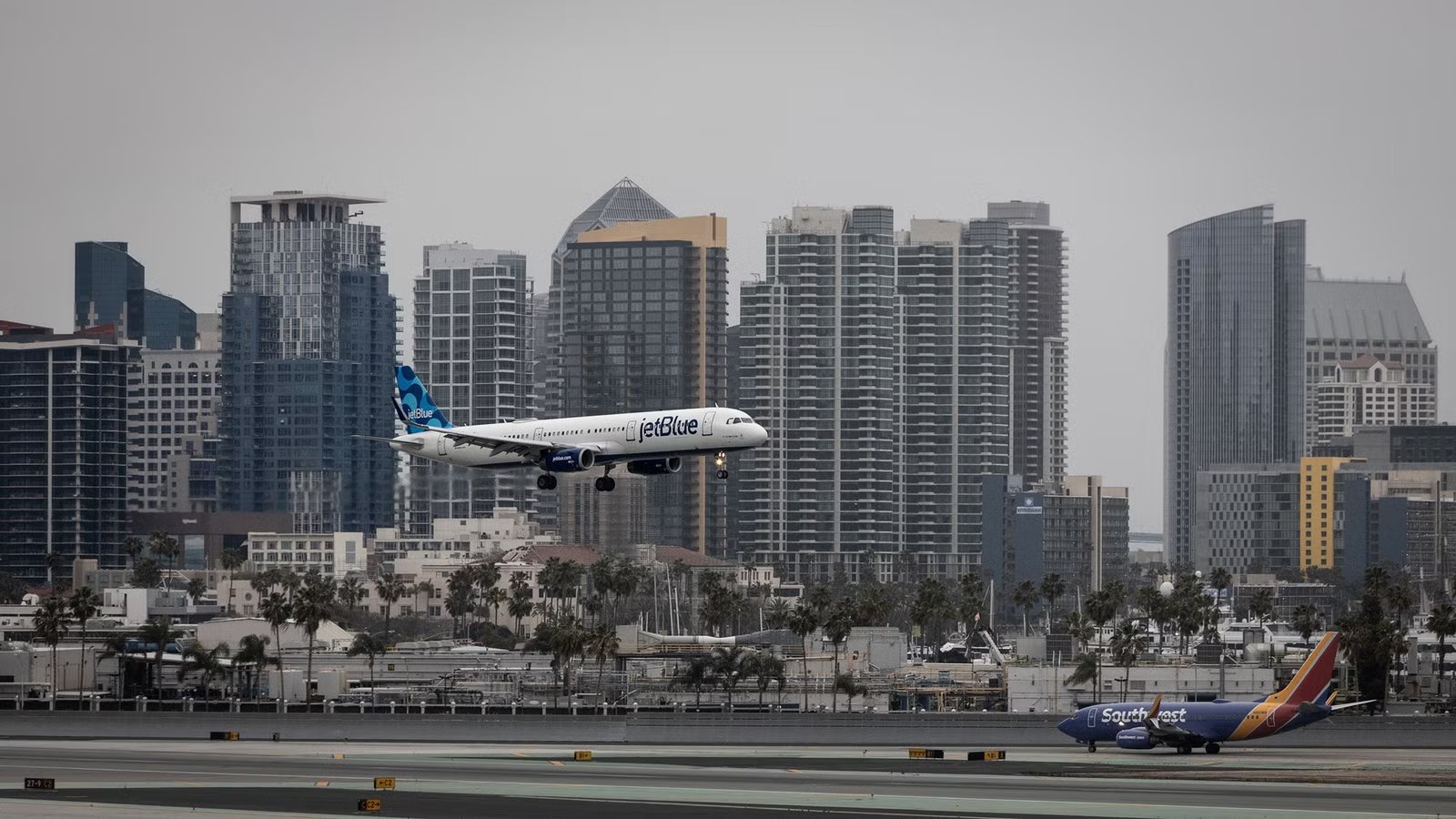
Travel plans turned to chaos at one of California’s busiest airports on Friday, after a drone and weather balloon were spotted in the airspace nearby, grounding flights for several hours. The flying objects were identified at around 2:00 PM on Friday, September 4, and resulted in ground delays until 4:30 PM.
A stratospheric cell tower was undergoing testing near  San Diego International Airport (SAN) on Friday: The cell tower was a large, shiny, shaped balloon belonging to a US aerospace and materials science company that was undertaking tests. It had traveled from New Mexico to Japan and back, and was passing through San Diego on Friday afternoon when it upset flight operations.
Stratospheric Cell Tower Interrupts Flights In San Diego

The unexpected travel path of the cell tower, paired with suspicious drones, forced hundreds of flights at San Diego to be delayed, as services both arriving and departing were issued a ground stop, which was initially in place until midnight due to security and safety concerns. Reports confirmed that air traffic otherwise resumed operations from 4:30 PM, but according to Thenewarea51 on X, it suggests operators were issued a warning to ‘fly at their own risk’.
SceyeCELL, the first of its kind cell tower in the sky, had departed for a trip across the Pacific to Japan on August 9, and this time it was making its way back to New Mexico when the interference occurred. The technology is designed to bring mobile broadband to Earth’s stratosphere, and has the potential to have coverage that otherwise would require more than 500 cell towers.
San Diego Airport confirmed to Fox5 that both the drone and weather balloon were the cause of the delays on Friday, and while an all-clear was given by 4:30, hundreds of flights were still delayed at 8:00 PM that evening.
TSA Investigates San Diego Drone Activity

The drone spotted near San Diego International Airport is currently under investigation by the TSA, after initial reports suggested the police were unable to locate the owner. Flying drones near airports is illegal, as it can cause mid-air collisions that could cause catastrophic damage and death.
A drone can easily smash into an aircraft and get sucked into the engine. This could risk a crash during takeoff or landing, and while drones usually cannot fly high enough to reach critical airspace, the operation of these pieces of technology in and around airports is highly dangerous and could result in flight delays, aircraft damage, or even engine failure resulting in a plane going down.
Cancellations or delayed flights as a result of these interferences cost airlines and airports millions of dollars, disrupt travel schedules, and put hundreds of people’s lives in danger. The balloon and cell tower incident was reported to have delayed around 400 flights on Friday afternoon.
Flights Delayed At The Country’s Busiest Single Runway Airport

Located just three miles (4.8 km) from downtown San Diego, the Southern California airport is the busiest single-use runway in the country and is an important hub for  Alaska Airlines. At just 17 feet (5.2 m) above sea level, it has operated continuously for 98 years, since its first flights in August 1928.
Data from The Frequent Flyer shows that the largest airline at San Diego is Southwest Airlines, with a 34% market share. This is followed by Alaska Airlines, who operate 20% of all flights. The most popular domestic routes are to  San Francisco International Airport (SFO),
  Denver International Airport (DEN), and
  Phoenix Sky Harbor International Airport (PHX), while key international routes are to
  London Heathrow Airport (LHR), San Jose del Cabo (SJD), and
  Munich Airport (MUC).
While the unexpected airspace intruders upset flight operations on Friday afternoon and grounded flights for several hours, the backlog could still be felt by 8:00 PM. Saturday operations remain unaffected.