dailynewsnblog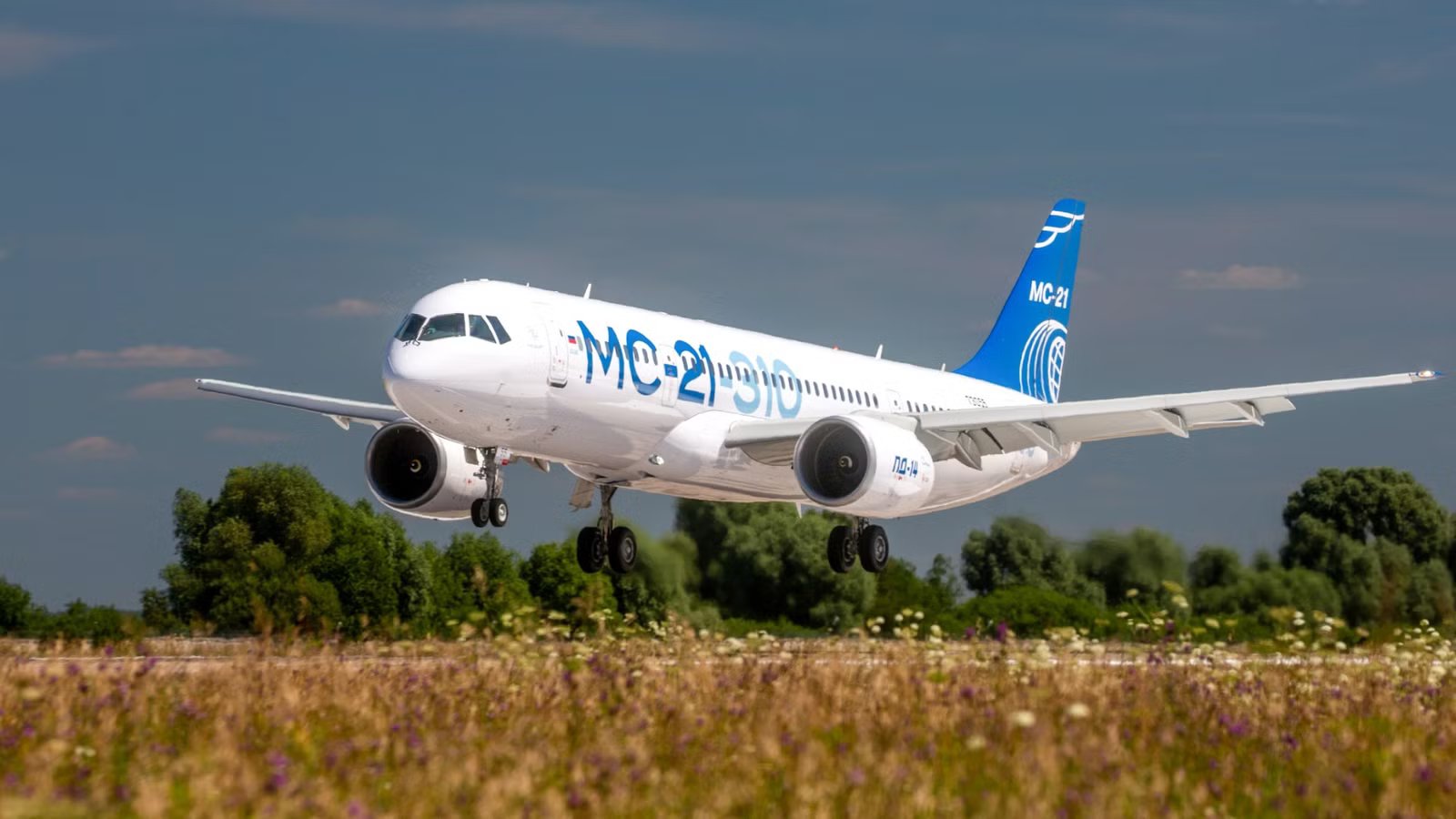
Russia’s United Aircraft Corporation has celebrated a major milestone, with the first serial production standard example of the forthcoming Yakovlev MC-21 having taken its first test flight earlier today. Much like China’s COMAC C919, the MC-21 is designed to compete with major narrowbody twinjets like those in the Boeing 737 MAX and Airbus A320neo families. However, it has faced considerable issues.
Indeed, having initially been designed with Western engines, specifically the Pratt & Whitney PW1000G, sanctions imposed on Russia following the country’s invasion of Ukraine in 2022 have forced Yakovlev, an arm of the UAC, to look closer to home. As such, the serial production standard model of the MC-21, which will be known in full as the MC-21-310, will instead be powered by Russian engines.
83 Minutes In The Air

According to reporting on the matter by The Moscow Times, UAC’s first serial production standard example of the Yakovlev MC-21 conducted its first test flight out of the Irkutsk Aviation Plant at Irkutsk Northwest Airport (UIIR) earlier today. The jet was airborne for a grand total of one hour and 23 minutes, and it reached a maximum height of 19,700 feet while flying at 600 km/h (372 miles per hour).
This milestone marks a key step forward for Yakovlev as it looks to move towards full-scale serial production in anticipation of the MC-21-310’s entry into service. On this front, The Moscow Times notes that an initial batch of 18 production airliners is now in the works at the Irkutsk factory, which Russian President Vladimir Putin visited last month. Commenting on the flight, test pilot Roman Taskayev said that:
“The first assembly line produced aircraft performed well, and the flight plan was completed in full.”
More Reliant On Russian Components

Delays to the development of a new aircraft are not uncommon: on the widebody side of things, the US-built  Boeing 777X jet has become infamous for running several years behind schedule. However, the Yakovlev MC-21’s development has been a particularly long and drawn-out process. Indeed, The Moscow Times notes that the MC-21 program was first launched in 2009, some 17 years ago.
It was originally known as the Irkut MC-21 before the Yakovlev name was applied to the project. After years of development, it seemed that the jet was finally reaching the light at the end of the tunnel after the Pratt & Whitney-powered MC-21-300 variant was certified in Russia in late 2021. However, just months later, the country’s invasion of Ukraine saw it cut ties with the Western world, killing the MC-21-300.
Now, the future of the program lies in the MC-21-310 model, which is powered by Russian-built Aviadvigatel PD-14 engines. Air Data News notes that these are one of several “Russian-made systems replacing the imported equipment originally selected for the program.” The site went on to add that today’s test flight should speed up customer deliveries, as it validated various procedures that should help close the gap time-wise between certification and the type’s entry into service.
Which Airlines Have Ordered The MC-21?

According to present fleet data made available by ch-aviation, 384 firm orders have been placed for the Yakovlev MC-21. Of these, more than half belong to Russian flag carrier and expelled SkyTeam member Aeroflot, with the national airline having put its name down for 198 units. Elsewhere, 99 orders have undisclosed customers, and Rossiya is also set to be a major customer, with 61 purchases in the books.
There have also been a couple of smaller orders for the Yakovlev MC-21, with Red Wings Airlines and IrAero respectively putting their names down for 16 and ten examples of the type. As far as what a typical onboard configuration for the MC-21 will look like is concerned, ch-aviation notes that one of the prototype aircraft (73054) has 16 business class (four-abreast) and 147 economy (six-abreast) seats.