dailynewsnblog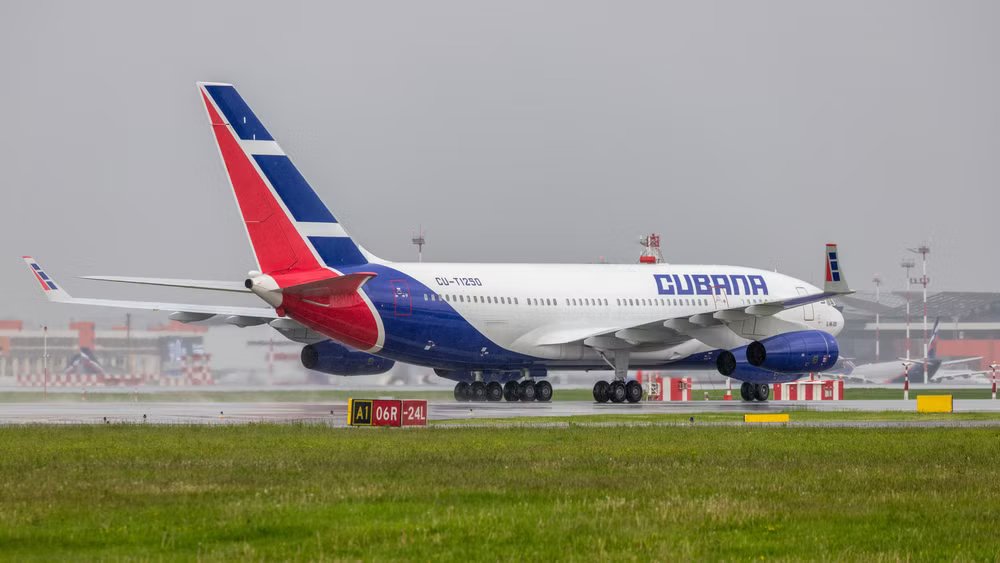
The Soviet Union developed the Ilyushin Il-96 quad-engined widebody aircraft as a flagship airliner for the declining country. Since then, the succeeding state of Russia has kept the program alive, but just barely. Instead of being a symbol of a world-leading aerospace sector, it can be seen as emblematic of a sector that survives, but is long past its glory days.
Efforts to restart the production of the Ilyushin Il-96 as the modernized Il-96-400M gained new traction in the 2010s. Ironically, while sanctions made Russia’s demand for a domestic widebody solution stronger than ever, the same sanctions also doomed the aircraft. Some claimed the Il-96-400M was Russia’s answer to the Boeing 777X or the Airbus A350, although few in the industry ever took it seriously.
Today, there is some indication that Russia is moving to purchase a few more modified examples of the Il-96 for its special air force needs, but this is far from conclusive. Its manufacturer is moving to employ more workers, but they may be tasked with other programs, while work on Russia’s large, airplaneless PD-35 turbofan continues.
The Meager Fleet Of Il-96s

The Il-96 was developed during the waning days of the Soviet Union. It first flew in 1988 and entered service with  Aeroflot in 1992. The aircraft was presented as a major technological leap for the Soviet Union, but it never moved much beyond a military program. With the collapse of the USSR, airliners looked to more advanced, safer, and fuel-efficient Western widebody airliners.
Only a few dozen examples have been built, mostly for the Russian Air Force as VIP government aircraft. Planespotters.net lists a total of 34 Il-96s that have been produced between 1992 and now. Of these, the three prototypes have been scrapped, another has been preserved, one has been written off, and one was not completed. That leaves around 28 airframes. Of these, eight are listed as stored, with just 17 examples active.
Of those active examples, one is the modernized Il-96-400M test article. The vast majority of these aircraft are operated on behalf of the Russian Air Force, although a single example is operating as a freighter for Russia’s Sky Gates Airlines. Famously, Cuba’s Cubana de Aviación received four examples, and one was restored for use in 2025. However, the economic issues in Cuba in the face of intense sanctions mean none are currently operating.
Efforts To Make It A Passenger Aircraft

Russia has long dreamed of resurrecting its collapsed passenger airliner industry. Following the fall of the USSR, Russian airlines, along with almost all export customers, transitioned to Western aircraft. Aeroflot became an all-Western airliner fleet. Production of legacy airliners (such as the Il-96 and Tu-214) continued at a very modest rate, mostly for military contracts.
These were subsequently modernized with Western-imported components. By the 2010s, Russia was developing the regional Sukhoi Superjet and the MC-21 narrowbody airliners as cleansheet aircraft relying heavily on Western engines, avionics, and other systems.
While the quad-engined Il-96 widebody never fully went away, it was wholly unable to economically compete with Airbus and Boeing widebody airliners. At the same time, Russia couldn’t let it fall out of production for prestige value, as high-profile government aircraft need to be Russian-built. However, the 2022 sanctions in the wake of the Ukraine invasion changed everything.
The economics of aircraft became subordinate to just being able to produce and fly airliners. Russia has moved to ‘russify’ its MC-21, Superjet (SJ100), Tu-214, and Il-114, so far, with mixed results. As of the time of writing, no post-sanctions passenger jets have entered passenger service. Sanctions also offered another window of opportunity for the Il-96 to make a comeback, but also doomed it at the same time.
The Fizzled Post-2022 Reboot

In 2022, in the face of sanctions cutting it off from purchasing international aircraft, Russia said it would produce around 1,000 aircraft of various types by 2030; this included 12 older-model Il-96-300s. That number of Il-96s was increased to 14 in 2024, although as of 2026, only a small portion of the total fleet has a realistic chance of being built by 2030.
In 2024, the BBC noted that “the Il-96 was abandoned back in the 1990s because it was already outdated, but now there’s no other choice: Russia has no long-haul projects.” One Russian aviation specialist told the BBC that
“We’re taking an old Soviet design and saying, ‘Let’s start producing it.’ It’s a long-range, four-engine aircraft, but no one’s made one like that for 15 years! And those that did are being written off because they have four engines. And the engines aren’t new either; they’re neither efficient nor durable. They’re unprofitable by definition. And as soon as we started talking about resuming production, we started talking about subsidies for operation.”
There is essentially no interest in the Il-96 from major Russian airlines, and Russia’s aviation industry base remains strained. The commercial industry is working with limited resources to certify and reintroduce multiple airliners in the middle of a war and at a time when funding and resource priorities are often with the Russian Air Force.
The modernized Il-96-400M was produced with imported Western avionics and other technology. Sanctions meant that it was infeasible to produce this variant, and Russia considered putting the older Il-96-300 into production as a civilian airliner.
Saving Face With A 777X & A350 Challenger

It’s often reported online that the updated and stretched Il-96-400M was pitched by Russia as an alternative to the Boeing 777X and Airbus A350. While this is somewhat correct, it’s also somewhat misleading. The old, heavy, quad-engine aircraft with PS-90 engines was never a serious economic contender, and Russia lacked the industrial capacity to produce them at scale.
As such, this was merely aspirational and held signaling and propaganda value. Something similar happened in August 2026 when Russia patented a new design for a commercial airliner that it called the Widebody Long-Range Aircraft. This was reported as being a cleansheet widebody able to rival the Boeing 787 Dreamliner and carry 240-320 passengers.
Il-96-300 vs Il-96-400M (per UAC) | Ilyushin Il-96-300 | Ilyushin Il-96-400M |
|---|---|---|
Length | 181 feet 7 inches (55.35 m) | 212 feet 3 inches (64.69 m) |
Payload | 551,000 lb (250 t) | 595,000 lb (270 t) |
Powerplant | 4х PS-90А | 4х PS-90А1 |
Passengers (Single-class layout) | 300 | 370 |
Number produced | Approximately 32 | One |
Skeptics pointed out that the development came after China kicked Russia out of its project to develop the C929 widebody 787 challenger in 2023, following the international sanctioning of Russia. China is now developing the C929 alone. On a different note, reporting out of Russia in September 2026 seems to suggest that the nine to 12-seater LMS-901 Baikal single-engine light multipurpose aircraft may be about to be canceled.
Instead, Russia appears poised to restart production of a modernized version of the An-2 biplane, which first entered service in 1947. With Russia’s aviation industry, it is important to not go to extremes. The truth is, Russia regains a large and capable aviation sector, but it is also much more constrained and limited than its public messaging would suggest.
Rumors It Could Be A ‘Doomsday’ Airplane

Instead of producing a new commercial passenger jet, some reports suggest Russia may acquire a small number of Il-96-400Ms to replace its aging Cold War-era ‘Doomsday’ aircraft based on the older Ilyushin Il-80 fleet. These aircraft are responsible for providing mobile nuclear command, control, and communications during a major crisis. The replacement program is known as Zveno-3S.
The US Air Force counterpart to this program is the existing four E-4B ‘Doomsday’ planes based on the aging Boeing 747-200 airplanes, which are being replaced by SNC via the Survivable Airborne Operational Center program. SNC purchased five ex-Korean Air Boeing 747-8Is for the conversion. Zveno-3S is a classified Russian development for the next-generation doomsday aircraft.
Should the Il-96-400M be selected, it would offer a significantly greater range and endurance than existing aircraft. It would bring a larger internal volume for more communications, staff, and systems. It should be emphasized that not much is publicly known and much of the online reporting is conjecture. However, as stated, the Il-96-400M was built using now-sanctioned Western components: it is likely a new ‘russified’ variant would need to be developed using available Russian systems and components.
Disentangling From Other Aircraft Programs

In December 2025, Russian news outlet Kommersant reported that the Voronezh aircraft plant was adjusting and redistributing its workload across various aircraft programs. It said no layoffs of the company’s core production personnel were planned for 2026. Instead, it would need to hire around 1,500 to 2,000 more workers.
The company’s key products include the Il-76, Il-78, Il-112V, and A-50 military transport aircraft, as well as Il-96 and Il-114-300 passenger aircraft. Some news outlets reported on the planned increased hirings to produce the military Il-96-400 aircraft, but it is not possible to identify which aircraft these new hires are specific to.
Russia has been trying to ramp up production of its Il-76 for years, while the Il-114-300 regional turboprop recently received its type certificate, clearing it for serial production. It is also investing in its PD-35 engine, which provides 77,000 lbf (35 tonnes).
While this could theoretically be used to re-engine the Il-96, that has not been established, and there are other use cases for it. There are no current production aircraft that use the PD-35, and it was originally being developed for the CR929 (now COMAC C929). The engine is still years away from achieving its type certificate and may now be part of another aircraft program.