dailynewsnblog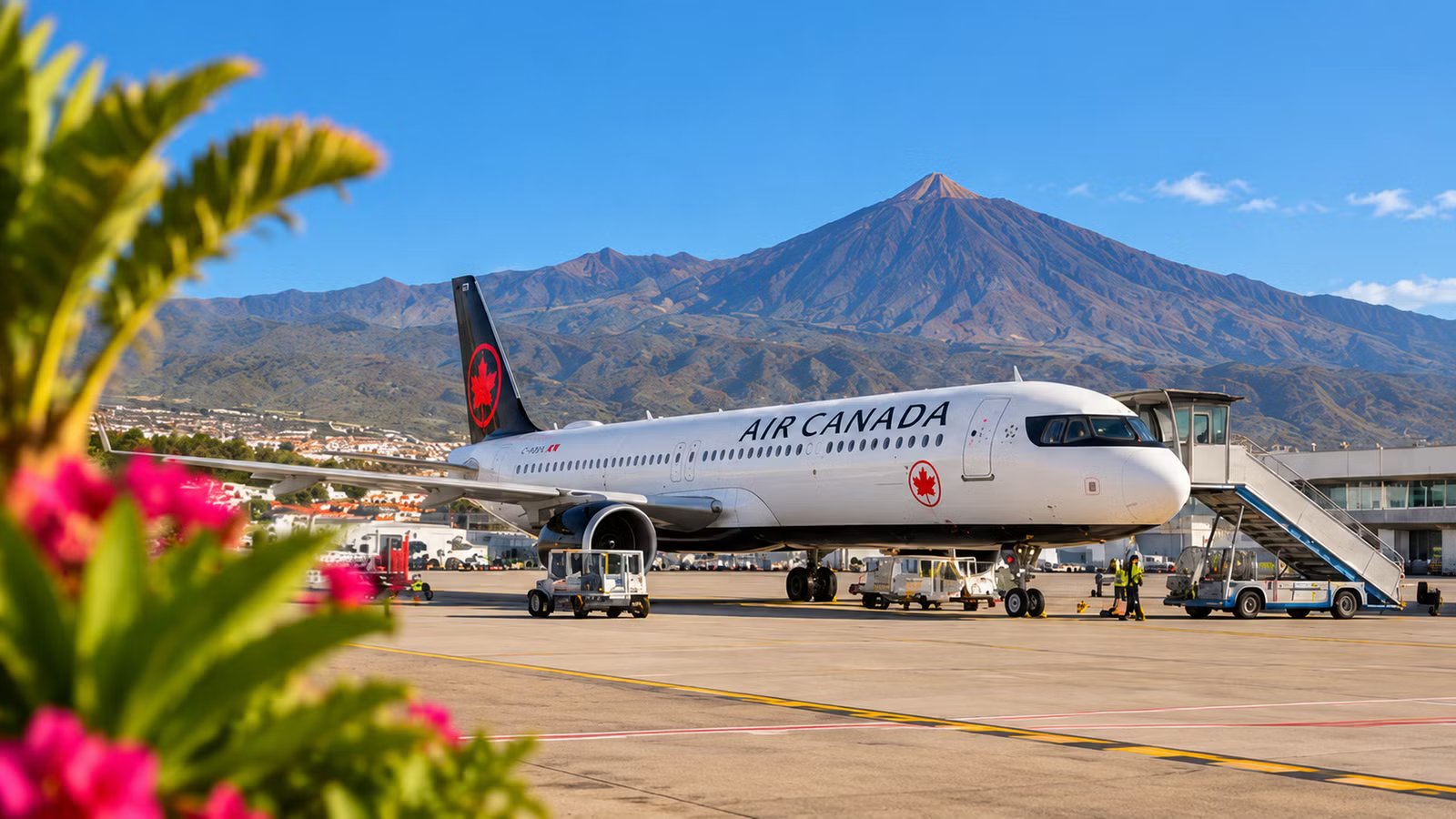
 Air Canada is less than a month away from starting its first service to Tenerife, giving Canada nonstop access to the Canary Islands for the first time. The new route from
  Toronto Pearson International Airport (YYZ) to Tenerife South Airport (TFS) begins on October 25, followed just six days later by a new route from Montréal–Trudeau International Airport (YUL) to Tenerife as well.
Both routes will be operated by Air Canada’s new Airbus A321XLR, allowing the carrier to serve roughly nine-hour transatlantic sectors with far fewer seats than a widebody. The Tenerife launches are also only the beginning of a much broader long-haul expansion from Toronto, Montréal, and Vancouver, with additional new services to Europe and Asia scheduled from late 2026 into 2027.
Air Canada’s New Tenerife Flights Start In October

Originally announced back in April as seasonal winter sun services, the new routes will start with a relatively low frequency. Toronto gets the first departure, with AC954 leaving at 8:35 PM on Thursdays and Sundays, and reaching Tenerife at 9:00 AM the following morning. The return AC955 departs Tenerife at 10:55 AM on Mondays and Fridays, arriving back in Toronto at 2:50 PM. Montréal follows six days later: AC956 leaves at 9:00 PM every Saturday and arrives at 9:00 AM the following morning, with the Sunday return reaching Montréal at 2:10 PM.
Route | Launch | Frequency | Departure | Arrival | Aircraft |
|---|---|---|---|---|---|
Toronto (YYZ) – Tenerife (TFS) | October 25, 2026 | 2 x weekly | 8:35 PM | 9:00 AM +1 | Airbus A321XLR |
Montréal (YUL) – Tenerife (TFS) | October 31, 2026 | 1 x weekly (initially) | 9:00 PM | 9:00 AM +1 | Airbus A321XLR |
The aircraft is almost as important as the destinations. Air Canada’s 182-seat A321XLR has 14 Signature Class seats, arranged 1-1, with fully flat beds and direct aisle access, plus 168 Economy seats. Air Canada has previously said its A321XLRs can fly for up to 11 hours, with a range of approximately 5,400 miles (8,700 km). — precisely the combination of range and relatively low capacity needed to make thinner transatlantic markets viable.
Air Canada Chief Commercial Officer Mark Galardo says the new routes are all about cementing the airline’s global network as one of the most far-reaching from North America:
“The addition of Tenerife reflects our continued ambition to offer our customers and Aeroplan members an exceptional, diversified array of unique destinations. Enabled by the next-generation capabilities of our A321XLR aircraft, travelers on the only non-stop service from North America now have convenient options to reach an island renowned for its stunning volcanic scenery, a rich array of bucket-list activities, and year-round warm weather.”
Interestingly, the route from Montréal is already growing beyond the original plan. It starts once weekly, gains a second weekly flight between February 2 and March 23, and is currently filed at three weekly from April 1 as Air Canada extends it through summer 2027 and makes it year-round. Toronto, by contrast, remains scheduled as a winter-seasonal service through late April.
Why The Canary Islands Are Suddenly Becoming A Canadian Battleground

The attraction of the new routes is straightforward: Tenerife offers warm weather through the Canadian winter, while being different enough from the Caribbean to widen Air Canada’s leisure portfolio. Tenerife’s tourism authority has spent several years targeting North American travelers and says Toronto and Montréal are among its most important source cities. Air Canada, meanwhile, is using the XLR to combine low-frequency flying with a premium cabin instead of risking the substantially greater capacity of an Airbus A330 or Boeing 787.
But Air Canada will not have the Canadian Canary Islands market to itself for long. Air Transat begins weekly service from Toronto and Montréal to Las Palmas’ Gran Canaria Airport (LPA) on December 12. That means that within weeks of Air Canada’s Toronto launch, Canada’s two largest cities will each have nonstop links to two different Canary Islands, creating a surprisingly competitive niche market that previously had no scheduled Canadian nonstop service.
Airline | Route | Launch | Frequency | Aircraft |
|---|---|---|---|---|
Air Canada | Toronto–Tenerife | October 25, 2026 | 2x weekly | Airbus A321XLR |
Air Canada | Montréal–Tenerife | October 31, 2026 | 1x weekly (initially) | Airbus A321XLR |
Air Transat | Montréal–Las Palmas | December 12, 2026 | 1x weekly | Airbus A321LR |
Air Transat | Toronto–Las Palmas | December 12, 2026 | 1x weekly | Airbus A321LR |
But there is also a warning from south of the border.  United Airlines launched a new route to Tenerife from
  Newark Liberty International Airport (EWR) in 2022, and eventually extended the Boeing 757 route through the winter. But its final operation ended in April 2025, and proposed resumptions were subsequently removed from the schedule. Air Canada and Air Transat are therefore approaching an already-tested but apparently challenging North American market with low frequencies and long-range narrowbodies, rather than flooding it with capacity.
Tenerife Is Only The Beginning Of Air Canada’s Long-Haul Expansion

The Canary Islands launches sit at the front of a considerably larger long-haul rollout by Air Canada. Schedule data shows upcoming flying from all three of its principal hubs, including new or returning links to Tel Aviv, Dubrovnik, Basel, Guangzhou, Sapporo, Oslo, Shannon, and Nice. Air Canada’s September network announcement described the program as the largest intercontinental expansion in its history.
Route | Launch Date | Aircraft |
|---|---|---|
Toronto (YYZ) – Tenerife (TFS) | October 25, 2026 | Airbus A321XLR |
Montréal (YUL) – Tenerife (TFS) | October 31, 2026 | Airbus A321XLR |
Vancouver (YVR) – Sapporo (CTS) | December 17, 2026 | Boeing 787-9 |
Vancouver (YVR) – Guangzhou (CAN) | May 4, 2027 | Boeing 787-9 |
Montréal (YUL) – Dubrovnik (DBV) | May 11, 2027 | Boeing 787-9 |
Toronto (YYZ) – Oslo (OSL) | June 2, 2027 | Airbus A321XLR |
Toronto (YYZ) – Shannon (SNN) | June 10, 2027 | Airbus A321XLR |
Toronto (YYZ) – Nice (NCE) | June 16, 2027 | Airbus A330-300 |
Montréal (YUL) – Basel (BSL) | June 16, 2027 | Airbus A321XLR |
The schedule data also puts the scale of Tenerife into perspective. Air Canada has 92 weekly European departures from Toronto and 70 from Montréal during the first week of November, while Tenerife begins with only two and one respectively. That is arguably the XLR’s sweet spot: instead of needing enough passengers to fill a Dreamliner several times each week, Air Canada can test smaller markets while still offering fully flat Signature Class seats. The airline is already doing exactly this by using the aircraft on new, thinner transatlantic markets such as Toulouse, Nantes and Lyon.
Vancouver provides the other side of the strategy. Air Canada launches its seasonal Sapporo service in December and has scheduled a year-round route to  Guangzhou Baiyun International Airport (CAN) from May 4, 2027, using the Boeing 787-9. Another Asian opportunity has now emerged: Canada and Vietnam expanded their air transport agreement on September 24 to permit direct scheduled passenger flights, potentially clearing a regulatory hurdle for a future Canada–Vietnam route. No Air Canada service to Vietnam has yet been announced, but with Vancouver continuing to grow as its transpacific hub, it is an obvious market to watch.