dailynewsnblog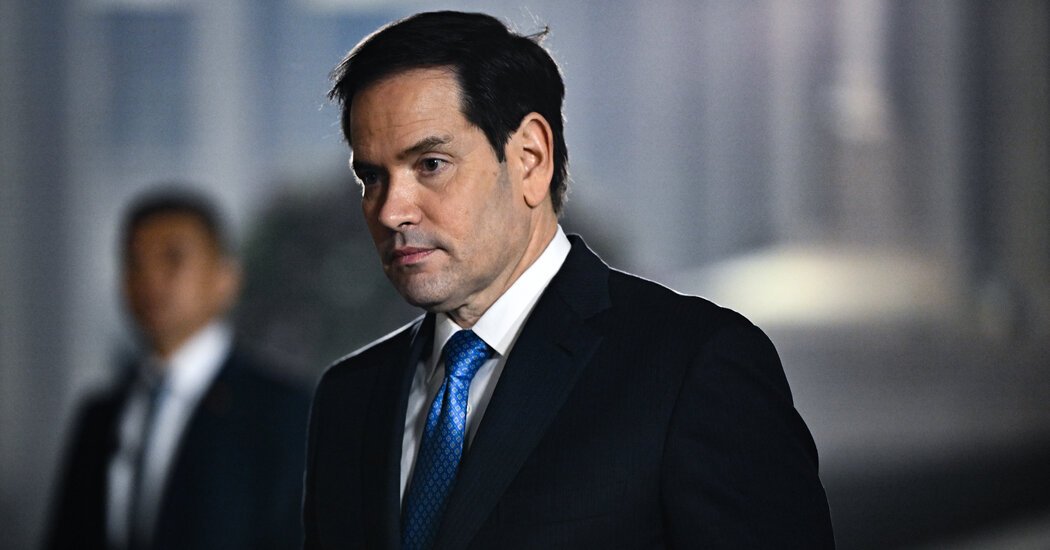
Before he shook hands with President Xi Jinping of China in Beijing this past week, Marco Rubio was an official enemy of the Chinese state.
As a senator representing Florida, Mr. Rubio was among Mr. Xi’s harshest critics in Washington. He accused the Chinese leader of “crimes against humanity” and of plotting to weaken the United States. Fed up, Mr. Xi’s government placed sanctions on Mr. Rubio in 2020 and banned him from entering the country.
So Mr. Rubio, now President Trump’s secretary of state and national security adviser, posed a sticky problem ahead of Mr. Trump’s first visit to China in his second term. But China creatively fudged the issue, allowing Mr. Rubio to accompany his boss and even meet the Chinese leader.
As Mr. Xi worked his way down a line of U.S. officials outside the Great Hall of the People, Mr. Rubio greeted him cordially without a smile. But Mr. Rubio later appeared delighted by the grandeur of a government he denounced less than 18 months ago as “the most potent and dangerous near-peer adversary this nation has ever confronted.”
Inside the hall, as he stood with fellow U.S. officials at a long wooden table awaiting the start of their meeting with Chinese counterparts, Mr. Rubio seemed to marvel at the grand building, smiling as he repeatedly gestured toward its high ceiling
Mr. Rubio, who entered the Trump administration with a reputation as a leading China hawk, has become more accommodating toward Beijing. He has talked about looking for areas of cooperation, in contrast to his years of emphasizing the party’s human rights abuses.
The difference, he told NBC News, is that he has a different job. “I’m the chief diplomat of the country, and I execute on the president’s foreign policy,” he said.
And the American president, an admirer of Mr. Xi, has said the two nations must build strong relations.
Mr. Trump’s effusiveness over China was evident throughout his two-day trip. On Friday, at tea with Mr. Xi, he raved: “This has been an incredible visit.”
“I think a lot of good has come of it,” Mr. Trump said. “We’ve made some fantastic trade deals, great, for both countries.”
As for Mr. Xi, Mr. Trump rolled out his usual praise: “He’s a man I respect greatly. We’ve become really friendly.”
Mr. Rubio had a more sober take on China policy. He said in the NBC interview that the United States would need to rebuild industrial manufacturing, and that “the Chinese are not going to like it, because they want to dominate those industries, but that’s what’s good for the American people.” He argued the United States should not be selling some advanced semiconductor chips to China. He also insisted that the U.S. government would not accept “any forced change in the status quo” to Taiwan, the de facto independent island that the party aims to control.
Under Mr. Rubio, the State Department has continued to carry out aggressive actions against China. That includes imposing sanctions on Chinese companies for various activities around the world. And the agency’s office commonly known as “China House” continues to try to help craft China policy that challenges the party.
But in his public remarks, Mr. Rubio has been keen to underscore the potential for cooperation with China, in alignment with Mr. Trump’s views.
“Areas where we can find mutual cooperation, I think we can,” Mr. Rubio said. “There’s probably virtually no problem in the world that we can’t solve if we work together on it.” As for tensions in the relationship, he said: “There’s always going to be irritants.”
On Taiwan, the State Department announced an $11 billion weapons sale package for the island last December, a move that frustrated China. But in the run-up to the summit, the department has not moved forward with a $13 billion arms package that Congress approved. U.S. lawmakers have called on the administration to announce the sales.
Asked whether Mr. Rubio had become more conciliatory toward China since his Senate days, the State Department sent a statement listing several ways the Trump administration had tried to assert strength in the relationship. “Under President Trump’s leadership, U.S.-China relations have been refocused on what matters most: rebuilding the safety, security and prosperity of Americans,” it said.
Soon after becoming a senator in 2011, Mr. Rubio emerged as a prominent critic of China’s government. He complained bitterly about the country’s economic and trade practices, as well as its record on human rights and democracy. He cast the nation as a fast-growing menace to U.S. national security.
As he embarked on a bid for the 2016 Republican presidential nomination, Mr. Rubio delivered an August 2015 speech condemning President Barack Obama for what he called a failed policy of appeasing China.
“We can no longer succumb to the illusion that more dialogue with China’s current rulers will narrow the gap in values and interests that separates us,” he said, vowing that as president he would challenge Beijing on economic, security and political matters. Mr. Rubio even hinted at a desire for regime change. “Freedom for the people of China must be our goal,” he said, calling it the “moral duty” of the United States.
With Mr. Obama scheduled at the time to host Mr. Xi in Washington the following month, Mr. Rubio argued that the U.S. president should not “roll out the red carpet” for the autocratic leader.
“This is an opportunity to speak bluntly to this authoritarian ruler, not to treat him to a state dinner,” he said.
On Thursday, Mr. Trump and Mr. Rubio dined at a state banquet in Beijing, and they are expected to host Mr. Xi when he makes a reciprocal visit to Washington around late September.
Although Mr. Rubio delivered that speech more than 10 years ago, his track record throughout his time in the Senate was consistent with its principles.
When mass anti-party demonstrations erupted in Hong Kong in 2019, Mr. Rubio championed the protesters.
That June, Mr. Rubio sponsored legislation to impose sanctions against Chinese officials deemed responsible for human rights abuses in Hong Kong, which Congress overwhelmingly approved. Mr. Trump threatened to veto the measure, complaining that it could endanger trade talks with Mr. Xi. But he ultimately signed the bill.
Mr. Rubio was also a leading champion of Taiwan, sponsoring bills to fast-track U.S. arms sales to the island and to grow ties with it. Vigilant about any hint of softened U.S. support for the island, Mr. Rubio grilled a senior State Department official at a Senate hearing in 2018 about why the Taiwanese flag, which China calls illegitimate, had vanished from an obscure page on the department’s website.
Mr. Rubio was a leading congressional critic of Beijing for its treatment of Uyghur Muslims. He branded the Chinese government’s widely documented policies of forced labor and “re-education” in the region of Xinjiang as “horrific” and “crimes against humanity and genocide.”
In June 2020, Mr. Rubio led the passage of legislation that called on the U.S. government to impose sanctions against Chinese officials tied to those policies. The Trump administration followed through.
An enraged Beijing retaliated with the sanctions against Mr. Rubio and other China hawks. Later that summer, the Chinese government imposed additional sanctions on them to retaliate against U.S. sanctions on Hong Kong officials.
But less than a half-year into his time as secretary of state, Mr. Rubio began stressing the need to cooperate with China. Mr. Trump was seeking a partnership with Mr. Xi following a failed salvo of tariffs on Chinese exports.
After a meeting in July 2025 in Malaysia with Wang Yi, China’s top diplomat, Mr. Rubio said the two men saw an “opportunity here to achieve some strategic stability and identify areas where we can cooperate together on and build better communications and working trust.”
Since then, State Department summaries of their occasional talks have included the same type of language.
As planning for the summit ramped up this year, the Chinese sanctions hung over Mr. Rubio, dubbed both 卢比奥 and 鲁比奥 (“lubiao”) by the state news agency for at least a decade. But then Beijing came up with a simple solution: Chinese officials said the sanctions had been imposed on Senator Rubio, not Trump aide Rubio.
“The sanctions are aimed at Mr. Rubio’s actions and rhetoric on China when he served as a U.S. senator,” Liu Pengyu, the Chinese embassy spokesman in Washington, said in a statement to The New York Times on Thursday when asked about the dilemma. He did not answer a question about whether China had dropped the sanctions.
Ruoxin Zhang contributed research.