dailynewsnblog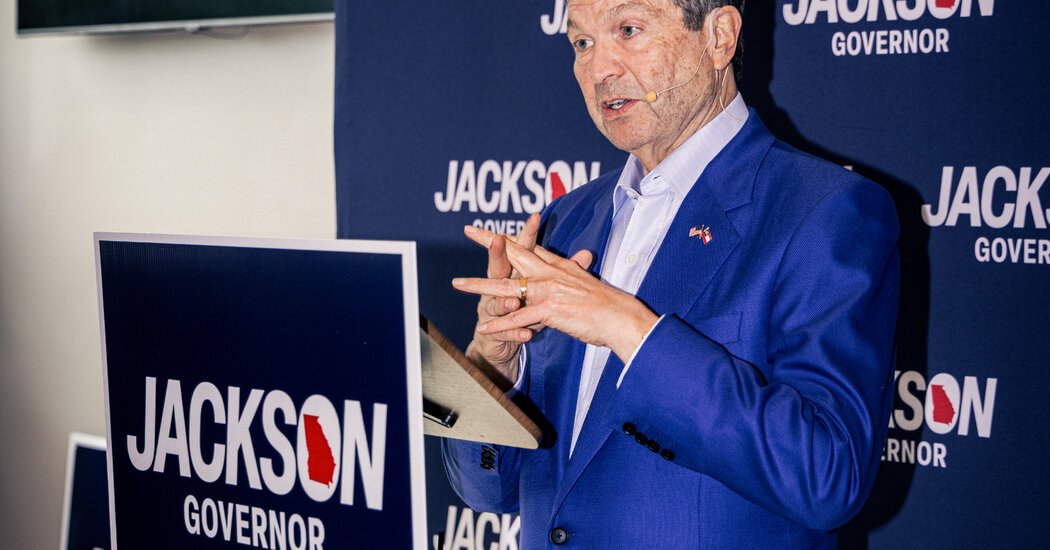
Rick Jackson, a billionaire seeking the Republican nomination for Georgia governor, has some Hollywood baggage.
Mr. Jackson, who faces a primary runoff on Tuesday, has campaigned on his promise to make Georgia more affordable and his by-the-bootstraps success as the founder of a health-care staffing company.
He has also moonlighted for years as an indie movie producer. While his low-budget movies have barely registered at the box office, several have nonetheless turned into tax windfalls, thanks to accounting maneuvers that have been the subject of three court battles with the Internal Revenue Service but that have not surfaced as an issue in the campaign.
In all, the Jackson Investment Group, the parent company of Mr. Jackson’s various ventures, has sought roughly $90 million in tax deductions from four money-losing films.
The biggest of the movies, “The Best of Enemies,” a 2019 release, starred Taraji P. Henson and Sam Rockwell. It recounts, as court filings put it, “the compelling, true story of the unlikely bond that formed between an African American civil rights activist and a Ku Klux Klan leader who worked together in the 1970s to integrate public schools in Durham, North Carolina.”
With a Rotten Tomatoes score of 51 percent, it earned an underwhelming $10 million or so, not enough to break even despite the help of state and federal tax breaks. (A.O. Scott, a New York Times critic, called it a “muddled and well-meaning big-screen attempt to find solace in the history of American racism.”)
Before the movie’s release, though, Mr. Jackson’s company donated the movie rights to Family Christian Resource Centers, a charity Mr. Jackson controls.
The company simultaneously valued the film at nearly $40 million, based on its experts’ analyses of comparable films, and claimed that amount as a tax deduction in its 2018 tax returns. The I.R.S. rejected the deduction, and the case has been in court since 2023.
His company had fought an earlier, similar case over deductions worth about $18 million for two religious-themed movies, “90 Minutes in Heaven” and “An Interview with God.”
After a 2023 trial, a federal judge reduced that amount by nearly $4 million, but otherwise sided with the company and rejected penalties the I.R.S. had sought.
“Rick isn’t going to let the I.R.S. bully him,” his campaign spokesman, Brian Robinson, said in a statement. “Rick beat the I.R.S. in 2023, the judge has thrown out the I.R.S.’s case once before, and Rick’s going to beat them again.”
His company has another ongoing case related to the 2021 film “Queen Bees,” starring Ellen Burstyn and James Caan. It made just $2.3 million at the box office, and its rights were also donated to a charity. Mr. Jackson’s company sought a $32.85 million deduction on that film, which was also rejected by the I.R.S. (The various cases also involve how bad loans made by Mr. Jackson’s company were valued.)
The I.R.S. said it does not comment on current litigation. In a filing this year in the “Best of Enemies” case, the agency said that “Rick Jackson testified that he would ‘never knowingly make a mistake.’” But, the agency asked, did his company “put forth the minimum reasonable effort to correctly determine its tax liability?”
“The answer to that question is no.”
Mr. Jackson’s company said it had hoped “The Best of Enemies” would repeat the success of the 2016 hit “Hidden Figures,” which starred Ms. Henson and told the story of three Black women who were NASA mathematicians during the space race. Lawyers have argued in their filings that the company was justified in using “Hidden Figures” as a metric when valuing “The Best of Enemies.”
But months before the rights to “Best of Enemies” were transferred to Mr. Jackson’s philanthropy, the film was having trouble finding a distributor, according to I.R.S. filings.
In February 2018, the United Talent Agency, which was shopping the movie, held a screening for potential distributors. CBS Films, Focus Films, Fox Searchlight and Sony all passed.
In March, after another distributor made what was considered a lowball offer, Rena Ronson, a United Talent executive, offered a note of caution.
“We have a film that has not generated the interest we need,” she wrote in an email cited in court filings, adding, “we don’t have a lot of leverage.”
United Talent, which is not a party to the case, declined to comment.
After a weeklong trial in January, the decision is in a judge’s hands, but it could be a while.
“It can take, give or take, a year or more for a complex case like this,” said John W. Porter, a lawyer at Baker Botts who specializes in tax cases and who is not involved in the case. He added that “the judges, as the fact finders, have a lot of leeway in determining value.”
In Tuesday’s runoff, Mr. Jackson will face Lt. Gov. Burt Jones, an election denier endorsed by President Trump. Mr. Jackson, for his part, has tried to establish his own MAGA chops, donating $1 million to a Trump-backed super PAC late last year and taking hard-line positions on topics like immigration.
Alain Delaquérière contributed research.